


Cone-Plate For Boring In The Lathe
Description
This section is from the book "Wrinkles And Recipes, Compiled From The Scientific American", by Park Benjamin. Also available from Amazon: Wrinkles and Recipes, Compiled From The Scientific American.
Cone-Plate For Boring In The Lathe
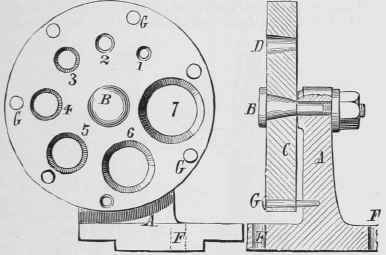
For chucking shafts and other similar work in the lathe (to bore holes in the ends of the shafts, etc.), the cone-plate shown in the engraving is the best appliance known to machinists. A is a standard, fitting in the shears of the lathe, at E, and holding the circular plate, C, by means of the bolt, B, which should be made to just clamp the plate, C, tightly when the nut is screwed tight. The plate contains a series of conical holes, 1, 2, 3, etc. (shown in section at D). The object of coning the pin, B, where it carries the plate, C, is that the latter shall be made to a good working fit and have no play. The operation is to place the shaft in the lathe, one end being provided with a driver, dog, or carrier, and placed on the running or line centre of the lathe; and the other end, to be operated upon, being placed in such one of the conical holes of the plate, C, as is of suitable size, the distance of the standard, A, from the lathe-centre is to be adjusted so that the work will revolve in the coned hole with about as much friction as it would have were it placed between both the lathe-centres. Thus the conical hole will take the place of the dead-centre of the lathe, leaving the end of the shaft free to be operated on. F F are holes to bolt the standard, A, to the lathe shears or bed; and G G, etc., are taper-holes to receive the pin, G, shown in the sectional view. The object of these holes and pin is to adjust the conical holes so that they will stand dead true with the lathe-centres; for if they stood otherwise, the holes would not be bored straight in the work. In the engraving, hole No. 7 is shown in position to operate, the pin, G, locking the plate, C, in that position. In setting the work, the nut on the pin, B, should be eased back just sufficiently to allow the plate, C, to revolve by hand; the work should then be put into position, and the pin, G, put into place; the standard, A, should then be adjusted to its distance from the live lathe-centre, and bolted to the lathe-bed; and finally, the nut on the pin, B, should be screwed up tight, when the work will be held true, and the cone-plate prevented from springing. Care must be taken to supply the conical holes, in which the work revolves, with a liberal quantity of oil, otherwise they will be apt to abrade.
Cone-Plate For Boring In The Lathe
Continue to:


My Books

