


Finishing-Tool For Wrought-Iron, Cast-Iron, Or Steel
Description
This section is from the book "Wrinkles And Recipes, Compiled From The Scientific American", by Park Benjamin. Also available from Amazon: Wrinkles and Recipes, Compiled From The Scientific American.
Finishing-Tool For Wrought-Iron, Cast-Iron, Or Steel
This is a finishing-tool for wrought-iron which will cut smoothly, clean, and true. being far preferable to the square-nosed tools sometimes used for the purpose of finishing iron, since such tools do not turn wrought-iron true, but follow the texture of the metal, cutting deepest in the softer parts, especially when their edges become in the least dull from use. This tool should be held with the cutting edge as close in to the tool-post or clamp as it can conveniently be, with a quick speed and fine feed, soapy water being applied to the work. It may be also used for taking light roughing cuts on small work, and is, for such purposes, an excellent tool, especially upon work so slight as to be liable to spring, for which purpose the cutting point should not be much rounded. Ground very keen, it will answer admirably for copper work, the cutting speed being very great; that is to say, at least fourfold that given below, which is for finishing cuts on wrought or cast iron.

Finishing-Tool For Wrought-Iron, Cast-Iron, Or Steel.
Size of work, inches diameter. | Cutting speed, feet per minute. | Feed |
1 and less | 38 | 30 |
1 to 2 | 30 | 25 |
2 " 5 | 25 | 20 |
5 " 12 | 23 | 20 |
12 " 20 | 20 | 10 |
20 and over | 18 | 14 |
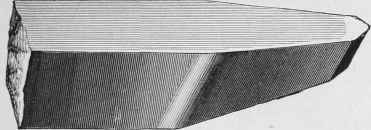
This tool should always be hardened right out; and if used upon cast iron, it should have less keenness upon the top face; that is to say, the plane of the top face should be ground more nearly to the same plane as the top face of the body of the tool. For use upon steel, the top face must be ground more nearly horizontal-a rule which, we may here observe, applies to all tools used upon wrought-iron. It should be placed in the lathe so that it cutting edge Stands above tin- horizontal centre-line of the work.
Continue to:


My Books

