


Side-Tool For; Wrought-Iron, Cast-Iron, Or Steel
Description
This section is from the book "Wrinkles And Recipes, Compiled From The Scientific American", by Park Benjamin. Also available from Amazon: Wrinkles and Recipes, Compiled From The Scientific American.
Side-Tool For; Wrought-Iron, Cast-Iron, Or Steel
The engraving represents the mostsuperior side-tool for either wrought or cast in., , or steel, the only difference being that it requires to be less keen for the latter than, .as here shown, for the former. It isemployed to cut side-faces and to take out round or square corners. For small work, it should be made so that it will cut at the point, and not on both edges at one time, when used in a square corner. For heavy work, it may be made more round-nosed, and allowed to cut all round the curve; and it will, in either shape, work equally well as a roughing-out or as a finishing tool, only requiring to be ground more keen to fit it for finishing purposes (which should be, on wrought-iron, performed with soapy water applied to the work), and at a faster speed and finer feed. For taking out a round corner or fillet in slight work, which is liable to spring from the pressure due to the cut, the point must be rounded very little, the curve being made by operating both the straight and cross feeds of the lathe. This tool is made right or left handed by simply bending it in the required direction, that illustrated being a left-hand tool. It should be made as hard as fire and water will make it, and used at the following speeds and feeds:
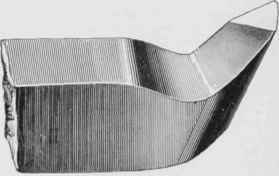
Side-Tool, For Iron
Diameter of work, in inches. | Speed. in feet, per minute. | Feed. |
1 and less | 30 | 30 |
1 to 2 | 25 | 25 |
2 " 5 | 22 | 20 |
5 " 12 | 20 | 20 |
When, however, it is employed for roughing-out purposes, these speeds may be, with advantage, slightly diminished and the feeds increased.
Continue to:


My Books

