


Side-Tool For Squaring Ends Of Wrought-Iron Work
Description
This section is from the book "Wrinkles And Recipes, Compiled From The Scientific American", by Park Benjamin. Also available from Amazon: Wrinkles and Recipes, Compiled From The Scientific American.
Side-Tool For Squaring Ends Of Wrought-Iron Work
The illustration represents a side-tool for wrought-iron, to be employed for squaring the ends of work held between the lathe centres, and in other cases wherein there is not sufficient room to admit a stouter tool. The cutting edge is shown at a, and should be made more keen for wrought, than for cast iron. In forging it, the hammering edgewise should be performed first, nor should any hammering be done to it edgewise after the steel has lost its"redness. It should, for light duty, and for all finishing purposes, be hardened right out, and, for heavy duty, be tempered to a straw-color. If, however, this tool is employed, as it sometimes is, for very heavy duty on a slottmg-machine, taking a cut, say, 2 1/2 inches deep and 1/8 inch thick, it must be lowered to a brownish purple and used at a cutting speed of about 10 feet per minute and be ground so that the cutting edge first strikes the cut near the bodv of the tool, and not at the point end. For ordinary work, it is best used with a comparatively fine feed and quick speed, since it is not sufficiently strong, when made very hard, to stand heavy duty.
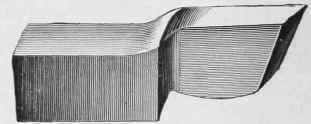
Side-Tool, . For Squaring Ends Of Wrought-Iron Work
Continue to:


My Books

