


Management Of Wardian Plant-Cases
Description
This section is from the book "Wrinkles And Recipes, Compiled From The Scientific American", by Park Benjamin. Also available from Amazon: Wrinkles and Recipes, Compiled From The Scientific American.
Management Of Wardian Plant-Cases
The following principles are those upon which a fern-case should be constructed: 1. Have no apparatus or arrangement for drainage. 2. Make your case as air-tight as possible, allowing for no ventilation.
Ferns require, for their growth, shade and moisture: upon the former, in a great degree, depends the latter. A northern or eastern aspect, where the morning sun reaches the case, we think is best. As regards moisture, we have the principle of self-support in an air-tight case; for if you allow the sun to reach the case for an hour or so in the morning, you will find that the moisture needful for the growth of your ferns is extracted from the earth; and when evening comes, this same moisture will condense and fall. Each day, this process of extraction and condensation takes place, and your plants flourish under a necessary and sufficient moisture. Now, this being the kind of air we want, we must not, of course, ventilate our case, and allow it to escape, otherwise the dry air of our rooms would enter, and the watering of the case become a necessity. This at once upsets all the benefits derived from these cases. The temperature, also, must be much more even in an air-tight case than in a ventilated one, where the constant opening and shutting of doors and windows would affect it. If we have no watering to do, we have no water to run off, and consequently require no drainage in the hot torn of our case. Now, in this air-tight principle, we get at the secret.
In stocking Wardian cases, the amateur will find that almost all ferns and mosses will do well in this case. 'There .are few of our greenhouse ferns that will not do well under this treatment; the gold and silver ferns are perhaps the exception; they do not always attain their full size and beauty in a Wardian case, but the adiantums, pteris, polypodiums, blechnums, and others do well.
In planting a case, do not place the plants too near, nor use too many of a large size, but put in a few plants and of a moderate size. Water well after setting the plants out. and shade the case for a day or two; then give it the morning sun each day for an hour or two, and your ferns will soon start. Nothing can be more interesting than to watch them-the frond pushes its head above the earth, the heat and moisture of the case have their effect, and it gradually rises and uncurls till it reaches its height, then it expands into the most beautiful and graceful of shapes; then what can exceed in delicacy and freshness this newly-born part? The lycopodiums grow finely, and spread very rapidly in the case; small pieces introduced at regular intervals in the case will, in a marvelously short time, double their original size; and if the pendent roots of the creeping species are pressed well on to the surface of the earth, the spaces between the plants and ferns will soon be filled up, and a rich and delicate carpet be produced over the whole case. For climbers, nothing can give more satisfaction than ficus stipulata, which can be obtained at all greenhouses. The roots of this plant, which strike out at every joint, have an adhesive power, and will attach themselves firmly to the glass in the case, which renders the growth more rapid and regular. It is a very interesting plant to watch; the roots adhering to the glass allow a free use of the microscope, and the growth and circulation can be studied to great advantage from the outside of the case.

The Princess Op Wales Case
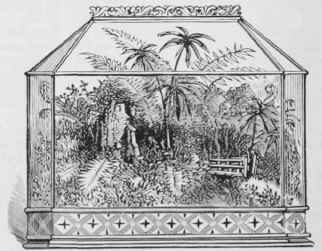
The Sydenham Case
As to soil, the best mixture for the growth of ferns and lycopodiums is the following: Leaf-mould, 9 parts; fresh sand, 1 part; gravel, about the size of a pea, 1 part: and stable manure, chopped very fine, l part. Ferns which grow naturally in dry places can be arranged on rock work in the centre of the case, if it is large enough to admit of it, and those requiring more moisture should be placed nearer the sides of the case, and they will get more moisture from the glass, where it deposits in great quantities. The spores of ferns can be sown on the surface of the earth in the Wardian case, and a constant supply of young plants can in this way be obtained, thus enabling the student to watch them in every stage of development.
It happens that not unfrequently the larvae of insects are introduced in the earth into the case, and hatch out under the influence of the heat. To provide against this, it will be found useful and interesting to put in a small-sized toad, and insects will disappear very soon, and give no further trouble. Toads will live through the winter perfectly well in this way, and their habits can be studied; some may become aware, by trying this experiment, that the toad, although not one of the handsomest of our reptiles, is not the least interesting.
Continue to:


My Books

