


Stuffing Birds
Description
This section is from the book "Wrinkles And Recipes, Compiled From The Scientific American", by Park Benjamin. Also available from Amazon: Wrinkles and Recipes, Compiled From The Scientific American.
Stuffing Birds
The following tools are required (see Fig. 1). -First, there is the scalpel. This can be purchased for a small sum from any maker of surgeon's instruments. The blade is short and very sharp, while the handle (not jointed) is long enough to allow of a firm grasp. From the same maker, a couple of pairs of Burgeon's scissors should also be obtai.....1, one quite small and sharp pointed, the other of medium size; also two or three spring forceps of various dimensions. A small pair of pliers for clipping wire is required, some spools of cotton (Nos. 10, 30, and100), a quantity of excelsior and tow, some cotton batting, a Little prepared glue, a number of pieces of wire about fifteen inches Long, and straight (size No. 20 or there abouts), a box of dry oatmeal, and some arsenical soap. This last can generally be obtained of druggists, or, if not, can he made of carbonate of potash 3 ounces, white arsenic, white soap, and air-slaked lime, 1 ounce each, and powdered camphor, 3/16 of an ounce. This is combined into a thick paste with water, and applied as below described, with a small paint brush. It sliould be marked as Poison, and kept scrupulously out of the reach of children or pet animals.
If the bird has been shot. immediately afterward all the- holes made in its body, as well as the mouth, should be plugged with cotton, in order to prevent the escape of blood or Liquids. Operations should not be begun for twenty four hours, so thai the body may base ample time to stiffen and the blood to coagulate. It is well during this period to inclose the bird, head downward, in a cone of paper, so that the feathers will be held smooth.
The first process is skinning. In commencing, the left hand is used to part the feathers, exposing the skin from the apex of the breast-bone to the tail. With the scalpel held like a pen, a free incision is made between these points, care being taken to divide the skin only, without cutting into the flesh. The skin is then pressed apart, and oatmeal dusted into the cut, in order to absorb any fluids which may escape. Careful lifting of the skin clear of the flesh follows, until the leg is reached, when the scalpel is again used to disarticulate the thigh-joints. The bone of each thigh is then exposed for its whole length, by pushing back the skin, and the meat removed, when the bone is replaced, and the other thigh treated in similar manner.
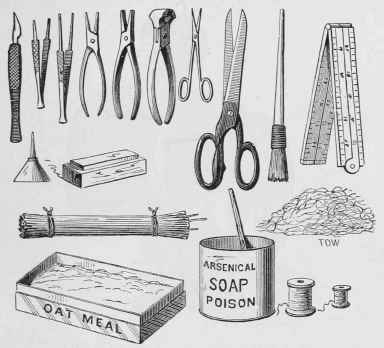
Fig. 1.- Taxidermical Implements
The skin is next detached, to the wings, which are cut from the body at the joint next the same, and the bones scraped clear of meat. Then the neck is divided, so that the skin, with the head attached, can be peeled from the entire body clear to the root of the tail. The last is bent toward the back with the left hand, the finger and thumb keeping down the detached parts of the skin on each side of the vent. A deep cut is then made across the latter until the back-bone, near the oil-gland at the root of the tail, is exposed. Sever the back-bone at the joint. This detaches the body, which may be removed and thrown aside, while the root of the tail, with the oil-gland, is left. Great care is needed in this operation, as, if not enough bone be left at its root, the tail will come out; but all fleshy matter should be neatly dissected away.
The neck need not be split or in any wise cut. The skin is merely pulled over the flesh, as a glove is removed from the finger, until the skull is exposed and appears as in the sketch, Fig. 2. With the point of the knife, remove the ears; and on reaching the eyes, carefully separate the lids from the eyeballs, cutting neither. It requires very delicate and slow work at this point, so as not to injure the eyelids. Then scrape out the eye cavities, and cut away the flesh of the neck, removing at the same time a small portion of the base of the skull. Through the cavity thus made extract the tongue and brains, and after cleaning away all fleshy matter, paint the eye orbits with arsenical soap, and stuff them tightly with cotton. Care should be taken not to detach the skin from the bill, as it is necessary to leave the skull in place. Finally, till the interior of the skull with tow (never with cotton), after coating internally with the prepared soap.
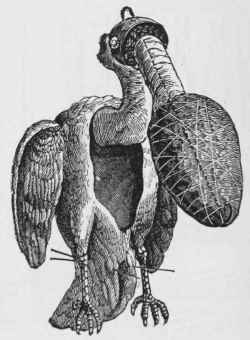
Fig. 2. Mode Of Attaching The False Body
The skinning operation being now completed, the stuffing is next proceeded with. To prepare for this, the bird, before, being nkinned, should have been measured, first as to its girth about the body, and second as to its length from root of tail to top of skull, following the shape of the form. Prom these data an artificial body of the right dimensions is constructed and inserted as follows: On a piece of straight wire, equal in length to the last measurement above mentioned, a bunch of excelsior is secured by repeated winding with stout thread. This bundle, which is represented in our Fig. 2, is moulded to a shape resembling that of the bird's body, and its girth is regulated by the similar measurement already obtained from the bird itself. As will be seen, it is attached at the end of the wire, the long protruding portion of which serves as a foundation for the neck. The extremity of the wire is clipped by the pliers to a sharp point, and then forced diagonally upward through the skull, on top of which it is clinched flat. Cotton batting is then wound about the wire between skull and body, until sufficient thickness is obtained to fill the skin of the neck. The position of the various parts at this point is represented in Fig. 2. Painting the inside of the skin with arsenical soap follows, and then the skin is drawn back so as to envelop the false body, and a needle and thread are thrust through the nostrils to make a loop for convenience in handling.
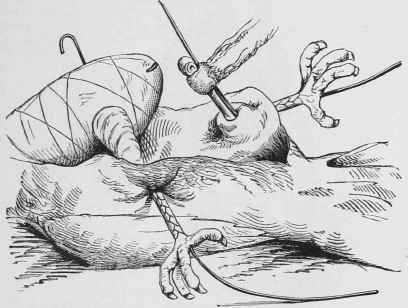
Fig. 3.-Stuffing The Legs
The finest pair of forceps is employed to pull the eyelid skin into place, to arrange the feathers, and to pull up the cotton in the orbits so as to stuff the cavities out plumply. More cotton is next pushed down the throat until the same is entirely filled. Two pieces of wire-quite stout for large bird-are then sharpened at one extremity. Taking the wire in one hand and guiding it with the other, the operator shoves it into the leg, from the ball of the foot up alongside the thigh bone, the skin being turned back for the purpose. Cotton is then wound about both wire and bone, in order to fill the thigh out naturally, and the same process is repeated for the other side. The ends of the wire below are left protruding in order to support the bird on a perch, if such be desired. The upper ends are pushed clean through the artificial body, from below up, and clinched on the upper side. This secures the legs, which are afterward bent in natural position (Fig. 3). The bird can now be set up-that is, the wires stretching out. below the claws can be wound about a perch or pushed through holes in a board and clinched on the under side. In the latter case, it will be necessary to spread the claws and fasten them with pins. For small birds, the cut in the breast need not be sewn up; a chicken or larger fowl will require a few stitches to hold the edges together. If the tail feathers are to be spread, a wire is thrust across the body and through each feather, holding all in the proper position. The wings are then gathered closely into the body, and two wires, one from each side, are pushed in diagonally from up, down, and through the skin of the second joint (Fig. 4). The wings are thus held, and the wires, as well as that through the tail, are left protruding for an inch or more. A touch of glue within the eye lids prepares the latter for the eyes. These must be purchased from taxidermists, hut for small birds common black heads will answer. If plain glass beads can he obtained, by the aid of a little paint the student can easily imitate the eye of a chicken. After the eyes are inserted, a sharp needle is used to pull the lids a round them and into place.
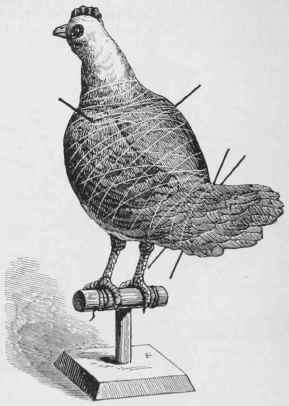
Fig.4.-The Bird Prepared Cob Drying.
The operator must now, with a line pair of forceps, carefully adjust the feathers, smoothing them down with a large camel's-hair brush. This done, thread must be wound over the body very loosely, beginning at the head, and continuing until all the feathers are securely bound. The bird is then left to dry for a day or two, when the thread is removed, the ends of wire cut off close to the body, and the work is complete.
Entomological Specimens, To preserve, from insect ravages. -Place crystals of carbolic acid throughout the cabinets, and the evaporation of the crystals will keep them thoroughly saturated with carbolic acid vapors, which will kill all living insects therein.
Continue to:


My Books

