


Stuffing Small Quadrupeds
Description
This section is from the book "Wrinkles And Recipes, Compiled From The Scientific American", by Park Benjamin. Also available from Amazon: Wrinkles and Recipes, Compiled From The Scientific American.
Stuffing Small Quadrupeds
Begin by making a Longitudinal incision between the hind legs, extending quite back to the vent, the hair having been carefully parted so that it may not be cut. Do not cut into the abdominal cavity. The skin can now be- separated from the flesh and turned back as far as the- thigh, which is severed at the joint. When this is done on both sides, the gut should be drawn out and severed at a short distance from the vent. The tail should also be disjointed at the root. This being done, the skin can be loosened around the body until the fore-legs are reached, when they also should be dissevered. The skinning now proceeds along the neck until the skull is reached. Here considerable care is necessary to re move the skin without damage to the cars, eyelids, and lips.
The skin is left attached to the skull; when the operation has proceeded far enough to expose the muscles of the jaws, the skin must he separated from the body at the first joint of the neck. The tongue, eyes, and muscles, remaining attached to the head, are now to be carefully removed, and the brain taken out from an opening in the back of the skull cut through for that purpose. To make this opening, amateurs can use a small gimlet or bit with very small animals, and a large one as circumstances may demand. The legs are now to be skinned out quite down to the claws, which completes the operation of skinning. During the entire process, all fluids escaping must be immediately soaked up with cotton. As soon as the skin is removed, it should be thoroughly rubbed with arsenical soap, not omitting the inside of the skull and mouth cavities.
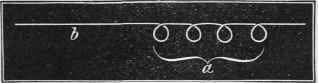
The following explanation of stuffing relates to a small animal such as the squirrel. Provide yourself with cotton, thread, and twine, also stuffing-forceps, a pair of pincers, a file, and wire-cutters. With the aid of the forceps (a pair of slender-jawed pliers), supply the various muscles of the face and head by inserting cotton both through the mouth and eyelids. Take annealed iron wire and cut off 6 pieces: No. 1, two or three inches longer than the total length of the body; Nos. 2 and 3 for the fore-legs; Nos. 4 and 5 for the hind-legs; each of these should be three inches longer than the limbs they are to support; No. 6, for a support for the tail, of the same proportionate length as the others. With a large pair of scissors, cut fine a quantity of tow, and with this, by the use of the long forceps, stuff the neck to its natural dimensions. Taking wire No. 1, bend it in four small rings, the distance between the two outer representing the length of the body taken from the skin, a, leaving one long end for a support to the head and neck, b (see figure). Mould tow about that part containing the rings, and, by winding it down with thread, form an artificial body. Sharpen the projecting end of the wire to a fine point with the file, and insert it up through the tow in the neck, and thence through the skull; the skin should then be pulled over the body. Wires No. 2 and 3 are placed next in position by inserting them through the soles of the feet, up within the skin of the leg, and through the body of tow, until they appear upon the opposite side. With the pincers, bend over the end of each, forming a hook; the wires must then be pulled backward, thus fastening the hooks firmly into the body. The loose skin of the limbs should then be stuffed with cut tow, taking care to imitate the muscles of the living subject. Nos. 4 and 5 can be fixed in position after the same manner, unless the animal is to rest entirely upon its rear (as in the case with the squirrel feeding); then the wire must be inserted at the tarsal joint instead of at the sole of the foot. If any depressions appear in the skin, they must be stuffed out with cut tow. Wire No. (5 should now be inserted at the tip of the tail, and forced down within the skin, hooking it into the body in the same manner as the leg-wires. Stuff the tail to its proper dimensions with cut tow, and carefully sew up the incision along the abdomen. Having prepared a board about § inch thick, pierce in it two holes at the proper distance apart for the reception of the wires (four holes will be needed if the animal is to stand on all extremities); these must be drawn through upon the under side until the feet rest close upon the upper surface;, when they should be clinched. The different joints of the limbs can now be imitated by bending the wire at the proper points. The eyes should next be placed in position, and cemented in the orbits by a little putty. Care should be taken in arranging the eyelid, for the expression depends altogether upon this point. Clip off any superfluous wire which may extend above the head with the wire-cutters. The specimen should be placed in some locality free from moisture, and allowed to dry thoroughly, when it is complete for the cabinet.
Stuffing Animals
Continue to:


My Books

