


The Pantagraph
Description
This section is from the book "Wrinkles And Recipes, Compiled From The Scientific American", by Park Benjamin. Also available from Amazon: Wrinkles and Recipes, Compiled From The Scientific American.
The Pantagraph
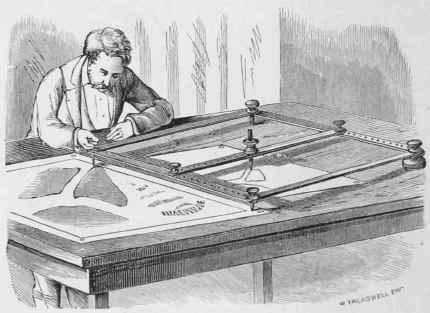
This consists of four rulers, jointed together at their intersections, and having, at two of the angles, supports terminating in round points or smoothly-running casters. At one of the other angles is a weight to which the apparatus is pivoted, and which holds it in place, and at the fourth corner is a tracing-point, shown in the hand of the operator. Directly across the frame thus made, and pivoted at its ends to the centres of two of the bars, is a fifth bar, through the middle of which passes a pencil. Along half the length of the two side-bars, and also of the central bar, are made perforations, so that the length of the rulers can be shortened as rendered necessary. The tracing point is moved over the outline to be followed, and its motion is communicated to the series of rulers, which, by a kind of parallel movement actuate the pencil to describe precisely the same line, equal in dimension to that of the copy, or enlarged or reduced. The scales of the two drawings are to each other as the distances of the pencil and of the tracing point from the pivot, and these distances are adjusted by altering the position of the joints in the holes.
The Pantagraph
Pencils, Copying, To make-Pencils are sold by stationers, the marks NFC which may be copied in the same manner as writing made by the pen with ordinary copying-ink. The method of preparing the leads is as follows: A thick paste is made of graphite, finely pulverized kaolin, and a very concentrated solution of aniline blue, soluble in water. The mixture is pressed into cylinders of suitable size and dried, when it is ready for use. Gum arabic may be substituted for the kaolin.
Sin Drawing. Draw with a pencil on a piece of tracing-paper the desired design; go over the lines with very black ink, turn the paper over, and follow the lines also with ink on the reverse side; fa-ten the paper by the cornels to a pane of clear glass. Make a solution of 1/2, oz. bichromate of potash in 2 ozs, hot water, strain when cold, and with this brush over the paper or silk on which the design is to be printed. Place the material thus prepared under the paper on the glass, and clamp all together. Expose the whole to bright sunlight, glass uppermost, then design, then bichromate paper; in a few moments, the design will be print ed deeply. Wash and soak for a short time in clean water (to fix), dry, and press with a warm flat-iron.
Continue to:


My Books

