


Bayle's Lamp Chimney
Description
This section is from "Scientific American Supplement". Also available from Amazon: Scientific American Reference Book.
Bayle's Lamp Chimney
The different types of lamps used in domestic lighting present several imperfections, and daily experience shows too often how difficult it is, even with the most careful and best studied models, to have a perfect combustion of the usual liquids - oil, kerosene, etc.
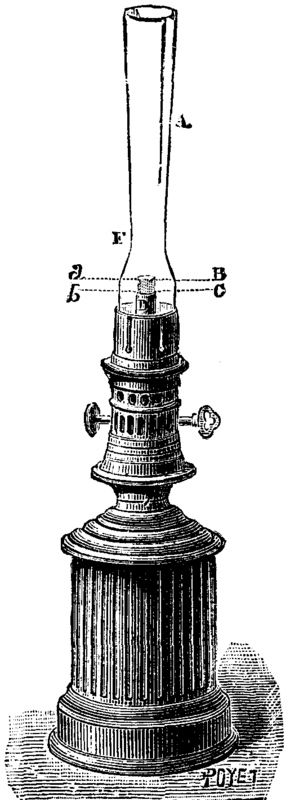
BAYLE'S NEW LAMP CHIMNEY.
Mr. P. Bayle has endeavored to remedy this state of things by experiments upon the chimney, inasmuch as he could not think of modifying the arrangements of the lamps of commerce "without injury to man" interests, and encountering material difficulties.
The chimney is not only an apparatus designed to carry off the smoke and gases due to combustion, for its principal role is to break the equilibrium of the atmospheric air, which is the great reservoir of oxygen, and to suck into the flame, through the difference of densities, this indispensable agent to combustion. The lamps which we now use are provided with cylindrical chimneys either with or without a shoulder at the base. The shouldered chimney would be sufficient to suck in the quantity of air necessary for a good combustion if we could at will increase its dimensions in the direction of the diameter or height. But, on account of the fragile nature of the material of which it consists, as also because of the arrangement of the lighting apparatus, we are forced lo give the chimney limited dimensions. The result is an insufficient draught, and consequently an imperfect combustion. It became a question, then, of finding a chimney which, with small dimensions, should have great suctional power.
Mr. Bayle has taken advantage of the properties of convergent-divergent ajutages, and of the discovery of Mr. Romilly that a current of gas directed into the axis and toward the small base of a truncated cone, at a definite distance therefrom, has the property of drawing along with it a quantity of air nearly double that which this same current could carry along if it were directed toward a cylinder. In getting up his new chimney, Mr. Bayle has utilized these principles as follows: Round-burner lamps have, as well known, two currents of air - an internal current which traverses the small tube that carries the wick, and an external one which passes under the chimney-holder externally to the wick. In giving the upper part of the chimney, properly so called, the form of a truncated cone whose smaller base is turned toward the internal current of air, that is to say, in directing this current toward the contracted part of the upper cone, at the point where the depression is greatest, a strong suction is brought about, which has the effect of carrying along the air between the wick and glass, and giving it its own velocity.
The draught of the two currents having been effected through the conical form of the upper part of the chimney, it remained to regulate the entrance of the external current into the flame. If this current should enter the latter at too sharp an angle, it would carry it toward the mouth of the chimney before the chemical combustion of the carbon and oxygen was finished; and if, on the contrary, it should traverse it at too obtuse an angle, it would depress and contract it. Experience has shown that in the majority of cases the most favorable angle at which the external current of air can be led into the flame varies between 35° and 45°. We say in the majority of cases, for there are exceptions; this depends upon the combustive materials and upon the conditions under which they enter the flame. The annexed figure shows the form adopted by the inventor for oil and kerosene lamps. As may be seen, the chimney consists of two cones, A and B, connected end to end by their small bases. The upper one, A, or divergent cone, is constructed according to a variable angle, but one which, in order to produce its maximum effect, ought not to differ much from 5°. This cone rests upon the convergent one, B, whose angle, as we have said, varies between 35° and 45°. To the large base of this cone there is soldered a cylindrical part, c, designed for fixing the chimney to the holder.
The height given the divergent cone is likewise variable, but a very beautiful light is obtained, when it is equal to six times the diameter of the contracted part. When the lamp is designed to be used in a still atmosphere, free from abrupt currents of air, the height may be reduced to four times the diameter of the base, without the light being thereby rendered any the less bright. As for the height to be given the convergent cone, B, that is determined by the opening of the angle according to which it has been constructed. Finally, as a general thing, the diameter of the small base should be equal to half the large base of the convergent cone, B.
The new chimney should be placed upon the holder in such a way that the upper part of the wick tube, D, is a few millimeters beneath the base of the convergent cone. The height to be given the wick varies according to the lamp used. It is regulated so as to obtain a steady and regular combustion. In oil lamps it must project about 1½ centimeters. If two lamps of the same size be observed, one of which is fitted with the new chimney and the other with the old style, we shall be struck with the difference that exists in the color of the flame as well as in its intensity. While in the case of the cylindrical glass the flame is red and dull, in that of the circuit it is white and very bright. This, however, is not surprising when we reflect upon the theoretical conditions upon which the construction of the new chimney is based - the strong influx of air having the result of causing a more active combustion of the liquid, and consequently of raising to white heat the particles of carbon disseminated through the flame. As it was of interest to ascertain what the increase of illuminating power was in a given lamp provided with the new chimney, Mr. Felix le Blanc undertook some photometric experiments.
The trials were made with a Gagneau lamp provided with a chimney of the ordinary shape, and then with one of Mr. Bayle's. The measurements were made after each had been burned half an hour. The light of the standard Carcel lamp being 1, there was obtained with the Gagneau lamp with the ordinary chimney 1.113 carcels, and with the Bayle chimney 1.404 carcels. Thus 1.113:1.404 represents the ratio of the same lamp with the ordinary chimney and with that of Bayle. Whence it follows that the light of the lamp with the old chimney being 1, that with the new one is 1.26, say an increase of about 25 per cent. There is nothing absolute about this figure, however. On kerosene lamps the new chimney, compared with the contracted Prussian one, gives an increase of 40 per cent. in illuminating power, and the oil is burned without odor or smoke.
As it was of interest to see whether this increase in intensity was not due to a greater consumption of oil, a determination was made of the quantity of the latter consumed per hour. The Gagneau lamp, with the old chimney, burned 62.25 grammes per hour, and with the Bayle 63 grammes in the same length of time.
It may be concluded, then, that the increase in light is due to the special form given the chimney. This new burner is applicable to gas lamps as well as to oil and petroleum ones.
The effects obtained by the new chimney may be summed up as follows: increase in illuminating power, as a natural result of a better combustion; suppression of smoke; and a more active combustion, which dries the carbon of the wick and thus facilitates the ascent of the oil. The velocity of the current of air likewise facilitates the action of capillarity by carrying the oil to the top of the wick. Moreover, the great influx of air under the flame continually cools the base of the chimney as well as the wick tube, and the result is that the excess of oil falls limpid and unaltered into the reservoir, and produces none of those gummy deposits that soil the external movements and clog up the conduits through which the oil ascends. Finally, the influx of air produced by this chimney permits of burning, without smoke and without charring the wick, those oils of poor quality that are unfortunately too often met with in commerce. - La Nature.
Continue to:


My Books

