


Modern Locomotive Practice
Description
This section is from "Scientific American Supplement". Also available from Amazon: Scientific American Reference Book.
Modern Locomotive Practice
By H. MICHELL WHITLEY, Assoc. M.I.C.E., F.G.S.
A little more than half a century ago, but yet at a period not so far distant as to be beyond the remembrance of many still living, a clear-headed North-countryman, on the banks of the Tyne, was working out, in spite of all opposition, the great problem of adapting the steam engine to railway locomotion. Buoyed up by an almost prophetic confidence in his ultimate triumph over all obstacles, he continued to labor to complete an invention which promised the grandest benefits to mankind. What was thought of Stephenson and his schemes may be judged by the following extracts from the Quarterly Review of 1825, in which the introduction of locomotive traction is condemned in the most pointed manner:
"As to those persons who speculate on making railways general throughout the kingdom, and superseding every other mode of conveyance by land and water, we deem them and their visionary schemes unworthy of notice.... The gross exaggeration of the locomotive steam engine may delude for a time, but must end in the mortification of all concerned.... It is certainly some consolation to those who are to be whirled, at the rate of 18 or 20 miles per hour, by means of a high-pressure engine, to be told that they are in no danger of being sea-sick while on shore, that they are not to be scalded to death or drowned by the bursting of a boiler, and that they need not mind being shot by the shattered fragments, or dashed in pieces by the flying off or breaking of a wheel. But with all these assurances, we would as soon expect the people of Woolwich to suffer themselves to be fired off upon one of Congreve's ricochet rockets, as trust themselves to the mercy of such a machine going at such a rate."
These words, strange and ludicrous as they seem to us, but tersely expressed the general opinion of the day; but fortunately the clear head and the undaunted will persevered, until success was at last attained, and the magnificent railway system of the present, which has revolutionized the world, is the issue. And the results are almost overwhelming in their magnitude. Here, in Great Britain alone, 654,000,000 people travel annually. There are 14,000 locomotives, and the rolling stock would form a train nearly 2,000 miles long; while the number of miles traveled in a year by trains is more than 10,000 times round the world; and the passengers would form a procession 100 abreast, a yard apart, and 3,700 miles long.
These stupendous results have been attained gradually; if we go back to 1848, we find that on the London and Birmingham Railway the number of trains in and out of Euston was forty-four per day. The average weight of the engines was 18 tons, and the gross loads were, for passenger trains 76 tons, and for goods 160. Now, the weight of an express engine and tender is about 65 tons, and gross loads of 250 to 300 tons for an express, and 500 tons for a coal train are not uncommon, while not only have the trains materially increased in weight, owing to the carriage of third-class passengers by all (except a few special) trains, and also to the lowering of fares and consequent more frequent traveling, but the speed, and therefore the duty of the engines, is greatly enhanced. A "Bradshaw's Guide" of thirty-five years ago is now a rare book, but it is very interesting to glance over its pages, and in doing so it will be found that the fastest speed in all cases but one falls far short of that which obtains at present.
The following table will show what the alteration has been:
| 1849. Speed miles per hour. | 1884. Speed miles per hour. | |
| Great Western - London to Didcot. | 56 | - |
| Great Western - Londonto Swindon. | - | 53 |
| North-Western - Euston to Wolverton. | 37 | - |
| North-Western - Northampton to Willesden. | - | 51½ |
| South-Western - Waterloo to Farnborough. | 39 | - |
| South-Western - Yeovil to Exeter. | - | 46 |
| Brighton - London Bridge to Reigate. | 36 | - |
| Brighton - Victoria to Eastbourne. | - | 45 |
| Midland - Derby to Masborough. | 43 | - |
| Midland - London to Kettering. | - | 47 |
| North-Eastern - York to Darlington. | 38 | - |
| North-Eastern - York to Darlington. | - | 50 |
| Great Eastern - London to Broxbourne. | 29 | - |
| Great Eastern - Lincoln to Spalding. | - | 49 |
| Great Northern - King's Cross to Grantham. | - | 51 |
| Cheshire Lines - Manchester to Liverpool. | - | 51 |
With this problem then before them, increased weight, increased speed, and increased duty, the locomotive superintendents of our various railways have designed numerous types of engines, of which the author proposes to give a brief account, confining himself entirely to English practice, as foreign practice in addition would open too wide a field for a single paper.
Commencing then with passenger engines for fast traffic, and taking first in order the Great Western Railway, we find that it holds a unique position, as its fast broad gauge trains are worked by the same type of engine as that designed by Sir Daniel Grooch in 1848, although, of course, the bulk of the stock has been rebuilt, almost on the same lines, and rendered substantially new engines. They are single engines of 7 ft. gauge with inside cylinders 18 in. diameter, and 24 in. stroke; the driving-wheels are 8 ft. in diameter, and there are two pairs of leading wheels, and one of trailing, all of 4 ft. 6 in. diameter. The total wheel base is 18 ft. 6 in.; the boiler is 4 ft. 6 in. diameter, and 11 ft. 3 in. long. The grate area is 21 square feet, and the heating surface is, in the fire-box, 153 square feet; tubes, 1,800 square feet; total, 1,953 square feet. The weight in full working order is, on the four leading wheels, 15 ton 18 cwt.; driving wheels, 16 tons; trailing wheels, 9 tons 10 cwt.; total, 41 tons 8 cwt.
The tender, which is low-sided and very graceful in appearance, weighs 15 tons 10 cwt., and will hold 2,700 gallons of water.
The boiler pressure is 140 lb. on the square inch, and the tractive power per pound of steam pressure in the cylinders is 81 lb. These engines take the fast trains to the West of England; the Flying Dutchman averages 170 tons gross load, and runs at a mean time-table speed of 53 miles per hour, which allowing for starting, stopping, and slowing down to 25 miles per hour through Didcot gives a speed of nearly 60 miles an hour.
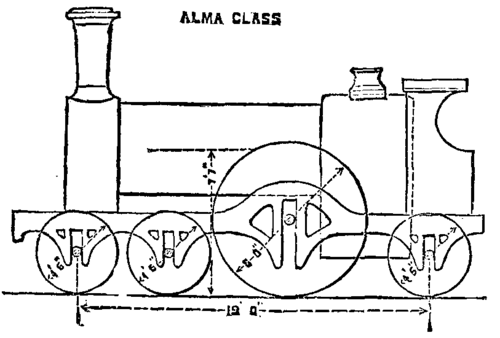
FIG. 1. - GREAT WESTERN RAILWAY.
The average consumption of coal per mile, of thirteen of these engines, with the express trains between London and Bristol, during the half-year averaged 24.67 lb. per mile, the lowest being 23.22 lb., and the highest 26.17 lb., the average load being about eight coaches, or 243 tons. We have already seen that in 1849 the Great Western express ran at a higher rate than at present, being an exception to the general rule; and the fastest journey on record was performed at this time by one of these engines, when on May 14, 1848, the Great Britain took this Bristol express, consisting of four coaches and a van, to Didcot, fifty-three miles, in forty-seven minutes, or at the average speed of sixty-eight miles an hour. The maximum running speed was seventy-five miles an hour, and the indicated horse-power 1,000. A class of engines corresponding to this type in their general dimensions, but with 7 ft. coupled wheels, was introduced on the line, but it was not found successful. Through the courtesy of Mr. Dean, I am enabled to give a table showing the running speeds and loads of the principal express trains, broad and narrow gauge, to the West and North of England, run on the Great Western Railway.
| Train. | Speed to first stopping station. | Weight of train. | ||||
| Station. | Distance. miles. | Average speed--miles per hour. | Engine and tender. tons. | Carriages and vans, empty. tons. | Total | |
| BROAD GAUGE TO WEST OF ENGLAND: | ||||||
| 9.0 Paddington to Plymouth | Reading | 36 | 47 | 67 | 149 | 216 |
| 11.45 do. | Swindon | 77¼ | 53 | 67 | 104 | 171 |
| NARROW GAUGE TO THE NORTH | ||||||
| 10.0 Paddington to Birkenhead | Reading | 36 | 39.2 | 60 | 190 | 250 |
| 4.45 do. | Oxford | 63½ | 48.8 | 60 | 129 | 189 |
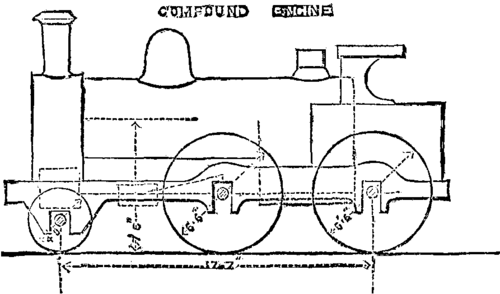
Fig 2
GREAT WESTERN RAILWAY.
The narrow gauge trains are worked by two classes of engines. The first is a single engine with inside cylinders 18 in. diameter, 24 in. stroke. The driving wheels are 7 ft. diameter, and the leading and trailing wheels 4 ft. The frames are double, giving outside bearings to the leading and trailing axles, and outside and inside bearings to the driving axle; this arrangement gives a very steady running engine, and insures, as far as can possibly be done, safety in case of the fracture of a crank axle. The frames are 15 inches deep, of BB Staffordshire iron. The wheel base is, leading to driving wheels, 8 ft. 6 in; driving to trailing wheels, 9 ft.; total, 17 ft. 6 in. The boiler is of Lowmoor iron, 10 ft. 6 in. long and 4 ft. 2 in. outside diameter. The grate area is 17 square feet, and the heating surface is, tubes, 1,145½ square feet; fire-box 133 square feet; total, 1,278½ square feet. The boiler pressure is 140 lb. on the square inch, and the tractive power per lb. of mean pressure in cylinders, 92 lb. The weight in full working order is, engine, leading wheel, 10 tons; ditto driving wheels, 14 tons; ditto trailing wheels, 9 tons 10 cwt.; tender, with 40 cwt. coal and 2,600 gals. water, 26 tons 10 cwt.; total, 60 tons.
Continue to:


My Books

