


Bell-Buoys
Description
This section is from "Scientific American Supplement". Also available from Amazon: Scientific American Reference Book.
Bell-Buoys
The bell-boat, which is at most a clumsy contrivance, liable to be upset in heavy weather, costly to build, hard to handle, and difficult to keep in repair, has been superseded by the Brown bell-buoy, which was invented by the officer of the lighthouse establishment whose name it bears. The bell is mounted on the bottom section of an iron buoy 6 feet 6 inches across, which is decked over and fitted with a framework of 3-inch angle-iron 9 feet high, to which a 300-pound bell is rigidly attached. A radial grooved iron plate is made fast to the frame under the bell and close to it, on which is laid a free cannon-ball. As the buoy rolls on the sea, this ball rolls on the plate, striking some side of the bell at each motion with such force as to cause it to toll. Like the whistling-buoy, the bell-buoy sounds the loudest when the sea is the roughest, but the bell-buoy is adapted to shoal water, where the whistling-buoy could not ride; and, if there is any motion to the sea, the bell-buoy will make some sound. Hence the whistling-buoy is used in roadsteads and the open sea, while the bell-buoy is preferred in harbors, rivers, and the like, where the sound-range needed is shorter, and smoother water usually obtains. In July, 1883, there were 24 of these bell-buoys in United States waters.
They cost, with their fitments and moorings, about $1,000 each.
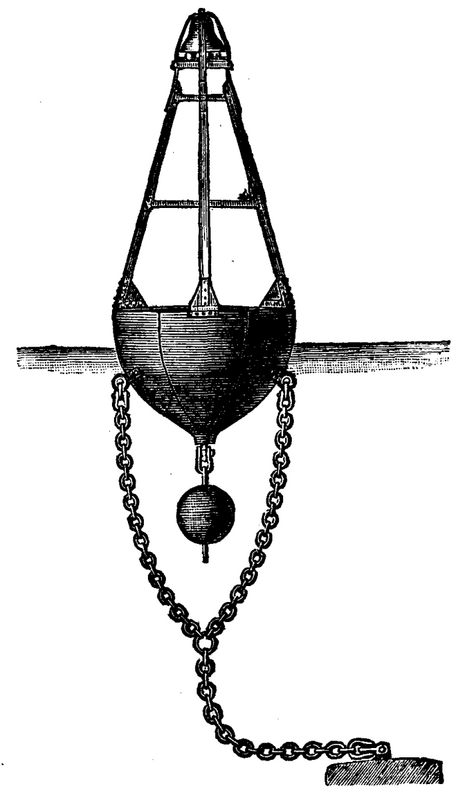
FIG. 2. - BROWN'S BELL BUOY.
Continue to:


My Books

