


Modern Locomotive Practice. Part 5
Description
This section is from "Scientific American Supplement". Also available from Amazon: Scientific American Reference Book.
Modern Locomotive Practice. Part 5
The author has been led to describe this engine fully on account of the numerous ingenious appliances which have been adopted in its design. In a trial trip on October 3, 1883, from Brighton to London Bridge and back, with an average load of 19½ coaches, or 285 tons gross, and with a speed of 45 miles per hour, the consumption of coal was 31 lb. per train mile, evaporating 8.45 lb. of water per pound of coal, and with as much as 1,100 indicated horse-power at one portion of the run. The finish and painting of these engines is well considered, but the large coupled wheels give a very high shouldered appearance, and as a type they are not nearly as handsome as the single engines previously described.
From the Brighton to the South-Western Railway is but a step; but here a totally different practice obtains to that adopted on most lines, all the passenger engines having outside cylinders, where they are more exposed to damage in case of accident, and, from being less protected, there is more condensation of steam, while the width between the cylinders tends to make an unsteady running engine at high speeds, unless the balancing is perfect; but the costly crank axle, with its risk of fracture, is avoided, and the center of gravity of the boiler may be consequently lowered, while larger cylinders may be employed. On the other hand, inside cylinders are well secured, protected, and kept hot in the smoke-box, thus minimizing the condensation of steam. The steam ports are short, and the engine runs steadier at high speeds, while with Joy's valve gear much larger cylinders can be got in than with the link motion. Thus modern improvements have minimized the advantages of the outside class.
The passenger engines for the fast traffic are of two types, the six-wheel engines with 7 ft. coupled wheels, and the new bogie engines which are being built to replace them. The former have 17 in. cylinders with 22 in. stroke, and a pair of coupled wheels 7 ft. in diameter, the leading wheels being 4 ft. diameter, and the wheel base 14 ft. 3 in. The grate area is 16.1 square feet, and the heating surface 1,141 square feet. The total weight in working order is 33 tons. The chief peculiarity of this type of engine consists in the boiler, which is fitted with a combustion chamber stocked with perforated bricks, the tubes being only 5 ft. 4 in. long. These engines are very expensive to build and maintain, owing to the complicated character of the boiler and fire-box, but as a coal burning engine there is no doubt the class was very efficient, but no more are being built, and a new type has been substituted. This is an outside cylinder bogie engine, with cylinders 18½ in. diameter and 26 in. stroke; the driving and trailing coupled wheels are 6 ft. 6 in. diameter, and the bogie wheels 3 ft. 3 in. The wheel base to the center of the bogie pin is 18 ft. 6 in.; the heating surface is, in the tubes, 1,112; fire box, 104; total, 1,216 sq. ft.
The weight of the engine in working order is 42 tons.
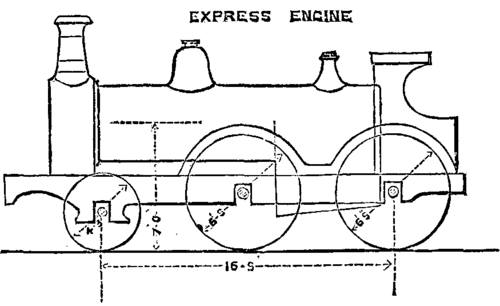
FIG. 7. - MIDLAND RAILWAY.
The Midland Railway route to the North is distinguished by the heavy nature of its gradients; between Settle and Carlisle, running through the Cumberland hills, attaining a height of 1,170 ft. above sea level, the highest point of any express route in the kingdom; and to work heavy fast traffic over such a line necessitates the employment of coupled engines. The standard express locomotive of this company has inside cylinders 18 in. in diameter and 26 in. stroke. The coupled wheels are 6 ft. 9 in. diameter, and the leading wheels 4 ft. 3 in., the total wheel base being 16 ft. 6 in., and the tractive force 104 lb. for each lb. of mean cylinder pressure. The boiler is of best Yorkshire iron, 10 ft. 4 in. long and 4 ft. 1 in. diameter. The grate area is 17.5 square feet, and the heating surface is, in the tubes, 1,096; fire-box, 110; total, 1,206. There are double frames to give outside bearings to the leading axle, as in the Great Western engine, and the engine is fitted with a steam brake. The weight in full working order is - leading wheels, 12 tons 2 cwt.; driving wheels, 15 tons; trailing wheels, 11 tons 6 cwt.; total, 38 tons 8 cwt. The tender weighs 26 tons 2 cwt., and holds 3,300 gallons of water and 5 tons of coal.
Latterly a fine type of bogie express engine has been introduced, with inside cylinders 18 in. diameter and 26 in. stroke, and four coupled driving wheels 7 ft. diameter. The total wheel base to the center of the bogie pin is 18 ft. 6 in. The grate area is 17.5 square feet, and the heating surface is, in tubes, 1,203 square feet, and fire-box, 110; total, 1,313; and the engine weighs 42 tons in working order. These engines take fourteen coaches, or a gross load of 222 tons, at 50 miles an hour over gradients of 1 in 120 to 1 in 130, with a consumption of 28 lb. of coal per mile. The London, Chatham, and Dover Company has also some fine engines of a similar type. They have inside cylinders 17½ in. diameter and 26 in. stroke; the coupled wheels are 6 ft. 6 in. diameter, and the bogie wheels 3 ft. 6 in., the wheel base to the center of the bogie pin being 18 ft. 2 in. The boiler is 10 ft. 2 in. long and 4 ft. 2 in. diameter, the grate area is 16.3 square feet, and the heating surface is, in the tubes, 962 square feet; fire-box, 107 square feet; total, 1,069. The boiler pressure is 140 lb., and the tractive force per lb. of steam in the cylinder 102 lb.
The weight in full working order is, on the bogie wheels, 15 tons 10 cwt.; driving wheels, 13 tons 10 cwt.; trailing wheels, 13 tons; total, 42 tons.
Mr. Worsdell has lately designed for the Great Eastern Railway a fine type of coupled express engine, which deserves mention. It has inside cylinders 18 in. diameter and 24 in. stroke, with coupled wheels 7 ft. diameter and leading wheels 4 ft. diameter, the latter being fitted with a radial axle on a somewhat similar plan to that previously described as adopted by Mr. Webb for the new North-Western engines; the frames are single, with inside bearings to all the wheels, and Joy's valve gear is used. The boiler pressure is 140 lb., and the tractive power per lb. of mean cylinder pressure 92 lb. The total wheel base is 17 ft. 6 in. The boiler, which is fed by two injectors, is of steel, 11 ft. 5 in. long and 4 ft. 2 in. diameter. The grate area is 17.3 square feet, and the heating surface is, in the tubes, 1,083; fire-box, 117; total, 1,200 sq. ft. The weight in working order is, on the leading wheels, 12 tons 19 cwt.; driving wheels, 15 tons; trailing wheels, 13 tons 4 cwt.; total, 41 tons 3 cwt. These engines burn 27 lb. of coal per train mile with trains averaging thirteen coaches.
Continue to:


My Books

