


Modern Locomotive Practice. Part 7
Description
This section is from "Scientific American Supplement". Also available from Amazon: Scientific American Reference Book.
Modern Locomotive Practice. Part 7
Having now passed in review the general types of engines adopted in modern English practice, the author would briefly draw attention to some points of design and some improvements effected in late years. And first, as to the question of single or coupled engines, there is a great diversity of opinion. Mr. Stirling conducts his traffic at a higher rate of speed, and certainly with equal punctuality, with his magnificent single 8 ft. engines, as Mr. Webb on the North-Western with coupled engines, and the economy of fuel of the former class over the latter is very remarkable; this is, no doubt, owing, as has been previously pointed out, to their ample cylinder power, which permits of the steam being worked at a high rate of expansion. There is no doubt that if single engines can take the load they will do so more freely and at a less cost than coupled engines, burning on the average 2 lb. of coal per mile less with similar trains. With, regard to loads, it is a question whether any express train should be made up with more than twenty-five coaches. The Great Northern engine will take twenty-six and keep time, and the Brighton single engine has taken the five P.M. express from London Bridge to Brighton, consisting of twenty-two coaches, at a speed of forty-five miles per hour.
Of course where heavy gradients have to be surmounted, such as those on the Midland route to Scotland, coupled engines are a necessity. Single engines are said to slip more than coupled; thus an 8 ft. single Great Northern engine running down the incline from Potter's Bar to Wood Green with twelve coaches at the rate of sixty miles an hour was found to be making 242 revolutions per mile instead of 210; and in an experiment tried on the Midland Railway it was found that a coupled engine with ten coaches at fifty miles an hour made seventeen extra revolutions a mile, but when the side rods were removed it made forty-three. The Great Western, Great Northern, and Brighton mainly employ single engines for their fast traffic; and the Manchester, Sheffield, and Lincolnshire have now adopted the single type in preference to the coupled for their express trains; while the North-Western, Midland, South-Western, and Chatham adopted the coupled type. One noticeable feature in modern practice is the increased height of the center line of boiler; formerly it was the great aim to keep this low, and numerous schemes to this effect were propounded, but now it has become generally recognized that a high pitched engine will travel as steadily and more safely round a curve - given a good road - than a low pitched one; and thus while in 1850 the average height of the center line of boilers varied between 5 ft. 3 in. and 6 ft. 3 in., now in the latest designs it lies between 7 ft. and 7 ft. 6 in.
Single frames are very generally adopted, but double frames and outside bearings to the leading and trailing wheels, as in the Great Western engines, give great steadiness in running, and this class has also double bearings to the driving wheels, thus entailing greater security in case of the facture of a crank axle. The general adoption of cabs on the foot-plate for the men is another improvement of late introduction, although at first not universally appreciated by those for whose comfort it was designed - "I felt as if I was in my coffin," said an old driver when asked how he liked the new shelter. Mild steel fire-boxes, which have been employed in America, are not in favor here, copper being universally used; they have been tried on the Caledonian, Great Southern and Western, North London, and North-Western, and were found not to succeed. Brake blocks of cast iron have now generally superseded wood; steel is being more and more used, especially on the North Western. There is less use of brasswork for domes and fittings, although it is claimed for brass that it looks brighter and can easily be kept clean.
There is greater simplicity of design generally, and the universal substitution of coal as coke for fuel, with its consequent economy; and last, but not least, the adoption of standard types of engines, are among the changes which have taken place in locomotive practice during the past quarter of a century.
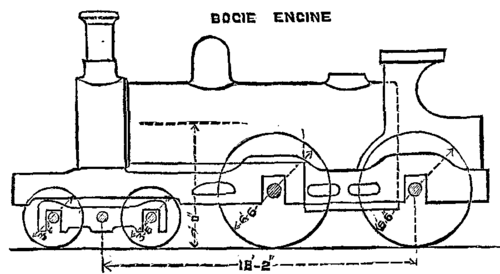
FIG. 8. - LONDON, CHATHAM, & DOVER RAILWAY.
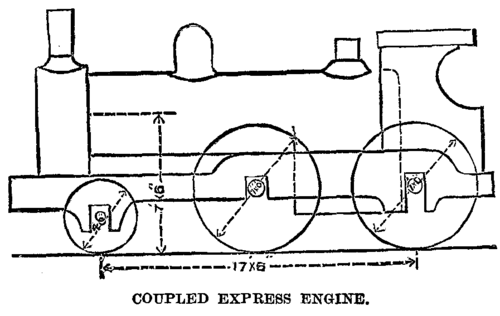
FIG. 9. - GREAT EASTERN RAILWAY.

FIG. 10. - MANCHESTER, SHEFFIELD, AND LINCOLNSHIRE RAILWAY.
Having now reviewed, as far as the limits of this paper will allow, the locomotive practice of the present day, the author would in conclusion draw attention to what may possibly be one course of locomotive development in the future. Time is money, and it may be in the coming years that a demand will arise for faster means of transit than that which we possess at present. How can we meet it? With our railways laid out with the curves and gradients existing, and with our national gauge, and our present type of locomotive, no great advance in speed is very probable; the mean speed of express trains is about fifty miles an hour, and to take an average train of 200 tons weight at this speed over a level line requires between 650 and 700 effective horse-power, within the compass of the best engines of the present day. But if instead of fifty miles an hour seventy is required, an entirely different state of things obtains. Taking a train of 100 tons, with engine and tender weighing 75 tons, or 175 tons gross, the first question to determine will be the train resistance, and with reference to this we much want careful experiments on the subject, like those which Sir Daniel Gooch made in 1848, on the Bristol and Exeter Railway, which are even now the standard authority; the general use of oil axle-boxes and long bogie coaches, irrespective of other improvements, would render this course desirable.
Continue to:


My Books

