


New Arrangement Of The Bichromate Of Potash Pile
Description
This section is from "Scientific American Supplement". Also available from Amazon: Scientific American Reference Book.
New Arrangement Of The Bichromate Of Potash Pile
Since Poggendorff in 1842 thought of substituting in the Bunsen battery a solution of bichromate of potash and sulphuric acid for nitric acid, and of thus making a single liquid pile of it, in suppressing the porous vessel, his idea has been taken up a considerable number of times. Some rediscovered it simply, while others, who were better posted in regard to the work of their predecessors, took Poggendorff's pile as he conceived it, and, considering the future that was in store for it, thought only of modifying it in order to render it better. Among these, Mr. Grenet was one of the first to present the bichromate of potash pile under a truly practical form. As long ago as 1856, in fact, he gave it the form that is still in use, and that is known as the bottle pile. Thus constructed, this pile, as is well known, presents a feeble internal resistance, and a greater electro-motive power than the Bunsen element. Unfortunately, its energy rapidly decreases, and the alteration of the liquid, as well as the large deposit of oxide of chromium that occurs on the positive electrode, prevents its being employed in experiments of quite long duration.
Mr. Grenet, it is true, obviated these two defects by first renewing the liquid slowly and continuously, and causing a current of air to bubble up in the pile so as to detach the oxide of chromium in measure as the deposit formed. Thus improved, the bichromate pile was employed on a large scale in the lighting of the Comptoir d'Escompte. In an extensive application like this latter, the use of compressed air for renewing the liquid can be easily adapted to the bichromate pile, as the number of elements is great enough to allow of the putting in of all the piping necessary; but when it is only desired to use this pile for laboratory purposes, and when there is need of but a small number of elements, it is impossible to adopt Mr. Grenet's elements in the form required by an electric lighting installation. It becomes absolutely necessary, then, to come back to a simpler form, and attempt at the same time to obviate the defects which are inherent to its very principle. In accordance with this idea, it will be well to point out the arrangement adopted by Mr. Courtot for his bichromate of potash piles - an arrangement that is very simple, but, sufficiently well worked out to render the use of it convenient in a laboratory.

Fig. 1. - COURTOT'S ARRANGEMENT OF THE BICHROMATE PILE.
Fig. 1 gives the most elementary form. It consists of an earthen vessel into which dip four carbon plates connected with each other by a copper ring which carries one of the terminals. In the center there is a cylindrical porous vessel that contains a very dilute and feebly acidulated solution of bichromate of potash into which dips a prism of zinc, which may be lifted by means of a rod when the pile ceases to operate. It is true that the presence of the porous vessel in the bichromate of potash element increases the internal resistance, but, as an offset, although it decreases the discharge, it secures constancy and quite a long duration for it.
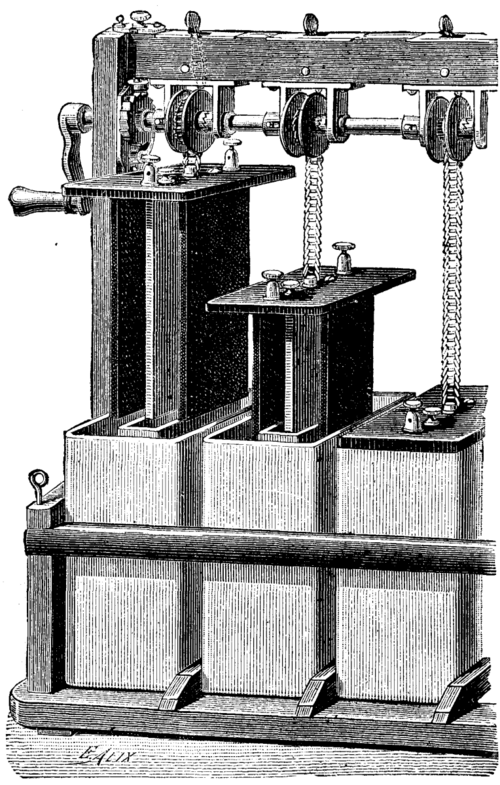
Fig. 2. - COURTOT'S ARRANGEMENT OF THE BICHROMATE PILE.
The elements thus constituted may be grouped, to the number of six, in a frame analogous to that shown in the engraving, and, sum total, form a small sized battery adapted to the current experiments of the laboratory, and capable of supplying two small four volt lamps for ten or twelve hours. We have had occasion to make use of these elements for the graduation of galvanometers, and, after ascertaining the constancy of the discharge, have found that the internal resistance of each couple is nearly 0.175 ohm, with an electro-motive force of two volts. As may be seen, these elements should, in general, all be mounted for tension, as they are in the figure, inasmuch as the mobility of the zincs permits, according to circumstances, of employing a variable number of them without changing anything. Moreover, with zincs amalgamated in a special manner, the attack is imperceptible, and the work in open circuit need scarcely to be taken into consideration.
Yet, despite the qualities inherent to the arrangement that we have just described, that defect common to all bichromate of potash piles - the deposit of oxide of chromium upon the carbon - is not here avoided. It occurs quite slowly, to be sure, but it does occur, and, from this point of view, the arrangement shown in Fig. 2 is preferable. The elements here are composed of prismatic porcelain vessels containing, as before, the solution and porous vessel.
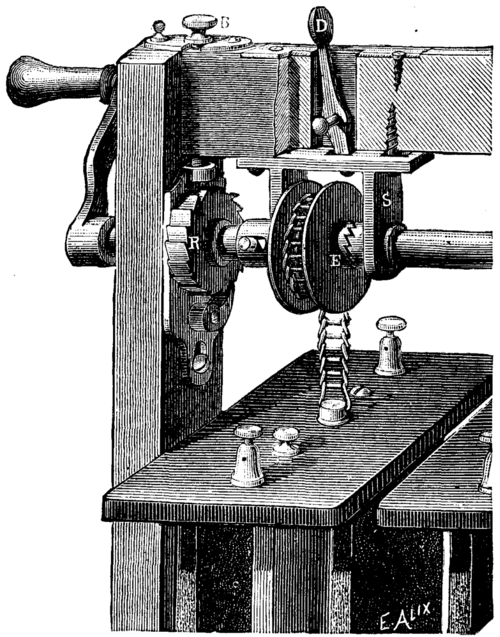
Fig. 3. - COURTOT'S ARRANGEMENT OF THE BICHROMATE PILE.
The whole is covered with a sheet of ebonite connected with the zinc and the two carbon plates in such a way that when the pile is not in operation the whole can be lifted from the liquid. Under such circumstances the deposit of oxide is notably diminished, and the duration of the discharge is consequently greatly increased.
Fig. 3 shows the details of a windlass that permits of lifting, according to circumstances, all the elements of the same trough or only a part of them. To effect this, the drum around which the chain winds that carries the carbons is mounted upon a sleeve fixed upon the axle. This latter is actuated by a winch; and a ratchet wheel, R, joined to a click which is actuated by a spiral spring, prevents the ebonite plates from falling back when it is desired to place the bolt under the button, B, of the spring.
When it is desired to put an element out of the circuit, it is only necessary to act with the finger upon the extremity of the lever, D. Under the action of the latter, the piece, s, which carries a groove for the passage of the screws that fix it to the upper cross-piece, takes on a longitudinal motion and consequently gears with the drum through the toothed sleeve, E. When an experiment is finished the zinc may thus be lifted from the liquid, and the deposit of oxide be prevented from forming upon the carbon. As may be seen, the arrangements which we have just described exhibit nothing that is particularly original. The windlasses used for removing the elements from a pile when the circuit is open have been employed for a long time; the bichromate pile is itself old, and, as we said in the beginning, it has been modified in its details a number of times. In spite of this, we have thought it well to point out the mode of construction adopted by Mr. Courtot, since, owing to the simplicity of the arrangements, it renders convenient and easily manageable a pile of very great constancy that may be utilized for supplying incandescent lamps, as well as for the most varied experiments of the laboratory. - La Lumiere Electrique.
Continue to:


My Books

