


On The Arrangement Of Ground Conductors
Description
This section is from "Scientific American Supplement". Also available from Amazon: Scientific American Reference Book.
On The Arrangement Of Ground Conductors
In telegraphy, as well as in the question of lightning rods, attention has been but incidentally paid to the improvement of ground conductors, and this point has not been the object of that careful study that has been bestowed upon the establishment of aerial lines. It is only recently that the interest created by lightning rods has given rise to new forms of conductors differing from those formerly used. The publications of the Prussian Academy of Sciences of from 1876 to 1880 contain some information of special importance in regard to this. It is stated therein that the effect of ground conductors may be notably increased by the division of the earth plates and the use of metallic rods, without necessitating a greater output of material. These facts, however, have not as yet been put to profit in practice for the reason, perhaps, that the considerations, which have remained general, have not at once permitted of obtaining forms what could be employed with perfect knowledge of the results. This is what led Mr. Ulbricht, of Dresden, to make calculations for a few forms of conductors, and to test their approximate values.
The results of these researches are printed in the Elektrotechnischen Zeitschrift for 1883 (p. 18).
The equations found show, in the first place, that there exist three means of obtaining a considerable effect, as regards the ground conductor, with a slight expenditure of material: The cylindrical electrode may be drawn out into the form of a bar or wire; the plate may be rendered narrow, and elongated in the form of a ribbon; and, besides, the annular plate may be enlarged in lessening the metallic surface.
Finally, a short, open cylinder with a vertical axis may be formed by curving a narrow plate or ribbon. It is not necessary to see the formula to recognize the fact that this cylinder must behave like a ribbon and a flat ring. The radius increasing, and the surface remaining constant, the resistance of the earth here likewise approaches zero.
As the resistance of the earth is inversely proportional to the diameter of the plates, the zero resistance can also be reached by dividing a plate ad infinitum. As the parts of the plate may be brought quite close to each other without perceptibly interfering with the action, a network has finally been reached by a division carried very far, yet limited, and by connecting the parts with one another by conducting cylinders.
If we seek to determine what forms of ground conductors are efficient and economical under given conditions, we shall have to begin by informing ourselves as to the choice of material to be used for the electrode, and shall then have to ascertain whether putting it in the ground will or will not necessitate much outlay. The most suitable material is copper, which may be used with advantage, in that it lasts pretty well underground, and that the facility which it may be worked permits of easily giving it more appropriate forms than those that can be obtained with cast iron, which is of itself less costly.
If the burying in the ground requires little or no labor, as when there exist ponds, rivers, and wells, or subterranean strata of water near the surface of the earth, elongated forms of conductors will be employed, such as the solid or hollow cylinder, the wire, the ribbon, the narrow ring, and the network. Plates approaching a square or circular shape are not advantageous. But if the ground has to be dug deeply in order to sink the conductor, the form of the electrode must be more condensed, and selected in such a way that the necessary action may be obtained with a minimum output of copper and labor. For great depths, and when the ground will permit of boring, an elongated and narrow cylinder will be used. Such a system, however, can only be employed when the cylinder is surrounded by spring water, since, without that, an intimate contact with earth that is only moist, cannot be obtained with certainty. In earth that is only moist and for moderate depths, preference may be given to an electrode laid down flat. The digging necessary in this case is onerous, it is true, but it permits of very accurately determining the state of the earth beneath and of obtaining a very perfect adherence of the electrode therewith.
Two forms, the annular ribbon or the flat ring and the network, present themselves, according to calculations, as a substitute for copper plates, which are so expensive; and these forms are satisfactory on condition that the labor of digging be not notably increased. These forms should always have a diameter a little greater than that of the plate. The flat ring and the network, however, offer one weak point, which they possess in common with the plate, and that is, their dimensions cannot be easily adapted to the nature of the ground met with without a notable increase in the expense. Now, if the ground should offer a conductivity less than what was anticipated, and it were desired to increase the plate, say by one-third, it would be impossible to do so as a consequence of the closed form.
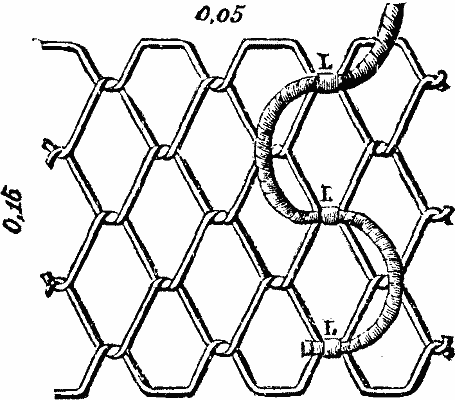
One important advantage is realized in this respect by combining the ring and the network in the form of a reticulated ring having a diameter of from 1 to 1½ meters. On cutting this ring at a given place and according to a certain radius we obtain the reticulated ribbon shown in the accompanying figure. The thickness of the wires is 2.5 mm., and their weight is 0.475 kilo. per meter. L, L, and L are the points at which the conducting cable is soldered. A reticulated ribbon of copper can be made in advance of any length whatever, and, according to local exigencies, it may be easily curved and given the form of a flat or cylindrical ring of varying width. Even though the ribbon has already been cut for a ring of given diameter, it may be still further enlarged by drawing it out and leaving a bit of the ring open, so as to thus obtain a nearly corresponding diminution in the resistance. Such a resistance may be still further diminished by rendering the ring higher, that is to say, by employing an annular cylindrical form.
Continue to:


My Books

