


Telephonic Transmission Without Receivers
Description
This section is from "Scientific American Supplement". Also available from Amazon: Scientific American Reference Book.
Telephonic Transmission Without Receivers
The annual meeting of the French Society of Physics, the success of which is continually increasing, took place this year in the salons of the Observatory, which were kindly placed at the Society's disposal by Admiral Mouchez.
There were three consecutive sessions, the one of Tuesday, April 15, being set apart for the members of the Association, the one of the 16th for the invited guests of Admiral Mouchez, and that of the 17th for the invited guests of the Society. The salons were partially lighted by the Siemens differential arc, continuous current lamps, and partially by the Swan incandescent lamp supplied by a distributing machine that permitted of the lamps being lighted and extinguished at will without changing the normal operation of all the rest. Many apparatus figured at this exhibition, but we shall on the present occasion merely call attention to those that presented a certain character of novelty or of originality.
Among the apparatus that we shall reserve a description of for the present was Messrs. Richard Bros.' registering thermometer designed for the Concarneau laboratory, an instrument which, when sunk at one mile from the coast, and to a depth of 40 meters, will give a diagram of the temperature of the ocean at that depth; and Mr. Hospitalier's continuous electrical indicators, designed for making known from a distance such mechanical or physical phenomena as velocities, levels, temperatures, pressures, etc.
Among the most important of the apparatus exhibited we must reckon Mr. Cailletet's devices for liquefying gases, and those of Mr. Mascart for determining the ohm. The results obtained by Mr. Mascart (which have been submitted to the Committee on Unities of the Congress of Electricians now in session at Paris), are sensibly concordant with those obtained independently in England by Lord Rayleigh. Everything leads to the hope, then, that a rapid and definite solution will be given of this important question of electric unities, and that nothing further will prevent the international development of the C.G.S. system.
Mr. Jules Duboscq** made a number of very successful projections, and we particularly remarked the peculiar experiment made in conjunction with Mr. Parinaud, that gave in projection two like spectra produced by the same prism, and which, through superposition, were capable of increasing the intensity of the colors, or, on the contrary, of reconstituting white light.
Among the optical applications we may cite Mr. Leon Laurent's apparatus for controlling plane, parallel, perpendicular, and oblique surfaces, and magic mirrors obtained with an ordinary light; Mr. S.P. Thompson's apparatus for demonstrating the propagation of electro-magnetic waves in ether (according to Maxwell's theory), as well as some new polarizing prisms; and a mode of lighting the microscope (presented by Mr. Yvon), that was quite analogous to the one employed more than a year ago by Dr. Van Heurck, director of the Botanical Garden of Anvers.
Acoustics were represented by an electro-magnetic brake siren of Mr. Bourbouze; Konig's apparatus for the synthesis of sounds; and Mr. S.P. Thompson's cymatograph - a pendulum apparatus for demonstrating the phenomena of beats.
It was electricity again that occupied the largest space in the programme of the session.
Apparatus for teaching are assuming greater and greater importance every day, and the exhibit of Mr. Ducretet included a large number of the most interesting of these. The house of Breguet exhibited on a reduced scale the magnificent experiments of Gaston Plante, wherein 320 leaden wire secondary elements charged for quantity with 3 Daniell elements, and afterward coupled for tension, served to charge a rheostatic machine formed of 50 condensers coupled for quantity. These latter, coupled anew for tension, furnished upon being discharged a spark due to a difference of potential of about 32,000 volts that presented all the characters of the spark produced by induction coils on the machines so improperly called "static." Finally, we may cite the apparatus arranged by Mr. S.P. Thompson for studying the development of currents in magneto-electric machines. The inventor studies the influence of the forms of the inductors and armatures of machines by means of an arrangement that allows him to change the rings or armatures at will and to take out the induced bobbins in order to sound every part of the magnetic field.
Upon giving the armature an angular motion limited by two stops, there develops a certain quantity of electricity that may be measured by causing it to traverse an appropriate ballistic galvanometer. Messrs. Deprez and D'Arsonval's galvanometer answers very well for this purpose, and its aperiodicity, which causes it quickly to return to zero as soon as the induced current ceases, permits of a large number of readings being taken within a very short space of time.
Measuring apparatus were represented by a new and very elegant arrangement of Sir William Thomson's reflecting galvanometers, due to Mr. J. Carpentier. The mounting adopted by Mr. Carpentier permits of an easy removal of the bobbins and of an instantaneous substitution therefor. The galvanometric part, composed of the needles and mirror, therefore remains entirely free, thus allowing of its being verified, and making it convenient to attach the silken fiber. Mr. Carpentier has, moreover, adopted for all the minor apparatus a transparent celluloid scale which simplifies them, facilitates observations, and renders the use of reflection almost industrial.
We shall complete our enumeration of the measuring apparatus by citing Ducretet's non-oscillating galvanometer, Sir William Thomson's amperemeters, voltameters, ohmmeters, and mhosmeters, constructed and exhibited by Breguet, and a new aperiodic galvanoscope of Mr. Maiche. Mr. Baudot exhibited the recent improvements that he has made in his multiplex printing telegraph, and M. Boudet of Paris showed a new system of telephone transmission by submarine cables.

FIG. 1. - DIAGRAM EXHIBITING THE ARRANGEMENT FOR TELEPHONIC TRANSMISSIONS WITHOUT A RECEIVER.
Finally, we shall conclude our enumeration by referring to the curiosities. The house of Siemens exhibited a miniature electric railway actuated by a new model of Reynier accumulators; M. Maiche operated a system of musical telephonic auditions that differed only in detail from those instituted by Mr. Ader at the exhibition of 1881; and Mr. Hospitalier presented a new form of an experiment devised by Mr. Giltay, consisting of a telephonic transmission of sounds without the use of receivers. Mr. Giltay's experiment is nothing but Mr. Dunand's speaking condenser without the condenser. A glance at Fig. 1 will show how things are arranged for the experiment. The transmitting system comprises two distinct circuits, viz.: (1) one formed of a pile, P, of 2 or 3 Leclanche elements, or of 1 or 2 small sized accumulators, an Ader microphane transmitter, M, and the inducting wire of a small induction coil, B; and (2) the other formed of the induced wire of the coil, B, of a pile, P', of 10 or 12 Leclanche elements, and of a line whose extremities terminate at R, in two ordinary electro-medical handles.
With this arrangement the experiment performed is as follows: When any one speaks or sings in front of the transmitter, T, while two persons, A and B, each having one hand gloved, are holding the handles in the ungloved hand, it is only necessary for A to place his gloved hand upon B's ear, or for the latter to place his hand upon A's, or for each to place his hand on the other's ear simultaneously, in order that A or B, or A and B simultaneously, may hear a voice issuing from the glove. Under these circumstances, Mr. Giltay's experiment is explained like Dunand's speaking condenser - the hand of A and the ear of B here constituting the armature of an elementary condenser in which the glove performs the role of dielectric.
Upon repeating this experiment at the laboratory of the School of Physics and Industrial Chemistry of Paris, it has been found that the glove maybe replaced by a sheet of plain or paraffined paper. In this case, when two persons are holding the handles, and have their ears applied, one against the other, if a sheet of paper be interposed, airs or words will be heard to proceed therefrom. Finally, it has been found possible to entirely suppress the paper, or dielectric, and to hear directly, by simply interposing the auditor or auditors in the circuit. One of the most curious forms of the experiment is the one shown in Fig. 2. Here a third person, C, hears the hands of A and B speak when a circuit is formed by means of three persons, A, B, and C, the two former, A and B, each holding one of the wires of the circuit and applying his free hand to the ear of C. Although the experiment is one that requires entire silence, and could not on that account be performed at the laboratory, a sort of telephonic chain can be formed in which five or six persons may hear at the same time.
A, putting his hand on the ear of B, the latter putting his to that of C, and so on up to the last person, who closes the circuit by grasping one of the handles, the other one being held by A.
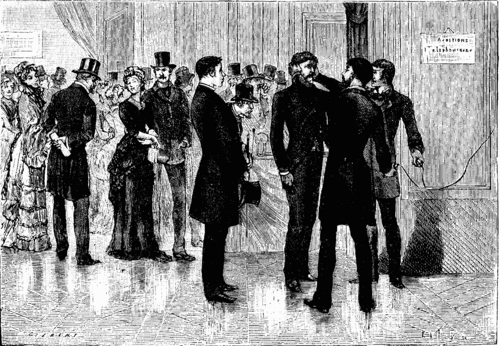
EXPERIMENT ON TELEPHONIC TRANSMISSION WITHOUT RECEIVING APPARATUS.
It is difficult in the present state of science to explain very clearly how these telephonic transmissions are effected without a receiver. All that we can conclude from it so far is that the ear is an instrument of incomparable delicacy and of exquisite sensitiveness, since it perceives vibrations in which the energy developer, particularly in the telephonic chain, is exceedingly feeble.
Without any desire to seek an application for an experiment that is simply curious, we yet believe that there is here a phenomenon of a nature to be studied by physicists. Discoveries in telephony and microphony have certainly opened up to science, as regards both theory and practice, new horizons that still promise other surprises for the future. But to return to the observatory: The success obtained by the exhibition of the French Society of Physics shows that these reunions respond to a genuine need - that of instructing in and popularizing science. While warmly congratulating the organizers of these meetings, we may express a wish that the good example set by the Society of Physics may be followed by other societies. We are convinced in advance that an equal success awaits them. - La Nature.
Continue to:


My Books

