


Pneumatic Malting
Description
This section is from "Scientific American Supplement". Also available from Amazon: Scientific American Reference Book.
Pneumatic Malting
The lethargy in the malting trade, and in all matters relating to malting processes, induced by two centuries of restrictive legislation, is being gradually shaken off by the malting industry under the new law. For many years nearly all improvements in malting processes originated abroad, as numberless Acts of Parliament fettered every process and the use of every implement requisite in a malt-house in this country. The entire removal of these legislative restrictions gives an opportunity for improved processes, which promises to open up a considerable field for engineering work, and to develop a very backward art by the application of scientific principles. The present time is, therefore, one of more material change than malting has ever experienced.

PNEUMATIC MALTING AT TROYES. Fig. 1.
Of the numerous improvements effected in the past few years, those made by M. Galland in France, and more recently by M. Saladin, are by far the most prominent. M. Galland originated what is known as the pneumatic system eight or nine years ago. This system is carried out at the Maxéville brewery, near Nancy.

PNEUMATIC MALTING AT TROYES. Fig. 2.
Since that time further improvements have been made by M. Galland; but more recently great advances have been made in the system by M. Saladin. He has developed the practice of the leading principle, and in conjunction with Mr. H. Stopes, of London, has added improved kilns and various mechanical apparatus for performing the work previously done by hand. He has also devised a very ingenious machine for cooling the moist air by which the process is carried on.

FIG. 4.--ECHANGEUR AND TURNING MACHINE.
At the recent Brewery Exhibition, some of the machinery used in these new maltings was shown in action by Messrs. H. Stopes & Co., together with drawings of a malting constructed at Troyes for M. Bonnette under M. Saladin's instructions. This malting is the third constructed for the same firm, the others being at Nancy. That at Troyes we now illustrate. We will not occupy space by a general description of the pneumatic system, one great feature in which is the continuous manufacture of malt throughout the year instead of only from five to eight months of the year, as it will be gathered from the following description of the Troyes malting:
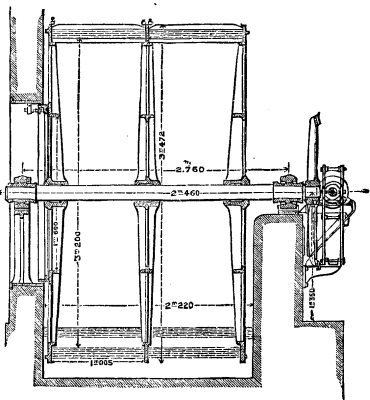
FIG. 5.--ECHANGEUR, AXIAL SECTION.
In our engravings, Figs. 1, 2, and 3, the letter A indicates the germinating cases; B, Saladin's patent turning screws; C A, air channels; D, passages; E R, main driving shafts; e, pulleys; F, metal recesses to fit turning screws; G, elevators; H, trap doors; I, air channels; J, openings to growing floor for air; K S, engines and fan room; L N, fans, supply and exhaust; T, boiler; U, chimney; f, well. The capacity of the malting is 130 qr. malt every day. This is equivalent to an English house of 520 qr. steep. The whole space occupied is the area necessary for kilns, malt and barley stores, engine and boiler house, and fans. No additional area is required for germinating floors, as ten germinating cases, A, are placed in the basement below the kilns and stores. The building is of brick, with the internal walls below the ground line resting upon cast iron columns and rolled joists. The germinating cases, A A, are of iron; the bottoms are double. One of perforated plate is placed 6 inches above the bottom. These plates admit of draining the corn if the germinating case is used as a steeping cistern also. Their chief object is, however to admit of ready circulation of the air by the means presently to be described.
Large channels, A a, serve as drains for moisture and to convey the air to or from the growing corn. Between each case is a passage, D, enabling the maltster to have free access to the corn at all points.

FIG. 6.--ECHANGEUR TRANSVERSE SECTION.
With the exception of the driving shaft, E, all the machinery is in duplicate, so that the possibility is remote of any breakdown that would seriously affect the working of the house. This is necessary, as should the fans, L N, be stopped for twenty-four hours the corn germinating at a depth exceeding 30 inches would heat and impair its vitality. The boilers, T, and engines, S, are of the common type of 20 horse power nominal. The fans, L N, are the Farcot patent, illustrated a short time since in our pages. The lower floors of the kilns are provided with the Schlemmer patent mechanical turners. The turners, Fig. 4, in the germinating cases are Saladin's patent.
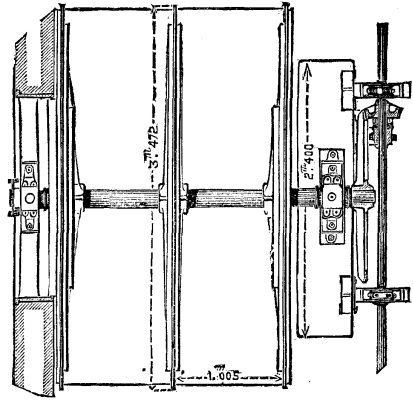
FIG. 7.--ECHANGEUR, SECTIONAL PLAN.
The germination of the grain is effected by means of cool moist air provided by the fan described and the cooler and moistener--Figs. 5, 6, and 7, herewith--known as an echangeur. As the germinating grain has a depth of from 30 inches to 40 inches some pressure is required, and mechanical means are necessary for efficient and economical turning. The echangeur is a very ingenious application of the well understood rapidity of evaporation of any liquid when spread out in very thin layers over large surfaces and exposed to a current of air. It consists of a cylinder, or series of cylinders, of increasing diameter, placed one within another. Each consists of finely perforated sheet iron. They are placed in a trough of water, just sufficiently immersed to insure complete wetting. When rotated at a slow speed, the surfaces of all the cylinders are kept just wetted. A volume of air is either driven or drawn through, as may be required for any particular purpose. In the model malting, as shown at Fig. 4, taken from that shown at the Brewery Exhibition, the air was driven through the echangeur and thence through the germinating barley.
Continue to:


My Books

