


Pneumatic Malting. Continued
Description
This section is from "Scientific American Supplement". Also available from Amazon: Scientific American Reference Book.
Pneumatic Malting. Continued
Here or as employed in the malting illustrated, the air in its passage comes first into contact with the moistened cylinders, and if hot and dry it becomes moist and cool, for the constant evaporation upon the cylinders has a very considerable refrigerating effect.
This was well known to the Egyptians over four thousand years ago, and the porous bottle--gergeleh--of Esnch has been made until the present day, to keep the drinking water cool and fresh. The echangeur is like a gigantic gergeleh, and by increasing the size and number of the cylinders, and causing the water in the moistening trough to circulate, any volume of air can be wetted to the saturation limit corresponding to its temperature. It will be seen that this apparatus gives the maltster complete control of the humidity and heat as well as volume of the air driven through germinating corn.

Fig. 8.
The turning apparatus is shown by Fig. 4, and consists, as will be seen, of a cylindrical frame provided with rollers which run on rails at the edge of the germinating cases. It is carried to and fro from either end of the case by compensating rope gearing which at the same time gives motion to the gearing actuating the turning screws. These screws do not quite touch the bottom of the germinating case, but are provided with a pair of small brushes, as shown in the annexed engraving, Fig. 8, which just skim it. The apparatus shown has but three of these screws, but the cases are generally made wide enough for six. The kilns are double, each possessing two floors, and worked upon the Stopes' system. The construction of the furnaces is of the ordinary French pattern. The arrangement of the house permits of great regularity in working. Every day 130 qrs. of barley is screened, sorted, cleaned, and passed into a steeping cistern. When sufficiently steeped it runs through piping into the germinating case, which, in the natural order of working, is empty. Here it forms the couch. When it is desirable to open couch a small amount of air is forced through the grain by opening the trap door connected with the main air channel.
This furnishes the growing corn with oxygen, removes the carbonic acid gas, and regulates temperatures of the mass of grain. Later the Saladin turner is put in motion about every eight to twelve hours. The screws in rotating upon their axes are slowly propelled horizontally. They thus effectually turn the grain and leave it perfectly smooth. This turning prevents matting of the roots, the regulation of temperature and exposure to air being effected by means of the cold air from the echangeur. When the grain is sufficiently grown it is elevated to the kilns. For forty hours it remains upon the top floor. It is then dropped upon the bottom floor, a further charge of green corn following upon the top floor. The benefit is mutual. The bottom floor is maintained at an even temperature, being virtually plunged in an air bath; free radiation of heat is prevented; the top surface of the malt is necessarily nearly as warm as that next the wires, which in its turn is subject to lower heats than would be necessary if free radiation from the surface was allowed. The top floor is by the intervention of the layer of malt between it and the fire prevented it from coming into direct contact with heat of a dangerous and damaging degree.
The same heat which is used to dry one floor, and in an ordinary kiln passes at once into the air as waste, is the best possible description of heat, namely, very slightly moistened heated air, to remove the moisture from the second layer of malt at a low temperature. It is of vital importance to retain this green malt at a low heat so long as any percentage of moisture exceeding, say, 15 per cent, is retained by the corn.
The regulation of temperature is shown by the diagrams, Figs. 9 and 10:
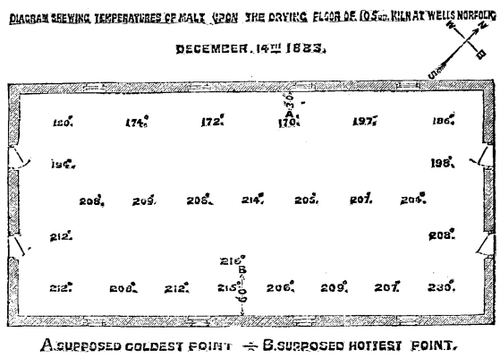
Fig. 9.
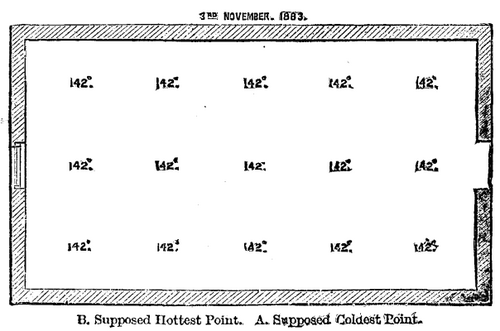
Fig. 10.
The distribution of the heated air in the kiln is rarely as uniform as is supposed, the temperature of the malt on drying floor being very different at different parts. In illustration of this, the following may be taken from a statement by Mr. Stopes of the results of an examination of the temperatures at different parts of a drying floor in a kiln in Norfolk: "A malting steeping 105 qr. every four days has a kiln 75 feet by 36 feet; an average drying area of under 26 feet per qr. The consequent depth of green malt when loaded is over 10 inches. The total area of air inlets is less than 27 feet super. The air outlet exceeds 117 feet, a ratio of 13 to 3. The capacity of head room equals 44,550 feet cube. The area of each tile is 144 inches, with 546 holes, giving an effective air area of some 32 inches. The ratio of non-effective metallic surface to air space is thus 9 to 2." The Casella anemometer gave no indications at several points, and fluctuating up and down draughts were observable at many others, especially at two corners and along the center. "The strongest upward draught pulsated with the gusts of wind and ranged from 30 feet to 54 feet per minute, a down draught of equal intensity occurring at intervals at the same spot, notwithstanding the fact that the air was rushing in at the inlets below the floor at the high velocity of 785 feet per minute.
The temperatures of the drying malt and superimposed air consequent upon the conditions thus indicated were naturally as follows: At B, the place supposed to be hottest: Heat of malt touching tiles, 216 deg.; heat of malt 1 inch above tiles, 167 deg.; heat of malt 3 inches above tiles 154 deg.; heat of malt 4 inches above tiles, 152 deg.; heat of malt 5 inches above tiles, 142 deg.; heat of malt on surface, 112 deg. At A, the place supposed to be coldest: Heat of malt next tiles, 174 deg.; heat of malt 2 inches above tiles, 143 deg.; heat of malt 4 inches above tiles, 135 deg.; heat of malt on surface, 104 deg.; the heat of the air 3 feet above tiles, 84 deg.; the heat of the air 5 feet above tiles, 82 deg. Fig. 9 shows the temperature at twenty-six points close to the tiles, taken with twelve registered and accurate thermometers in the space of fifteen minutes." These and other similar tests have led to the conclusion that the best malt drying cannot be done on a single floor.
Fig. 10 is a similar diagram showing the temperatures on a drying floor of kiln at Poole, Dorset, altered to Stopes' system of drying. The temperature at different depths of the drying grain was as follows: Malt at surface of tiles, 142 deg.; malt at 1 inch above tiles, 142 deg.; malt at 2 inches above tiles, 142 deg.; malt at 4 inches above tiles, 141 deg.; malt on surface, 140 deg.
The advantages of the Saladin system over that hitherto working in Britain are numerous, and are thus enumerated by Messrs. Stopes & Co. who are agents for M. Saladin: The area occupied by the building does not equal one-third of that otherwise required. The actual growing-floor space is only about one-seventh, and the number of workmen is ruled necessarily by the size of the house, but on an average is reduced two-thirds; but the employment of much more power is necessary, and the power is used at more frequent intervals. The use of plant and premises is continuous, the processes of malting being equally well performed during the summer months. The further advantage of this is that brewers secure entire uniformity in age of malt. By the English system the stocks of finished malt necessarily fluctuate largely. All grain is subjected to the same conditions of surrounding air, exposure, and temperature. The volume of air supplied to the germinating corn is entirely under control, as are also its temperature and humidity. When germination is arrested and the green malt is drying, the double kilns insure control of the temperatures of the corn in the kilns.
The infrequency of turning the germinating grain benefits the growth of the roots and the development of the plumule, besides saving much labor. No grains are crushed or damaged by the feet or shovels of workmen. The air supplied to the corn can be inexpensively freed from disease germs and impurities. The capital needed for malting can be reduced by the diminished cost of installation, and the reduced stocks of malt on hand. The quality of the malt made is considerably improved. The percentages of acidity are much reduced. The stability of the beer is increased, and a greater percentage of the extractive matter of the barley is obtainable by the brewer.--The Engineer.
Pneumatic Malting
According to K. Lintner, the worst features of the present system of malting are the inequalities of water and temperature in the heaps and the irregular supplies of oxygen to, and removal of carbonic acid from, the germinating grain. The importance of the last two points is demonstrated by the facts that, when oxygen is cut off, alcoholic fermentation--giving rise to the well-known odor of apples--sets in in the cells, and that in an atmosphere with 20 per cent. of carbonic acid, germination ceases. The open pneumatic system, which consists in drawing warm air through the heaps spread on a perforated floor, should yield better results. All the processes are thoroughly controlled by the eye and by the thermometer, great cleanliness is possible, and the space requisite is only one-third of that required on the old plan. Since May, 1882, this method has been successfully worked at Puntigam, where plant has been established sufficient for an annual output of 7,000 qrs. of malt. The closed pneumatic system labors under the disadvantages that from the form of the apparatus germination cannot be thoroughly controlled, and cleanliness is very difficult to maintain, while the supply of oxygen is, as a rule, more irregular than with the open floors.

Improved Pneumatic Filtering Presses.
Continue to:


My Books

