


Portable Railways. Part 2
Description
This section is from "Scientific American Supplement". Also available from Amazon: Scientific American Reference Book.
Portable Railways. Part 2
With this description of railway it does not matter whether the curves are to the right or to the left. The pair of rails are curved to a suitable radius, and can only need turning end for end to form a curve in the direction required. The rails weigh 9 lb., 14 lb., 19 lb., and 24 lb. per running yard, and are very similar to the rails used on the main railways of France, except that their base has a proportionally greater width. As to the strength of the rail, it is much greater in proportion to the load than would at first sight be thought; all narrow-gauge railways being formed on the principle of distributing the load over a large number of axles, and so reducing the amount on each wheel. For instance, the 9 lb. rail used for the portable railway easily bears a weight of half a ton for each pair of wheels.
The distance between the rails differs according to the purpose for which they are intended. The most usual gauges are 16in., 20 in., and 24in. The line of 16 in. gauge, with 9 lb. rails, although extremely light, is used very successfully in farming, and in the interior of workshops.
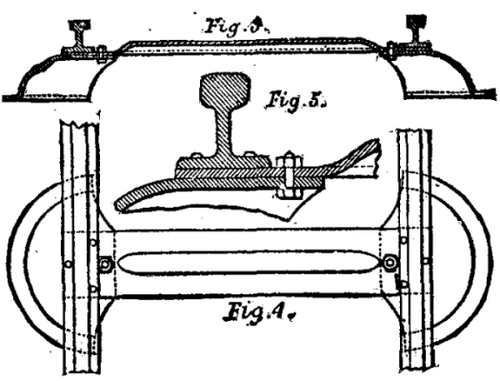
Fig. 3. Fig. 4. Fig. 5.
A length of 16 ft. 5 in. of 9 lb. steel rail, to 16 in. gauge, with sleepers, etc., scarcely weighs more than 1 cwt., and may therefore be readily carried by a man placing himself in the middle and taking a rail in each hand.
Those members of the Institution who recently visited the new port of Antwerp will recollect having seen there the portable railway which Messrs. Couvreux and Hersetit had in use; and as it was these works at the port of Antwerp that gave rise to the idea of this paper, it will be well to begin with a description of this style of contractor's plant.
The earth in such works may be shifted by hand, horsepower, or locomotive. For small works the railway of 16 in. gauge, with the 9 lb. rails, is commonly used, and the trucks carry double equilibrium tipping-boxes, containing 9 to 11 cubic feet. These wagons, having tipping-boxes without any mechanical appliances, are very serviceable; since the box, having neither door nor hinge, is not liable to need repairs.
This box keeps perfectly in equilibrium upon the most broken up roads. To tip it up to the right or the left, it must simply be pushed from the opposite side, and the contents are at once emptied clean out. In order that the bodies of the wagons may not touch at the top, when several are coupled together, each end of the wagon is furnished with a buffer, composed of a flat iron bar cranked, and furnished with a hanging hook.
Plant of this description is now being used in an important English undertaking at the port of Newhaven, where it is employed not only on the earthworks, but also for transporting the concrete manufactured with Mr. Carey's special concrete machine.
These little wagons, of from 9 to 11 cubic feet capacity, run along with the greatest ease, and a lad could propel one of them with its load for 300 yards at a cost of 3d. per cube yard. In earthworks the saving over the wheel-barrow is 80 per cent., for the cost of wagons propelled by hand comes to 0.1d. per cube yard, carried 10 yards, and to go this distance with a barrow costs ½d. A horse draws without difficulty, walking by the side of the line, a train of from eight to ten trucks on the level, or five on an incline of 7 per cent. (1 in 14).
One mile of this railway, 16 in. gauge and 9 lb. steel rail, with sixteen wagons, each having a double equilibrium tipping box containing 11 cubic feet, and all accessories, represents a weight of 20 tons--a very light weight, if it is considered that all the materials are entirely of metal. Its net cost price per mile is 450l., the wagons included.
Large contracts for earthwork with horse haulage are carried on to the greatest advantage with the railway of 20 in. gauge and 14 lb. rails. The length of 16 ft. 5 in. of this railway weighs 170 lb., and so can easily be carried by two men, one placing himself at each end. The wagons most in use for these works are those with double equilibrium tipping boxes, holding 18 cubic feet. These are at present employed in one of the greatest undertakings of the age, namely, the cutting of the Panama Canal, where there are used upward of 2,700 such wagons, and more than 35 miles of track.
A mile of these rails of 20 in. gauge with 14 lb. rails, together with sixteen wagons of 18 cubic feet capacity, with appurtenances, costs about 6601., and represents a total weight of 33 tons.
This description of material is used for all contracts exceeding 20,000 cubic yards.
A very curious and interesting use of the narrow-gauge line, and the wagons with double equilibrium tipping-box, was made by the Societe des Chemins de Fer Sous-Marins on the proposed tunnel between France and England. The line used is that of 16 in. gauge, with 9 lb. rails.
The first level of the tunnel, which was constructed by means of a special machine by Colonel Beaumont, had only a diameter of 2.13 m. (7 ft.); the tipping boxes have therefore a breadth of only 2 ft., and contain 7¼ cubic feet. The boxes are perfectly balanced, and are most easily emptied. The wagons run on two lines, the one being for the loaded trains, and the other for the empty trains.
The engineers and inspectors, in the discharge of their duties, make use of the Liliputian carriages. The feet of the travelers go between the wheels, and are nearly on a level with the rails; nevertheless, they are tolerably comfortable. They are certainly the smallest carriages for passengers that have ever been built; and the builder even prophesies that these will be the first to enter into England through the Channel Tunnel.
One of the most important uses to which a narrow gauge line can be put is that of a military railway. The Dutch, Russian, and French Governments have tried it for the transporting of provisions, of war material, and of the wounded in their recent campaigns. In Sumatra, in Turkestan, and in Tunis these military railroads have excited much interest, and have so fully established their value that this paper may confine itself to a short description.
Continue to:


My Books

