


Portable Railways
Description
This section is from "Scientific American Supplement". Also available from Amazon: Scientific American Reference Book.
Portable Railways
[Footnote: Paper read before the Institution of Mechanical Engineers.]
By M. DECAUVILLE, Aîne, of Petit-Bourg (Seine and Oise), France.
Narrow gauge railways have been known for a very long time in Great Britain. The most familiar lines of this description are in Wales, and it is enough to instance the Festiniog Railway (2 feet gauge), which has been used for the carriage of passengers and goods for nearly half a century. The prosperous condition of this railway, which has been so successfully improved by Mr. James Spooner and his son, Mr. Charles Spooner, affords sufficient proof that narrow gauge railways are not only of great utility, but may be also very remunerative.
In Wales the first narrow gauge railway dates from 1832. It was constructed merely for the carriage of slates from Festiniog to Port-Madoc, and some years later another was built from the slate quarries at Penrhyn to the port of Bangor. As the tract of country traversed by the railways became richer by degrees, the idea was conceived of substituting locomotives for horses, and of adapting the line to the carriage of goods of all sorts, and finally of passengers also.
But these railways, although very economical, are at the same time very complicated in construction. Their arrangements are based upon the same principles as railways of the ordinary gauge, and are not by any means capable of being adapted to agriculture, to public works, or to any other purpose where the tracks are constantly liable to removal. These permanent narrow gauge lines, the laying of which demands the service of engineers, and the maintenance of which entails considerable expense, suggested to M. Decauville, Aîne, farmer and distiller at Petit-Bourg, near Paris, the idea of forming a system of railways composed entirely of metal, and capable of being readily laid. Cultivating one of the largest farms in the neighborhood of Paris, he contemplated at first nothing further than a farm railroad; and he contrived an extremely portable plant, adapted for clearing the land of beetroot, for spreading manure, and for the other needs of his farm.
From the beginning in his first railroads, the use of timber materials was rigidly rejected by him; and all parts, whether the straight or curved rails, crossings, turntables, etc., were formed of a single piece, and did not require any special workman to lay them down. By degrees he developed his system, and erected special workshops for the construction of his portable plant; making use of his farm, and some quarries of which he is possessed in the neighborhood, as experimental areas. At the present time this system of portable railways serves all the purposes of agriculture, of commerce, of manufactures, and even those of war.
Within so limited a space it would be impossible to give a detailed description of the rails and fastenings used in all these different modes of application. The object of this paper is rather to direct the attention of mechanical engineers to the various uses to which narrow gauge portable railways may be put, to the important saving of labor which is effected by their adoption, and to the ease with which they are worked.
The success of the Decauville railway has been so rapid and so great that many inventors have entered the same field, but they have almost all formed the idea of constructing the portable track with detachable sleepers. There are thus, at present, two systems of portable tracks: those in which the sleepers are capable of being detached, and those in which they are not so capable.
The portable track of the Decauville system is not capable of so coming apart. The steel rails and sleepers are riveted together, and form only one piece. The chief advantage of these railways is their great firmness; besides this, since the line has only to be laid on the surface just as it stands, there are not those costs of maintenance which become unavoidable with lines of which the sleepers are fixed by means of bolts, clamps, or other adjuncts, only too liable to be lost. Moreover, tracks which are not capable of separation are lighter and therefore more portable than those in which the sleepers are detachable.
With regard to sleepers, a distinction must be drawn between those which project beyond the rails and those which do not so project. M. Decauville has adopted the latter system, because it offers sufficient strength, while the lines are lighter and less cumbersome. Where at first he used flat iron sleepers, he now fits his lines with dished steel sleepers, in accordance with Figs. 1 and 2.
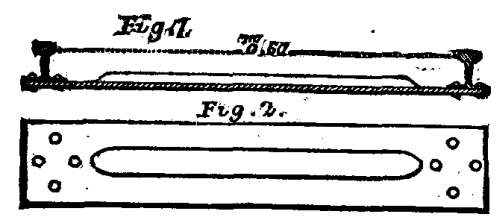
Fig. 1. Fig. 2.
This sleeper presents very great stiffness, at the same time preserving its lightness; and the feature which specially distinguishes this railway from others of the same class is not only its extreme strength, but above all its solidity, which results from its bearing equally upon the ground by means of the rail base and of the sleepers.
In special cases, M. Decauville provides also railroads with projecting sleepers, whether of flat steel beaten out and rounded, or of channel iron; but the sleeper and the rail are always inseparable, so as not to lessen the strength, and also to facilitate the laying of the line. If the ground is too soft, the railway is supported by bowl sleepers of dished steel, Figs. 3 and 4, especially at the curves; but the necessity for using these is but seldom experienced. The sleepers are riveted cold. The rivets are of soft steel, and the pressure with which this riveting is effected is so intense that the sleepers cannot be separated from the rails, even after cutting off both heads of the rivets, unless by heavy blows of the hammer, the rivets being driven so thoroughly into the holes made in the rails and sleepers that they fill them up completely.
The jointing of the rails is excessively simple. The rail to the right hand is furnished with two fish-plates; that to the left with a small steel plate riveted underneath the rail and projecting 1¼ in. beyond it. It is only necessary to lay the lengths end to end with one another, making the rail which is furnished with the small plate lie between the two fish-plates, and the junction can at once be effected by fish-bolts. A single fish-bolt, passing through the holes in the fish-plates, and through an oval hole in the rail end, is sufficient for the purpose.
Continue to:


My Books

