


Gastrostomy
Description
This section is from "Scientific American Supplement". Also available from Amazon: Scientific American Reference Book.
Gastrostomy
Surgery has, as is well known, made great progress in recent years. Apropos of this subject, we shall describe to our readers an operation that was recently performed by one of our most skillful surgeons, Dr. Terrillon, under peculiar circumstances, in which success is quite rare. The subject was a man whose oesophagus was obstructed, and who could no longer swallow any food, or drink the least quantity of liquid, and to whom death was imminent. Dr. Terrillon made an incision in the patient's stomach, and, through a tube, enabled him to take nourishment and regain his strength. We borrow a few details concerning the operation from a note presented by the doctor at one of the last meetings of the Academy of Medicine.
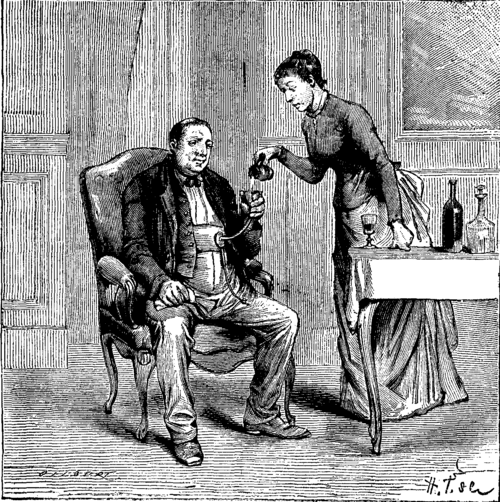
Fig. 1. - FEEDING A PATIENT THROUGH A STOMACHAL TUBE.

Fig. 2. - DETAILS OF THE TUBE. C, rubber tube for leading food to the stomach, E; B B', rubber balls, which, inflated with air by means of the tube, T, and rubber ball, P, effect a hermetic closing; A, stopper for the tube, C; R, cock of the air tube.
Mr. X., fifty-three years of age, is a strong man of arthritic temperament. He has suffered for several years with violent gastralgia and obstinate dyspepsia, for which he has long used morphine. The oesophagal symptoms appear to date back to the month of September, 1887, when he had a painful regurgitation of a certain quantity of meat that he had swallowed somewhat rapidly.
Since that epoch, the passage of solid food has been either painful or difficult, and often followed by regurgitation. The food seemed to stop at the level of the pit of the stomach. So he gave up solid food, and confined himself to liquids or semi-liquids, which readily passed up to December 20, 1887. At this epoch, he remarked that liquids were swallowed with difficulty, especially at certain moments, they remaining behind the sternum and afterward slowly descending or being regurgitated. This state of things was more marked especially in the first part of January. He was successfully sounded several times, but soon the sound was not able to pass. Doctors Affre and Bazenet got him to come to Paris, where he arrived February 5, 1888.
For ten days, the patient had not been able to swallow anything but about a quart of milk or bouillon in small doses. As soon as he had swallowed the liquid, he experienced distress over the pit of the stomach, followed by painful regurgitations. For three days, every attempt made by Dr. Terrillon to remove the obstacle that evidently existed at the level of the cardia entirely failed. Several times after such attempts a little blood was brought out, but there was never any hemorrhage.
The patient suffered, grew lean and impatient, and was unable to introduce into his stomach anything but a few spoonfuls of water from time to time. As he was not cachectic and no apparent ganglion was found, and as his thoracic respiration was perfect, it seemed to be indicated that an incision should be made in his stomach. The patient at once consented.
The operation was performed February 9, at 11 o'clock, with the aid of Dr. Routier, the patient being under the influence of chloroform. A small aperture was made in the wall of the stomach and a red rubber sound was at once introduced in the direction of the cardia and great tuberosity. This gave exit to some yellowish gastric liquid. The tube was fixed in the abdominal wall with a silver wire. The operation took three quarters of an hour. The patient was not unduly weakened, and awoke a short time afterward. He had no nausea, but merely a burning thirst. The operation was followed by no peritoneal reaction or fever. Three hours afterward, bouillon and milk were injected and easily digested.
Passing in silence the technical details, which would not interest the majority of our readers, we shall be content to say that Mr. X., thanks to this alimentation, has regained his strength, and is daily taking his food as shown in Fig. 1. The aperture made in the stomach permits of the introduction of the rubber apparatus shown in Fig. 2, the object of which is to prevent the egress of the liquids of the stomach and at the same time to introduce food. A funnel is fitted to the tube, and the liquid or semi-liquid food is directly poured into the stomach. Digestion proceeds with perfect regularity, and Mr. X., who has presented himself, of his own accord, before the Academy, and whom we have recently seen, has resumed his health and good spirits. - La Nature.
Continue to:


My Books

