


Magnetism In Its Relation To Induced Electromotive Force And Current. Part 2
Description
This section is from "Scientific American Supplement". Also available from Amazon: Scientific American Reference Book.
Magnetism In Its Relation To Induced Electromotive Force And Current. Part 2
While we are in the habit of saying that a conductor moved across a field of lines, or vice versa, generates electric current, I think the statement incomplete. The movement only sets up a potential difference, and the power expended in effecting the movement generates C × E. The current is energy less the potential, or the energy expended gives the two effects of potential or pressure and current or rate of movement. Consequently an insulator, or an open-circuited conductor, traversing a field, consumes no energy, potential difference only being produced. Nevertheless, as will be shown, the magnetic circuits or lines themselves may furnish the energy for their own movement across a conductor, and so develop current as well as potential.
This occurs in the effort of lines to shorten their paths, to lessen their density, to pass to better media. Indeed, a close examination will show that wherever power is expended in developing current in a circuit, cutting lines of force, the energy expended is first employed in stretching the lines, which thus receive the energy required to permit them, in shortening, to cut the conductor and set up currents in the electric circuit in accordance with the potential difference developed in that circuit and its resistance.
I think we may also say, though I do not remember to have seen the statement so put, that whenever electric potential is set up inductively, as in self-induction, mutual induction, induction from one circuit to another, and induction from magnets or magnetic field, it is set up by the movement of lines of force laterally across the body, mass or conductor in which the potential is developed, and that whenever current is set up in a wire or an existing current prolonged, or an existing current checked by induction, self-induction, or induction from magnets, the action is a transfer of energy, represented by strained lines of force shortening or lessening their resistance, or lengthening and increasing the resistance in their paths. The magnetic field is like an elastic spring - it can in one condition represent stored energy - it can be strained and will store energy - it can be made to relieve its strain and impart energy.
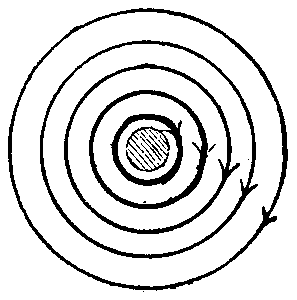 Fig. 1.
Let us examine some known phenomena in this light. Take the case of a simple wire, conveying current, say, in a line away from observer, Fig. 1. There exists a free field of circular magnetism (so called), shading off away from the wire, and which is represented by concentric circles of increased diameter. The superior intensity or strength of the lines near the wire may also be represented by their thickness. This is often shown also by crowding the lines near the wire, though I am disposed to regard Fig. 1 as more nearly expressing the condition, unless we are to regard the lines as simply indicating a sort of atmosphere of magnetic effect whose density becomes less as we proceed outward from the wire, in which case either form of symbol suffices. The direction of polarization of the lines may be indicated by an arrow head pointing in a direction of right-handed rotation in the path of the lines. This is the typical figure or expression for all forms of simple magnetic circuit - the form of the lines, their length, position, density, will depend on the shape of the conductor or conductors (when more than one) and the materials surrounding or in proximity to the wire or wires.
If the current traversing the conductor is constant, the magnetic field around it is stable and static, unless other influences come in to modify it. The cutting off of the current is followed by instability of the field whereby it can and must produce dynamic effects. I say must because the field represents stored energy, and in disappearing must give out that energy. To throw light on this part of the subject is one of the objects of the present paper. Cutting off the current supply in the case assumed leaves the developed magnetic lines or strains unsupported. They at once shorten their paths or circuits, collapsing upon the conductor as it were, and continuing this action, cut the section of the conductor, and apparently disappear in magnetic closed circuits of infinitesimal diameter but of great strength of polarization. It appears to me that we must either be prepared to give up the idea of lines of force or take the position that the magnetic circuits precipitate themselves in shortening their circuits and disappearing upon and cut the conductor. It was Hughes who put forward the idea that an iron bar in losing its apparent magnetism really short-circuits the lines in itself as innumerable strongly magnetized closed circuits among the molecules. In becoming magnetic once more these short circuits are opened or extended into the air by some source of energy applied to strain the lines, such as a current in a conductor around the bar.
May not this idea be extended, then, to include the magnetic medium, the ether itself? Does it contain intensely polarized closed circuits of magnetism which are ready to be stretched or extended under certain conditions by the application of energy, which energy is returned by the collapse of the extended circuits? This is doubtless but a crude expression of the real condition of things, for the lines are only symbols for a condition of strain in a medium which cannot be represented in thought, as we know nothing of its real nature. There is one point in this connection which I must emphasize. The strained lines, Fig. 1, are indications of stored energy in the ether, and the lines cannot disappear without giving out that energy. Ordinarily, it makes its appearance as the extra current, and adds itself so as to prolong the current which extended the lines when an attempt is made to cut off such current. Were it conceivable that the current could be cut off and the wire put on open circuit while the lines still remained open or strained, the energy must still escape when the field disappears. It would then produce such a high potential as to be able to discharge from the ends of the conductor, and if the conductor were of some section, part of the energy would be expended in setting up local currents in it. The field could not disappear without an outlet for the energy it represents. But we cannot cut off a current in a wire so as to leave the wire on open circuit with the lines of the magnetic circuit remaining around it without iron or steel or the like in the magnetic circuit. We can approach that condition, however, by breaking the circuit very quickly with a condenser of limited capacity around the break. This is done in the Ruhmkorff coil primary; the condenser forms a sort of blind alley for the extra current on its beginning to flow out of the primary coil.
Continue to:


My Books

