


Magnetism In Its Relation To Induced Electromotive Force And Current. Part 6
Description
This section is from "Scientific American Supplement". Also available from Amazon: Scientific American Reference Book.
Magnetism In Its Relation To Induced Electromotive Force And Current. Part 6
That the core receives the energy when the coil cannot is shown in the well known fact that in some dynamos with armatures of bobbins on iron cores, the running of the armature coils on open circuit gives rise to dangerous heating of the cores, and that under normal work the heating is less. In the former case the core accumulates the energy represented in the magnetic changes. In the latter the external circuit of the machine and its wire coils take the larger part of the energy which is expended in doing the work in the circuit. In this case, also, the current in the coils causes a retardation of the speed of change and extent of change of magnetism in the iron cores, which keeps down the intensity of the magnetic reaction. In fact, this retardation or lag and reduction of range of magnetic change may in some machines be made so great by closing the circuit of the armature coils themselves or short-circuiting them that the total heat developed in the cores is much less than under normal load.
I wish now, in closing, to refer briefly to phenomena of moving lines of force, and to the effects of speed of movement. In order to generate a given potential in a length of conductor we have choice of certain conditions. We can vary the strength of field and we can vary the velocity. We can use a strong field and slow movement of conductor, or we can use a weak field and rapid movement of the conductor. But we find also that where the conductor has large section it is liable to heat from eddy currents caused by one part of its section being in a stronger field than another at the same time. One part cuts the lines where they are dense and the other where they are not dense, with the result of difference of potential and local currents which waste energy in heat. We cannot make the conductor move in a field of uniform density, because it must pass into and out of the field. The conditions just stated are present in dynamos for heavy current work, where the speed of cutting of lines is low and the armature conductor large in section.
But we find that in a transformer secondary we can use very large section of conductor, even (as in welding machines) 12 to 15 square inches solid copper, without meeting appreciable difficulty from eddy currents in it. The magnetic lines certainly cut the heavy conductor and generate the heavy current and potential needed. What difference, if any, exists? In the transformer the currents are generated by magnetic field of very low density, in which the lines are moving across the conductor with extreme rapidity. The velocity of emanation of lines around the primary coil is probably near that of light, and each line passes across the section secondary conductor in a practically inappreciable time. There is no cause then for differences of potential at different parts of the section heavy secondary. Then to avoid eddy currents in large conductors and generate useful currents in them, we may cause the conductor to be either moved into and out of a low density field with very great speed, or better, we must cause the lines of a very low or diffused field to traverse or cut across the conductor with very high velocity.
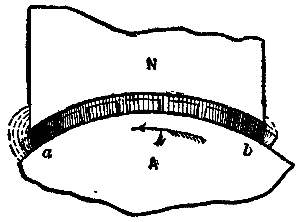 Fig. 8.
It is a known fact that, in dynamos with large section armature conductors, there are less eddy currents produced in the conductors when they are provided with iron cores or wound upon iron cores than when the conductors are made into flat bobbins moved in front of field poles. Projections existing on the armature between which the conductors are placed have a like effect, and enable us to employ heavy bars or bundles of wire without much difficulty from local currents. The reason is simple. In the armatures with coils without iron in them, or without projections extending between the turns, the conductor moves into and out of a very dense field at comparatively low velocity, so that any differences of potential developed in the parts of the section of conductor have full effect and abundant time to act in setting up harmful local currents. In the cases in which iron projects through the coil or conductor, the real action is that the lines of the magnetic circuits move at high speeds across the conductor, and the conductor is at all times in a field of very low density. Figs. 8 and 9 will make this plain.
In Fig. 8 we have shown a smooth armature surface, having a heavy conductor laid thereon, and which is at a just entering a dense field at the edge of the pole, N, and at b leaving such field. It will be seen that when in such position the conductor, if wide, is subjected to varying field strength, and moves at a low speed for the generation of the working potential as it passes through the field, thus giving rise to eddy currents in the conductor.
 Fig. 9.
In Fig. 9 the conductors are set down between projections, in which case both armature and field poles are laminated or subdivided. As each projection leaves the edge of field pole, N, the lines which it had concentrated on and through it snap backward at an enormous speed, and cross the gap to the next succeeding projection on the armature, cutting the whole section of the heavy armature conductor at practically the same instant. This brisk transfer of lines goes on from each projection to the succeeding one in front of the field pole, leaving a very low density of field at any time between the projections. The best results would be obtained when the armature conductor does not project beyond or quite fill the depth of groove between the projections. Of course there are other remedies for the eddy current difficulty, notably the stranding and twisting of the conductor on the armatures so as to average the position of the parts of the compound conductor.
 Fig. 10.
Perhaps the most extreme case of what may be called dilution of field by projections and by closed magnetic circuits in transformers would be that of a block of iron, B, Fig. 10, moved between poles, N and S, and having a hole through it, into and through which a conductor is carried. The path through the iron is so good that we can scarcely consider that any lines cross the hole from N to S; yet as B moves forward there is a continual snapping transfer of lines from the right forward side of the hole to the left or backward side, cutting the conductor as they fly across, and developing an electromotive force in it. I have described this action more in detail because we have in it whatever distinction in the manner of cutting the lines of the field is to be found between wire on smooth armatures and on projection armatures and modifications thereof; and also between flat, open coils passing through a field and bobbins with cores of iron. The considerations advanced also bring out the relation which exists between closed iron circuit transformers and closed iron circuit (projection) dynamos, as we may call them.
I had intended at the outset of this paper to deal to some extent with the propagation of lines of magnetism undergoing retardation in reference to alternating current motor devices, transformers with limited secondary current, or constant average current, an alternating motor working with what I may term a translation lag, etc.; but it was soon found that these matters must remain over for a continuation of this paper at some future time. My endeavor has been in the present paper to deal with the lines of force theory as though it were a symbol of the reality, but I confess that it is done with many misgivings that I may have carried it too far. Yet, if we are to use the idea at all it has seemed but right to apply it wherever it may throw any light on the subject or assist in our understanding of phenomena.
[1]
A paper read before the American Institute of Electrical Engineers, New York, May 22, 1889.
Continue to:


My Books

