


Phosphorescence In High Vacua
Description
This section is from "Scientific American Supplement". Also available from Amazon: Scientific American Reference Book.
Phosphorescence In High Vacua
I have already pointed out that the molecular motions rendered visible in a vacuum tube are not the motions of molecules under ordinary conditions, but are compounded of these ordinary or kinetic motions and the extra motion due to the electrical impetus.
Experiments show that in such tubes a few molecules may traverse more than a hundred times the mean free path, with a correspondingly increased velocity, until they are arrested by collisions. Indeed, the molecular free path may vary in one and the same tube, and at one and the same degree of exhaustion.
Very many bodies, such as ruby, diamond, emerald, alumina, yttria, samaria, and a large class of earthy oxides and sulphides, phosphoresce in vacuum tubes when placed in the path of the stream of electrified molecules proceeding from the negative pole. The composition of the gaseous residue present does not affect phosphorescence; thus, the earth yttria phosphoresces well in the residual vacua of atmospherical air, of oxygen, nitrogen, carbonic anhydride, hydrogen, iodine, sulphur and mercury.
With yttria in a vacuum tube, the point of maximum phosphorescence, as I have already pointed out, lies on the margin of the dark space. The diagram (Fig. 24) shows approximately the degree of phosphorescence in different parts of a tube at an internal pressure of 0.25 millimeter, or 330 M. On the top you see the positive and negative poles, A and B, the latter having the outline of the dark space shown by a dotted line, C. The curve, D E F, shows the relative intensities of the phosphorescence at different distances from the negative pole, and the position inside the dark space at which phosphorescence does not occur. The height of the curve represents the degree of phosphorescence. The most decisive effects of phosphorescence are reached by making the tube so large that the walls are outside the dark space, while the material submitted to experiment is placed just at the edge of the dark space.
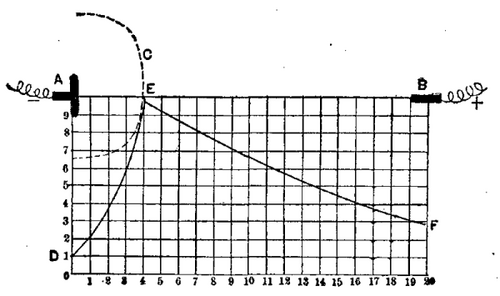
FIG. 24 - PRESSURE = 0.25 MM. = 330 M.
Hitherto I have spoken only of the phosphorescence of substances placed under the negative pole. But from numerous experiments I find that bodies will phosphoresce in actual contact with the negative pole.
This is only a temporary phenomenon, and ceases entirely when the exhaustion is pushed to a very high point. The experiment is one scarcely possible to exhibit to an audience, so I must content myself with describing it. A U-tube, shown in Fig. 25, has a flat aluminum pole, in the form of a disk, at each end, both coated with a paint of phosphorescent yttria. As the rarefaction approaches about 0.5 millimeter the surface of the negative pole, A, becomes faintly phosphorescent. On continuing the exhaustion this luminosity rapidly diminishes, not only in intensity but in extent, contracting more and more from the edge of the disk, until ultimately it is visible only as a bright spot in the center. This fact does not prop a recent theory, that as the exhaustion gets higher the discharge leaves the center of the pole and takes place only between the edge and the walls of the tube.
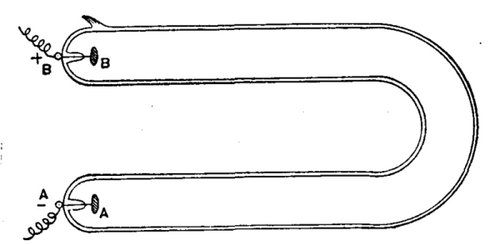
FIG. 25
If the exhaustion is further pushed, then, at the point where the surface of the negative pole ceases to be luminous, the material on the positive pole, B, commences to phosphoresce, increasing in intensity until the tube refuses to conduct, its greatest brilliancy being just short of this degree of exhaustion. The probable explanation is that the vagrant molecules I introduce in the next experiment, happening to come within the sphere of influence of the positive pole, rush violently to it, and excite phosphorescence in the yttria, while losing their negative charge.
[1]Presidential address before the Institute of Electrical Engineers, London; continued from SUPPLEMENT, No. 792, page 12656.
[2]"The thickness of the dark space surrounding the negative pole is the measure of the mean length of the path of the gaseous molecules between successive collisions. The electrified molecules are projected from the negative pole with enormous velocity, varying, however, with the degree of exhaustion and intensity of the induction current." - Phil. Trans., part i., 1879, par. 530.
"The extra velocity with which the molecules rebound from the excited negative pole keeps back the more slowly moving molecules which are advancing toward the pole. The conflict occurs at the boundary of the dark space, where the luminous margin bears witness to the energy of the discharge." - Phil. Trans., part i., 1879, par. 507.
"Here, then, we see the induction spark actually illuminating the lines of molecular pressure caused by the excitement of the negative pole." - R.I. Lecture, Friday, April 4, 1879.
"The electrically excited negative pole supplies the force majeure, which entirely, or partially, changes into a rectilinear action the irregular vibration in all directions." - Proc. Roy. Soc., 1880. page 472.
"It is also probable that the absolute velocity of the molecules is increased so as to make the mean velocity with which they leave the negative pole greater than that of ordinary gaseous molecules." - Phil. Trans., part ii., 1881, par. 719.]
[3]"It has been suggested that the extent of the dark space represents the mean free path of the molecules.... It has been pointed out by others that the extent of the dark space is really considerably greater than the mean free path of the molecules, calculated according to the ordinary way. My measurements make it nearly twenty times as great. This, however, is not in itself a fatal objection; for, as we have seen, the mean free path of an ion may be different from that of a molecule moving among others." - Schuster, Proc. Roy. Soc., xlvii., pp. 556-7.
[4]"Physical Memoirs," part ii., vol. i., p. 244. The paragraph is italicized in the original.
[5]Loc. cit., p. 242.[6]In a valuable paper read before the Royal Society, November 20, 1890, by Professors Liveing and Dewar, on finely divided metallic dust thrown off the surface of various electrodes, in vacuum tubes, they find not only that dust, however fine, suspended in a gas will not act like gaseous matter in becoming luminous with its characteristic spectrum in an electric discharge, but that it is driven with extraordinary rapidity out of the course of the discharge.
[Continued from SUPPLEMENT, No. 794, page 12690.]
Continue to:


My Books

