


The Conic Sections
Description
This section is from "Scientific American Supplement". Also available from Amazon: Scientific American Reference Book.
The Conic Sections
By Prof. C.W. MACCORD, Sc.D.
In Fig. 1 let D be a given point, and O the center of a given circle, whose diameter is FG. Bisect DF at A. Also about D describe an arc with any radius DP greater than DA, and about O another arc with a radius OP = DP + FO, intersecting the first arc at P, then draw PD, and also PO, cutting the circumference of the given circle in L. Since PD = PL, and DA = AF, it is evident that by repeating this process we shall construct a curve PAR, which satisfies the condition that every point in it is equally distant from a given point and from the circumference of a given circle. Since PO-PD = LO, and AO-AD = FO, this curve is one branch of the hyperbola of which D and O are the foci.
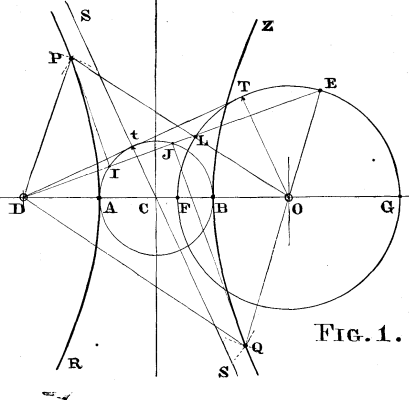
Bisect DG at B, then about D describe an arc with any radius DQ greater than DB, and about O another are with radius OQ = DQ-FO; draw from Q the intersections of these arcs, the line QD, and also QO, producing the latter to cut the circumference in E. By this process we may construct the curve QBZ, each point of which is also equally distant from the given point D, and from the concave instead of the convex arc of the given circumference. The difference between QD and QO being constant and equal to FO, and AB being also equal to FO, this curve is the other branch of the same hyperbola, whose major axis is equal to the radius of the given circle.
The tangent at P bisects the angle DPL, and is perpendicular to DL, which it bisects at a point I on the circumference of the circle whose diameter is AB, the major axis, the center being C, the middle point of DO. As P recedes from A, it is evident that the angles P D L, P L D, will increase, until DL assumes the position D T tangent to the given circle, when they will become right angles. P will therefore be infinitely remote, and the point I having then reached t, where D T touches the smaller circle, C t S will be an asymptote to the curve. This shows that the measurements from the convex arc, for the construction of A P, are made only from the portion FT of the given circumference.
In the diagram the point Q is so chosen that DL produced passes through E, so that QJ, the tangent at Q, is parallel to PI. It will thus be seen that the measurements from the concave arc, for the construction of BQ, are confined to the portion G T of the given circumference. As DLE rises, the points P and Q recede from A and B, the points L and E approach each other, finally coinciding at T; at this instant I and J fall together at t, so that S S is the common asymptote to A P and B Q.
 In Fig. 2 the given point D lies within the circumference of the given circle. Bisect DF at A, and DG at B; about D describe an arc with any radius DP greater than DA, and about O another, with radius OP = OF - DP, these arcs intersect in P, and producing OP to cut the circumference in L, we have PD = PL. Similarly ED = EH, UD = UW, etc. And since PD + PO = LP + PO, DE + EO = HE + EO, and so on, the curve is obviously the ellipse of which the foci are D and O, and the major axis is AB = FO, the radius of the given circle.
If, as in Fig. 3, the given point be made to coincide with the center of the circle, the ellipse becomes a circle with diameter A B = F O. But if the point be placed upon the circumference, as in Fig. 4, the ellipse will reduce to the right line A B coinciding with FO.

In this case we may also apply the same process as in Fig. 1; D T becomes a tangent at D to the circumference, and the asymptotes coincide with the axis of the hyperbola, of which one branch reduces to the right line A P extending from A to infinity on the left, and the other reduces to the right line B G Q, extending from B to infinity on the right.
If the circle be reduced to a point, as in Fig. 5, the resulting locus is a right line perpendicular to and bisecting D O. If on the other hand the diameter of the given circle be infinite, the circumference, as in Fig. 6, becomes a right line perpendicular to the axis at F, and the curve satisfies the familiar definition of the parabola, D E being equal to E H, D P equal to P L, and so on.
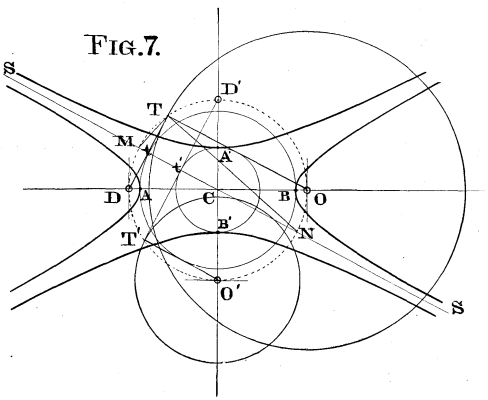 In Fig. 7, as in Fig. 1, DT is tangent at T to the given circle whose center is O, and at t to the circle about C whose diameter is AB, the major axis. Since DTO is a right angle, T lies upon the circumference of the circle whose center is C, and diameter DO; this circle cuts the asymptote SCS at M and N. The semi-conjugate axis is a mean proportional between D A and AO; now drawing TM and TN, it is seen that Tt is that mean proportional; and a circle described about C with that radius will be tangent to TO. DT, then, is the radius of the circle to be described about the focus of the conjugate hyperbola for its construction according to the enunciation first given: and we observe that DT and TO are supplementary chords in the circle about C through D and O. The conjugate foci must therefore lie upon this circumference, at D' and O'; and since D'O' is perpendicular to DO, D'T will be perpendicular and T'O' will be parallel to SCS.
Now as TO increases, T'O' will diminish, until, when TO equals DO, T'O' will vanish and with it Ct'; and at this crisis, the case is the same as in Fig. 4; but the conjugate hyperbola logically reduces to two right lines, extending from C to infinity on the right and left. As indeed it should from the familiar construction, since the distances from D' and O' to any point on the horizontal axis being equal, their difference is constant and equal to zero.
It appears, then, that a conic section may be defined as the locus of a point which is equally distant from a given point and from the circumference of a given circle. Boscovich defines it as the locus of a point so moving that its distances from a given point and from a given right line shall have a constant ratio.
The latter definition involves the conceptions of a rectilinear directrix, and a varying ratio in the cases of the different curves, this ratio being unity for the parabola, less for the ellipse, and greater for the hyperbola. The former involves the conception of a circular directrix with a ratio equal to unity in all cases; and the two definitions become identical in the construction of the parabola, which is in fact the only curve of which a clear idea is given by either of them. That of Boscovich has been given a prominence far in excess of its merits, being made the foundation for the discussion of these important curves, and this in a textbook whose preface contains the following true and emphatic statement, viz.:
"The abstract nature of a ratio, and the fact that it is a compound concept, peculiarly unfit it for elementary purposes."
The definition herein set forth has not been given in any treatise on the subject, so far as we have been able to ascertain. And it is presented with the distinctly expressed hope that it never will be, except as a mere matter of abstract interest.
Of this it may, like the other, possess a little, but both have the great disadvantage that, except in relation to the parabola, the idea which they convey to the mind of the curves to which they relate, if indeed they convey any at all, is most obscure and indirect; and of practical utility neither one can claim a particle.
Continue to:


My Books

