


Gum Arabic And Its Modern Substitutes. Part 2
Description
This section is from "Scientific American Supplement". Also available from Amazon: Scientific American Reference Book.
Gum Arabic And Its Modern Substitutes. Part 2

Curves showing viscosity change with temperature for three typical gums. A--Arabic VII. B--Senegal VIII. C--Ghatti 15.
EFFECT OF TEMPERATURE UPON VISCOSITY--GUM VII.
| Temperature. ºC. | η | Z found. | Z calculated. |
| 50 | 0.0283 | 228 | 228.00 |
| 45 | 0.0305 | 246 | 246.55 |
| 42 | 0.0352 | 284 | 266.75 |
| 38 | 0.0368 | 297 | 289.00 |
| 34 | 0.0410 | 330 | 313.06 |
| 30 | 0.0419 | 339 | 339.00 |
| 26 | 0.0445 | 359 | 367.80 |
| 22 | 0.0492 | 398 | 396.47 |
| 20 | 0.0511 | 412 | 412.00 |
| 18 | 0.0531 | 428 | 428.00 |
Effect Of Temperature Upon Viscosity
GUM VIII.
| Temperature. ºC. | η | Z found. | Z calculated. |
| 50 | 0.0430 | 347 | 347 |
| 46 | 0.0475 | 383 | 371.14 |
| 42 | 0.0502 | 405 | 397.09 |
| 38 | 0.0510 | 411 | 424.73 |
| 34 | 0.0575 | 463 | 454.06 |
| 30 | 0.0602 | 485 | 485 |
| 26 | 0.0637 | 513 | 517.82 |
| 22 | 0.0667 | 538 | 552.25 |
| 20 | 0.0707 | 570 | 570 |
| 18 | 0.0755 | 609 | 583.07 |
The constants for the first gum are those given in the preceding column, while for the latter they were--
A = 771.9: B = -11.15: C = 0.053
As will be observed, the effect of heat appears to be the same upon the two typical gum arabics quoted above, an increase of temperature from 18° C. to 50° C. decreasing the viscosity by nearly one half in both cases, and the same seems to be true of most gum arabics. Roughly also the same holds good for Ghattis, as the following numbers show:
| Gum. | Z at 18° C. | Z at 50° C. |
| Gum arabic. | 1016 | 579 |
| Gum arabic. | 428 | 228 |
| Gum arabic. | 609 | 347 |
| Gum arabic. | 581 | 258 |
| Ghatti. | 572 | 306 |
| Ghatti. | 782 | 418 |
The following table shows the effect of heat upon the viscosity of a typical Ghatti:
GHATTI GUM NO. 15.--VISCOSITY.
| Temperature. °C. | η | Z. |
| 50 | 0.0517 | 418 |
| 46 | 0.0581 | 468 |
| 42 | 0.0628 | 506 |
| 38 | 0.0726 | 585 |
| 34 | 0.0788 | 635 |
| 30 | 0.0857 | 691 |
| 26 | 0.0889 | 717 |
| 22 | 0.0919 | 741 |
| 20 | 0.0946 | 763 |
| 18 | 0.0964 | 777 |
There is therefore no essential difference in the behavior of a Ghatti and a gum arabic on heating. Some interesting results, however, were obtained by heating gums, both Ghattis and arabics, at a fixed temperature for the same time, cooling, and then after making the solutions up to the original volume taking their viscosities at the ordinary temperature. The effect of heating for two hours to 60° C., 80° C., or 100° C. was a small permanent alteration in viscosity of the solution, and it would therefore seem desirable that gum solutions should be made up cold to get the maximum results. The following numbers illustrate this change, viz.:
| After heating to | ||||
| Gum Arabic 10 Per Cent. | Without heat. | 60°C. | 80°C. | 100°C. |
| Z at 18°C | 570 | 468 | 470 | 517 |
| Z at 30°C | 485 | 400 | 422 | 439 |
| Z at 50°C | 347 | 287 | 258 | 301 |
| Ghatti gum No. 15, 5 per cent. Z at 18°C. | 1,104 | 780 | 660 | 758 |
The variation of viscosity with strength of solution was also studied with one or two typical gums. A 10 per cent. is invariably more than twice as viscous as a 5 per cent. solution. The following curve was obtained from one of the Ghattis. Similar results were shown by other gums.
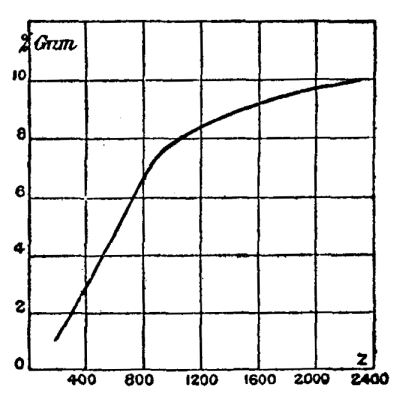
Variation of Viscosity, with Dilution. Ghatti No. 888.
It would seem, therefore, that strong solutions, say of 50 per cent. strength, would be more alike in viscosity than solutions of 5 per cent. strength of the same gums. In other words, the viscosity of a gum solution should be taken as nearly as possible to the strength it is used at, to obtain an exact quantitative idea of its gumming value.
The observation of this fact was one of the circumstances which decided us to use 5 per cent. solutions for the determination of Ghatti gum viscosities, the ratio between the 5 per cent. and 10 per cent. solutions of gum arabics being roughly the same as that between the respective weights required for gumming solutions of equal value.
From observation of the general nature of the solutions of Ghatti gums, and from the fact that when allowed to stand portions of the apparently insoluble matter passed into solution, the hypothesis suggested itself that metarabin was soluble in arabin, although insoluble in cold water. If this hypothesis were correct, it would explain the apparent anomaly of Ghattis giving solutions of higher viscosity than gum arabics, although they leave insoluble matter behind. The increase in viscosity would be due to the thickening of the arabic acid by the metarabin. Moreover, the solutions yielded by various Ghattis leaving insoluble matter behind would be all of the same kind, viz., a saturated solution of metarabin in arabin more or less diluted by water. Still further, if the insoluble residue of a Ghatti be the residual metarabin over and above that required to saturate the arabin, then it will be possible to dissolve this by the addition of more arabin in the form of ordinary gum arabic. In order to see if this were the case the following experiments were performed. Equal parts of a Ghatti and of a gum arabic were ground up together and dissolved in water. The resulting solution was clear. It was diluted until of 10 per cent. strength, and its viscosity then taken:
| Contains 50 per Cent. Ghatti. | ||
| A. Pressure 200 mm | η | Z |
| Temperature 15° C | 0.2517 | 2,030 |
The viscosity of this solution therefore was considerably greater than the mean viscosity of the 10 per cent. solutions of the Ghatti and the gum arabic, viz., (0.288 + 0.0636)/2 = 0.1758 for the calculated η. Hence it is evident that the increase in viscosity is due to the solution of the metarabin.
Next a solution was made from a mixture of 70 per cent. Ghatti and 30 per cent. gum arabic. This was also clear and gave a considerably higher viscosity than the previous solution.
| Contains 70 per Cent. Ghatti. | ||
| B. Pressure 200 mm | η | Z. |
| Temperature 15° C | 0.3177 | 2,562 |
It will be obvious that the increase of viscosity over the previous solution in this case must be due to the smaller amount of the thin gum arabic which is present, i.e., in the first case there is more gum arabic than is required to dissolve the whole of the insoluble metarabin. Further experiments showed that this is also true of the second mixture, as the viscosities of the following mixtures illustrate:
| Strength of Solution. | η | Z. |
| C. 80 per cent. Ghatti. | 0.3642 | 2,937 |
| D. 75 per cent. Ghatti. | 0.33095 | 2,669 |
| E. 77.5 per cent. Ghatti. | 0.4860 | 3,819 |
This last solution E we called for convenience the "maximum viscosity" solution, as we believe it to be a 10 per cent. solution containing arabin very nearly saturated with metarabin. As will be observed, its viscosity differs widely from those of solutions C and D, between which it lies in percentage of Ghatti. The first named solution C contains too little of gum arabic to dissolve the whole of the metarabin. Consequently there is a residue left undissolved, which of course diminishes its viscosity. The second solution D is too low in viscosity, as it still contains too much of the weak gum arabic, and as will be seen further on, a very slight change in the proportions increases or decreases the viscosity enormously.
We next tried a series of similar experiments with a Ghatti containing far less insoluble residue and which consequently would require less gum arabic to produce a perfect solution. Mixtures were made in the following proportions, viz.:
| ---- | 13.3 per Cent. Ghatti. | |
| F. Pressure 200 mm | η | Z. |
| Temperature 15° C | 0.0976 | 787 |
| ---- | 86.6 per Cent. Ghatti. | |
| G. Pressure 200 mm | η | Z. |
| Temperature 15° C | 0.4336 | 3,497 |
This latter solution is approaching fairly closely to our "maximum viscosity" with the previous Ghatti, and probably a very slight decrease in the amount of gum arabic would bring about the required increase in viscosity.
When these experiments were first commenced we were still under the impression, which several months' experience of working with gums had produced, namely, that the Ghattis were quite distinct in their properties to ordinary gum arabics. But the new hypothesis, and the experiments undertaken to confirm it, showed clearly that if the viscosity of a gum solution depends on the ratio of metarabin to arabin, then there is no absolute line of demarkation between a Ghatti and a gum arabic. In other words, there is a constant gradation between gum arabic and Ghattis, down to such gums as cherry gum, consisting wholly of metarabin and quite insoluble in water. Therefore those gum arabics which are low in viscosity consist of nearly pure arabin, while as the viscosity increases so does the amount of metarabin, until we come to Ghattis which contain more metarabin than their arabin can hold in solution, when their viscosity goes down again.
From these observations it would follow, that by taking a gum of less viscosity than the gum arabic previously used to dissolve the Ghatti, less of it would be required to do the same work. We confirmed this suggestion experimentally by taking another gum arabic of viscosity 0.0557 at 15° C. A mixture containing 93.3 per cent. of this Ghatti and 6.7 per cent. of our thinnest gum arabic gave a clear solution which had the highest viscocity we have yet obtained for a 10 per cent. solution.
| H. Pressure 200 mm. Temperature 15° C. | η 0.5525 | Z. 4,456 |
This gum arabic may be regarded as nearly pure arabin (as calcium and potassium, etc., salt). By diluting the new "maximum viscosity" solution, therefore, with the 10 per cent. solution of the gum arabic in fixed proportions we obtain a series of viscosities which are shown in the following curve.
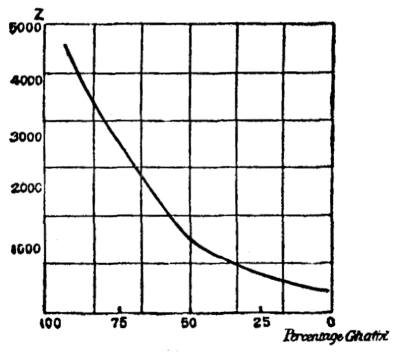
Curve Showing Influence of Ghatti upon Viscosity.
Continue to:


My Books

