


Historical Development Of The Horseshoe. Part 2
Description
This section is from "Scientific American Supplement". Also available from Amazon: Scientific American Reference Book.
Historical Development Of The Horseshoe. Part 2
How then did out of this Roman cure shoe develop the horseshoeing of southern Europe?
It was to be expected, with the Roman horseshoe, that the mode of fastening became unsatisfactory and necessitated a remedy or change. An attempt of this kind has been preserved in the so-called "Asiatischen Koppeneisensole" (Asiatic cap-iron-sole) (Fig. 3), which the Hon. Mr. Lydtin at Karlsruhe had made according to a model of the Circassian Horse Tribe Shaloks, and also according to the reverse of Lycian coins (called Triguetra).
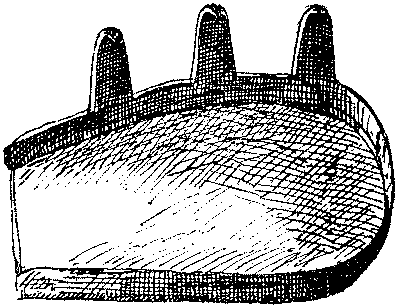
FIG. 3.
This horseshoe plate, likely originating in the twelfth century, covers the whole surface of the sole, like the Roman shoes, with the exception of the wall region, which contains a rim 1 centimeter high, and above this rises at one side toward the heel three beak-like projections, about 4 centimeters high and 1 centimeter wide at the base, being pointed above and turned down, which were fastened in the wall of the hoof, in the form of a hook.
This mode of fastening evidently was also insufficient, and so the fastening of the shoe by nails was adopted. These iron plates used for shoes were too thin to allow nails with sunken heads to be used, so only nails with blades and cubical shaped heads were applicable. These nail heads, 6 to 8 in number, which left the toe and the back part of the heel free, served at the same time to secure the horse from slipping, which the smooth plates, covering the whole hoof surface, without doubt facilitated.

FIG. 4.
Shoes of this kind, after the old Roman style, with a very strong rim bent upward, likely proved very comfortable for the purpose of protection, in the Sierras of the Pyrenean peninsula, where they seem to have been in use for a long time; for in the twelfth century we find in Spain the whole form of the Roman shoe, only fastened by nails (Figs. 4 and 5). At first the shoe seems to have been cut off at the heel end, but as apparently after being on for some time, bruises were noticed, the shoe was made longer at the heel, and this part was turned up so as to prevent them from becoming loose too soon, as both the Spanish horseshoes of this period show, and the acquisition was even later transferred to England (Fig. 7).

FIG. 5.
The shoe containing a groove (Fig. 6), which we shall see later, made its appearance in Germany in the fifteenth century. From this time, according to our present knowledge, ceases the period of the Roman horseshoe. Its influence, however, lasted a great deal longer, and has even remained until our present day.

FIG. 6.
Its successor became partly the Arabo-Turkomanic and partly the Southwest European horseshoe.
For the descendants of the Numidian light cavalry, the Roman and old Spanish horseshoe was evidently too heavy for their sandy, roadless deserts, so they made it thinner and omitted the bent-up rim, because it prevented the quick movement of the horse. For the protection of the nail heads the outer margin of the shoe was staved, so as to form a small rim on the outer surface of the shoe, thus preventing the nail heads from being worn and the shoe lost too soon.

FIG. 7.

FIG. 8.

FIG. 9.
A horseshoe of that kind is shown by Fig. 8, which was used in North Africa in the twelfth century, and became the model for all forms of horseshoes of the Mahometan tribes. Even now quite similar shoes (Fig. 9) are made south and east from the Caspian Sea, at the Amu-Darja, in Samarkand, etc., which were probably introduced under Tamerlane, the conqueror of nearly the whole of Asia Minor in the fourteenth century.
The so-called "Sarmatische" (Sarmatian) horseshoe (Figs. 10 and 11), of South Russia, shows in its form, at the same time, traces of the last named shoe, however, greatly influenced by the Mongolian shoe, the "Goldenen Horde," which at the turn of the sixteenth to the seventeenth century played havoc at the Volga and the Aral. The unusual width of the toe, and especially the lightness of the iron, reminds us of the Turkomanic horseshoe, whereas, on the contrary, the large bean-shaped holes, as well as the calks, were furnished through Mongolian influence.
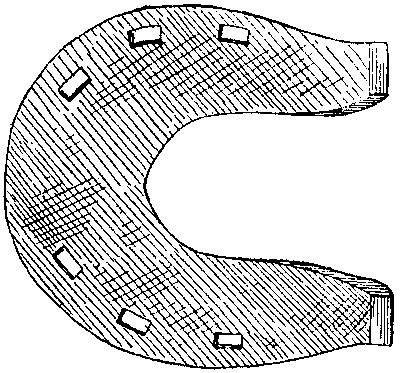
FIG. 10.
The Sarmatian tribes were principally horsemen, and it is not surprising, therefore, that the coat of arms of the former kingdom of Poland in the second and third quadrate shows a silver rider in armor on a silver running horse shod with golden shoes, and that at present about 1,000 families in 25 lineages of the Polish Counts Jastrzembiec Bolesezy, the so-called "Polnische Hufeisen Adel" (Polish Horseshoe Nobility), at the same time also carried the horseshoe on their coats of arms. The silver horseshoe in a blue field appears here as a symbol of the "Herbestpfardes" (autumnal horse), to which, after the christianization of Poland, was added the golden cross. The noblemen participating in the murder of the holy Stanislaus in 1084 had to carry the horseshoe reversed on their escutcheon.
Continue to:


My Books

