


Historical Development Of The Horseshoe. Part 3
Description
This section is from "Scientific American Supplement". Also available from Amazon: Scientific American Reference Book.
Historical Development Of The Horseshoe. Part 3
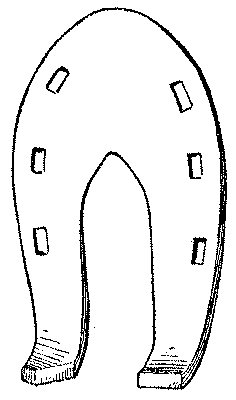
FIG. 11.
From the African and Turkomanic horseshoe, through the turning up of the toes and heels, originated later the Turkish, Grecian and Montenegrin horseshoe of the present as shown by Fig. 12.

FIG. 12.
By the Moorish invasion in Spain, the Spanish-Gothic horseshoeing was also modified, through which the shoe became smooth, staved at the margin, very broad in the toe, and turned up at toe and heel, and at a later period the old open Spanish national horseshoe (Fig. 13) was developed. As we thus see, we can in no way deny the Arabian-Turkish origin of this shoe.
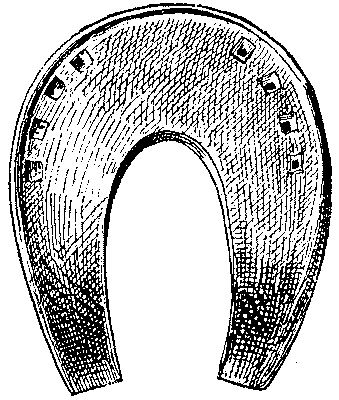
FIG. 13.
As France had received her whole culture from the south, and as the crusades especially brought the Roman nation in close contact with them for centuries, so it cannot appear strange that the old French horseshoe, a form of which has been preserved by Bourgelat and is represented by Fig. 14, still remained in the smooth, turned up in front and behind, like the shoe of the southern climates, with Asiatic traces, which hold on the ground, the same as all southern shoeing, by the nail heads.

FIG. 14.
The transit of the German empire, in order to keep up the historical course, once more brings us back to the middle of the fifth century. At this time Attila, the "Godegisel" (gods' scourge), left his wooden capitol in the lowlands near the river Theis, to go to the Roman empire and to the German and Gallican provinces, there to spread indescribable misery to the horrors of judgment day.
The following is a prayer in those days of horror:
"Kleiner Huf, kleines Ross,
Krummer Sabel, spitz Geschoss -
Blitzesschnell und sattlefest:
Schrim uns Herr von Hunnenpest."
We are at present reminded of those times of fright, when during the clearing and tilling of the soil, a small roughly made horseshoe is found in Southern Germany, about as far as the water boundary of the Thuringian forest, and occasionally on, but principally around Augsburg, and in France as far as the Loire.
These shoes, covering the margin or wall of the foot, show slight traces of having been beveled on the lower surface, and contain two bent calks very superficially placed. Occasionally they are sharpened and turned in two directions. The characteristic wide bean-shaped nail holes are conical on the inside, and are frequently placed so near the outer margin of the shoe that from the pressure the hoofs were likely to split open. The nail heads were shaped like a sleigh runner, and almost entirely sunk into the shoe. It evidently was not bent up at the toe, like the old form of these kinds of shoes.
These shoes, according to our conception of to-day, were so carelessly finished that in the scientific circles of historical researches they were, until very recently, looked upon as saddle mountings or something similar, and not as horseshoes.
This shoe was for some time, while it was plentifully found in France, regarded as of Celtic make; but this is certainly not the case, as it is of Hunish and Hungarian "nationalitat" (nationality). An exactly scientific proof, it is true, according to our present knowledge, cannot be furnished; however, it will stand well enough until the error is proved.
This peculiar kind of horseshoe has been found in South Germany and Northeast France, as far as the region of Orleans, where, as it has been proved, the Huns appeared. This, therefore, speaks for their descendants: 1st, the far extended and yet sharply limited places of finding the shoe; 2d, the small size corresponds to the historically proved smallness of the Hunish horse; 3d, the hasty and careless make, which does not indicate that it was made by settled workmen; 4th, the horseshoe (Fig. 15) bespeaks the Hunish workmanship of the present Chinese shoe, which, in making of the nail holes, shows to-day related touches of the productions of the Mongolian ancestors.
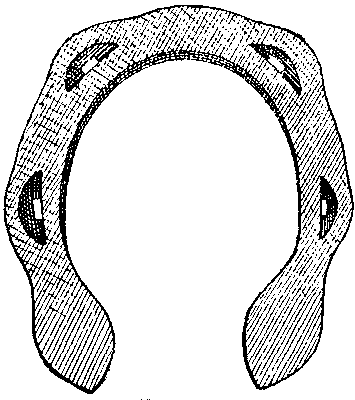
FIG. 15.
Aside from the peculiar shaped nail holes, the characteristic of the Hunish shoe consists in the changes of the calks for summer and winter shoeing, as well as in the sinking of the nail heads. The Huns, therefore, aside from the indistinctly marked attempts of the Romans in this direction, which are the only ones known to me, must be regarded as the inventors not only of the calks, but partly, next to the Normans, also of the sharpened winter shoeing, and of the not unimportant invention of sinking the nail heads observed in Fig. 15.
The Hunish shoeing was therefore an important invention for the Germans. After centuries later, wherever horseshoeing was practiced, it was done solely according to Hunish methods; whereby the shoe was very possibly made heavier, was more carefully finished and in course of time showed an attempt to bend the toe (Fig. 16a).

FIG. 16.
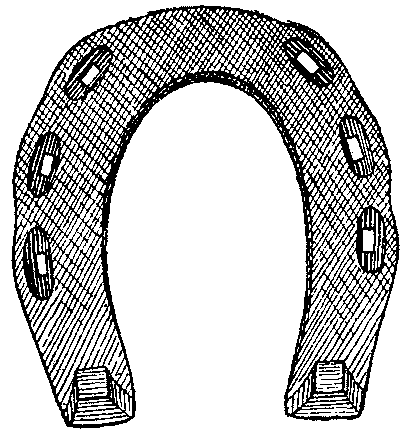
FIG. 16A.
In the Bomberg Dom we find an equestrian statue, not unknown in the history of art, which was formerly held to be that of Emperor Conrad III. At present however the opinion prevails generally that it represents "Stephen I., den Heiligen" (Stephen I., the Saint).
Continue to:


My Books

