


Prehistoric Horse In America
Description
This section is from "Scientific American Supplement". Also available from Amazon: Scientific American Reference Book.
Prehistoric Horse In America
To the Editor of the Scientific American:
Apropos to Professor Cope's remarks before the A.A.A.S. at Washington, reported in SCIENTIFIC AMERICAN, September 12, inclose sketch of a mounted man, whether on a horse or some other mammal, is a question open to criticism.
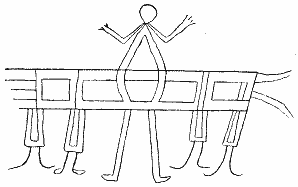
Height, 43 in.; length, 63 in. San Rafiel del Sur, 1878 Drawn for and forwarded to Peabody Museum - No. 53.
The figure seems incomplete - whether a cloven foot or toes were intended, cannot say.
A large fossil horse was exhumed in the marsh north of Granada, when ditching in 1863. Then Lake Managua's outlet at Fipitapa ceased its usual supply of water to Lake Nicaragua. When notified of the discovery the spot was under water. Only one of the very large teeth was given to me, which was forwarded to Prof. Baird, of Smithsonian - Private No. 34.
When Lake Nicaragua was an ocean inlet, its track extended to foot hills northward. Its waterworn pebbles and small bowlders were subsequently covered by lake deposit, during the time between the inclosure and break out at San Carlos. In this deposit around the lake (now dry) fossil bones occur - elephas, megatherium, horse, etc. The large alluvium plains north of lake, cut through by rivers, allow these bones to settle on their rocky beds. This deposit is of greater depth in places west of lake.
Now, if we suppose these animals were exterminated in glacial times, it remains for us to show when this was consummated.
Subsequent to the lake deposit and exposure no new proofs of its continuance are found.
1. This deposit occurred after the coast range was elevated.
2. Elevation was caused by a volcanic ash eruption, 5 or 6 of a series. (Geologically demonstrated in my letters to Antiquarian and Science.)
3. Coast hills inclosed sea sediment, now rock containing fossil leaves.
4. Wash from this sediment, carried with care, formed layers of sandstone, up to ceiling.
5. This ceiling was covered with elaborate inscriptions.
6. The inscription sent you was a near neighbor to cave.
7. Another representing a saurian reptile on large granite bowlder is also a neighbor (a glacial dropping).
8. Old river emptying into Lake Managua reveals fossil bones; moraines east of it are found.
From these data we see the glacial action was prior to the sedimentary rock here, and had spent its force when elevation of coast range occurred. No nearer estimate is possible.
As the fossil horse occurs here, our mounted man may have domesticated him, and afterward slaughtered for food like the modern Frenchman. Unfortunately Prof. Cope did not find a similar inscription.
EARL FLINT.
Rivas, Nicaragua, October 27, 1891.
Continue to:


My Books

