


Zanzibar
Description
This section is from "Scientific American Supplement". Also available from Amazon: Scientific American Reference Book.
Zanzibar
The sudden death on August 25 of Sultan Hamid bin Thwain, the ruler of Zanzibar, the attempted usurpation by Seyyid Khalid, and the bombardment of the palace by the British warships, have directed public attention to this comparatively little known but important city on the east coast of Africa.
The Zanzibar dominions achieved their independence some forty years ago under Seyyid Majid, whose father was Seyyid Said, the Sultan of Muscat and Zanzibar. The dominions formerly extended from Warsheik south to Tanghi Bay. In 1890 the coast line from Ruvuma to Wanga, with the island of Mafia, was ceded to Germany, by which partition the country was reduced to two islands, Zanzibar and Pemba, containing about a thousand square miles with 165,000 inhabitants, a strip of coast line ten miles long, together with three smaller islands and five seaports. Zanzibar is a British protectorate, as are also the Zanzibar dominions on the mainland as far north as the mouth of the Juba. The remainder of the mainland dominions to the south are leased to an Italian company.
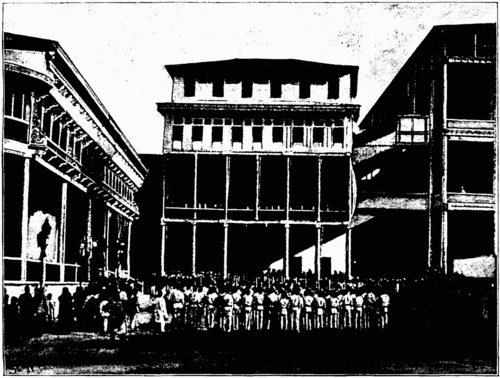 PALACE SQUARE, ZANZIBAR: TROOPS ASSEMBLED IN FRONT OF GOVERNMENT HOUSE; PALACE, WITH THE LATE SULTAN IN THE GALLERY, TO THE RIGHT HAND; HAREM TO THE LEFT.
The island of Zanzibar, together with the neighboring islands of Pemba and Mafia, to the north and south, is generally of coral formation, with here and there hills of a reddish clay, which rise in the south to an elevation of 450 feet and in the north develop into a range of hills which runs parallel to the shore at a height of over 1,000 feet. The dense forests which originally covered the island have been cut down, and the soil, which is of unusual fertility, is under thorough cultivation, yielding heavy crops of corn and manioc, which latter forms the staple food of the people.
The soil and climate are specially suited to the clove, which is raised in great quantities, the crop forming four-fifths of the total clove crop of the world. The seaboard lying opposite the island of Zanzibar is level and swampy, and the many rivers which flow from the escarpment of the great inland plateau have brought down a vast deposit of rich alluvial matter, upon which, aided by the moist, warm climate, a dense growth of tropical vegetation flourishes. A native growth of this region is the copal tree, famous as yielding the best gum known to commerce. Rice, maize, millet, the cocoa nut and the oil palm are cultivated, and the whole country is well adapted to the raising of sugar, coffee, cotton, indigo, and the various spices.
Of the original races of the island of Zanzibar only a few representatives survive. These live on the east side, and are known as Wa-Hadimu Bantus. The main population is a strange mixture of "full blood and half-caste Arabs, Indian 'Canarians' (that is, half-caste Portuguese from Kanara on the Malabar coast of India), Swahili of every shade, slaves or freedmen from all parts of East Africa," with a small sprinkling of Americans and Europeans.
The city of Zanzibar is next to Alexandria and Tunis, the largest city on the coast of Africa, and contains a population variously estimated at from 80,000 to 100,000 souls. It is easily separable into two quarters, the trading quarter, which lies along the beach and contains the palace of the Sultan, and the eastern outlying suburb in which live the lower class. The view of Zanzibar from the sea is picturesque, the palace, forts and towers, the Mission Cathedral and the successive white buildings of varied outline, making a pleasing panorama. But when the visitor passes into the heart of the city he loses himself in a tangle of foul and narrow streets, where filth and immorality abound.
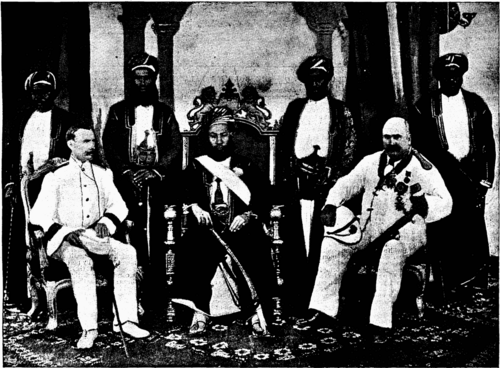 THE LATE SULTAN OF ZANZIBAR AND HIS MINISTERS.
The palace, which is the central point of the city's life, is thus described by a former resident, Mr. Charles L. Lyons: "A low, rambling structure divided into three parts. The higher portion is of stone, and surrounded by verandas of carved teak wood, which are very ornate and elaborate specimens of eastern decorative art work. Adjoining this is the section occupied as living apartments, and the third section is occupied by the harem, which, under the late Sultan, comprised about twenty-five Circassian women.
"The palace was a curious combination of magnificence and tawdriness. The reception room, which is about 250 ft. square, was hung with beautiful draperies embroidered in real gold. In many places the walls were inlaid with precious stones curiously and indiscriminately mingled. Next to a valuable uncut sapphire or a ruby one would find a carbuncle or some valueless stone. Many of the chairs in the finer apartments were of gold inlaid with precious stones, and about many of the rooms were inscriptions from the Koran applied in solid gold." Other conspicuous buildings as seen from the water are the Government House, the Custom House, the Signal Tower, and the Mission Cathedral.
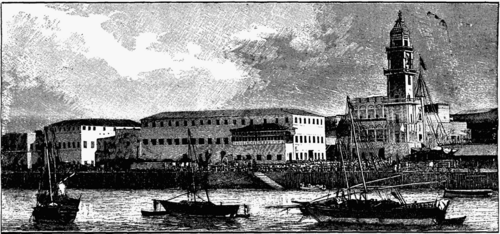 EXTERIOR VIEW OF THE SULTAN'S PALACE, ZANZIBAR.
The harbor affords a fine anchorage for shipping, and is well worthy to be the central shipping point of the east coast of Africa. The total imports for 1894 were valued at over $6,000,000 and the exports at about $5,500,000. British India controls the greater share of the import trade, sending over large cargoes of grain, rice, and piece goods from Bombay, the yearly value of the trade being $1,675,000. The German trade amounts to $340,000, and a large amount of cotton goods and kerosene oil is imported from America.
The law of succession to the throne of Zanzibar does not recognize the right of the eldest son or the son of the eldest brother deceased. In the eyes of the Mohammedan Council of State Seyyid Khalid, the late usurper, has no stronger claim to the throne than his cousin, the present Sultan Hamid bin Mohammed bin Seyyid. Khalid is spoken of as "a rash and willful young man of twenty-five," and Hamid as "an elderly gentleman, fifty or sixty years of age, respected for his prudent and peaceable conduct, acceptable to the better class of Mussulman townsfolk, and trusted as a ruler likely to preserve the traditional policy of the realm." Immediately upon the interment of the late Sultan, however, which took place two short hours after his suspicious death, Khalid proclaimed himself ruler. He gathered the palace guards together, placed barricades in the palace square, trained the guns upon the British warships, and awaited developments. They came the next morning in the shape of an ultimatum from Admiral Rawson of the St. George, a first class cruiser of 7,700 tons, which, together with four smaller cruisers and gunboats, lay off the city in the harbor, summoning Khalid to surrender, leave the palace, and make his soldiers pile their arms in front of it.
If he failed to do this, the palace would be bombarded within two hours after the dispatch of the ultimatum.
As Khalid's reply was to further strengthen his defense, at the appointed time the bombardment began. Meanwhile the loyal Zanzibar troops, with a detachment of British marines and seamen, attacked the barricades. The palace was knocked to pieces and set on fire by the shells, and Khalid, driven from the shelter, fled to the German consulate for safety.
Hamid was proclaimed Sultan by General Matthews, Mr. Cave, the consul, and Admiral Rawson, and order was at once restored to the city.
At the time of the bombardment it was freely predicted that the annexation of Zanzibar would speedily follow; but it now appears that the government considers that no advantages are to be gained by such a step, the cost of a direct administration being much greater than the native administration, which under the present protectorate is working satisfactorily.
We are indebted for our illustrations to the Illustrated London News and to Black and White.
Continue to:


My Books

