


The Wanderings Of Checks
Description
This section is from the book "Banking, Credits And Finance", by Thomas Herbert Russell. Also available from Amazon: Banking, credit and finance (Standard business).
The Wanderings Of Checks
Under old-fashioned methods, each bank was in the habit of selecting its collection agents, sending them by mail their collection paper, charging their customers very substantial collection rates and passing the same to their credit when collected. Nowadays the country trader, no matter where he is located, sends his check on a local bank to pay his account in a distant city, and the receiver of the check expects his bank to collect the amount of the check free of expense, and to give him full credit for it the day it is deposited.
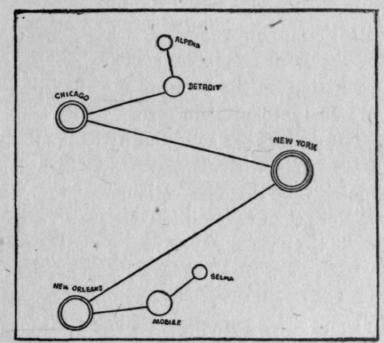
Suppose for instance that a merchant of Selma, Ala., sends his check on a Selma bank by mail to pay a bill in Alpena, Mich. The Alpena merchant deposits it in his local bank, and this local bank sends it to its Detroit correspondent; that is, deposits it in the Detroit bank where its account is kept. The Detroit bank sends the check to its Chicago correspondent. The Chicago bank may have no connection with a Southern city. It sends the check to its New York correspondent. The New York bank forwards the check to New Orleans, where it may pass through the clearing-house to some other New Orleans bank which forwards it to its correspondent in Mobile. The Mobile bank sends the check to Selma, and has it charged up to the account of the man who issued it.
Now all these banks and clearing-houses through which the check passes, stamp their indorsement and other information on the back of the check, so that the check itself bears a complete record of its travels.
Millions of dollars are collected by banks daily in this way, and generally without expense to their customers. It is estimated that these collections cost the New York city banks more than two million dollars a year in loss of interest while the checks are en route. Fifteen thousand collection letters are sent out every day by the banks of New York City alone. There have been spasmodic attempts in some cities to make a charge for the collection of out-of-town checks, but such attempts are unpopular among business men.
Continue to:


My Books

