


Problems Of Agricultural Economics. Part 2
Description
This section is from the "Economics In Two Volumes: Volume II. Modern Economic Problems" book, by Frank A. Fetter. Also available from Amazon: Economic
Problems Of Agricultural Economics. Part 2
§ 4. Farming viewed as a capitalistic enterprise. Thus the farm comes to be looked upon more and more, not merely as a home, but much as if it were a commercial enterprise or a factory, by which products are made for sale. This change, to be sure, is far from complete, as the figures for the average farmer's income show that a large share of the family living still comes from the farm. It has gone on much further in some districts than in others, as is indicated in the types of farming discussed below. But, just to the extent that the farmer grows crops to sell, his outlook on his work undergoes a change. He is less exclusively a farmer, concerned with the technical processes of farming; he must be more largely a business man. Like a manufacturing enterpriser, he buys the factors of production, combines them into new products, and sells them again. He becomes interested in market conditions and prices. He grows more commercially minded. He views the farm no longer as a fixed area, but one that may be enlarged by purchase or by rental, and that may be reduced by selling or letting the less needed parts. One fifth of farm-owners now rent additional land. In commercial farming the land is not contrasted with capital as something apart, consisting of the value of the equipment and stock; but the whole complex of land and other goods is thought of as a capital investment. The greater ease of transferring landed property in America and the greater mobility of our population have always made it more natural here than in Europe to look upon land as a capital investment. This view is now becoming more general as a result of the commercializing of farming enterprise.
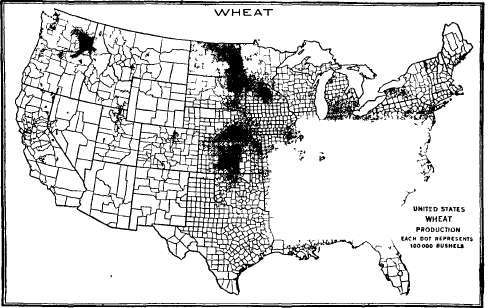
Fig. 3, Production of wheat.
Note: Largely produced in a comparatively restricted wheat belt bordering the semi-arid region; elsewhere mainly a rotation crop.
This change has been favored by other influences. Particularly has the use of machinery and of other equipment, calling for a larger investment per man and per acre, been making agriculture, in its form of enterprise, more like manufacturing and commercial undertakings.
§ 5. Diversified versus specialized fanning. To be largely self-sufficing a farming family must carry on general farming, that is, must produce a diversity of products. As farming becomes more commercialized it usually becomes more specialized, and a certain district produces a smaller variety of products. In some part of the country and on particular farms this specialization is extreme: In various parts of California, citrus fruits or prunes or beans may be the only crop raised; wheat in central Kansas and the Dakotas; fresh milk and vegetables on thousands of farms surrounding the great cities; cotton in many parts of the South. Many farmers in these districts have no gardens or orchards, keep no cow, and buy much or all of the grain for their horses, as well as milk, butter, vegetables, and fruit for their own use. Poultry and eggs are shipped in trainloads two thousand miles from the Middle West to California to be consumed by orange-growers. Many farmers in the East no longer keep sheep, pigs or beef cattle, and they buy out of the butcher's wagon all the meat except fowls used by their families. This partly explains the decrease of live stock in the whole country in recent years and the relative increase in the price of meat.

Fig. 4, Dairy products. Observe the close relation with manufactures in Fig. 3, ch. 26.
§ 6. Conditions favoring diversified farming. There are however, limits to the net advantage of specialization in crops, and competent authorities on agriculture question whether in many cases that limit has not been reached and passed. Most farms have a variety of soils and conditions - hilltops, slopes, bottom-lands - which are suitable for different purposes. A rotation of crops is necessary to get good yields. Live stock must be kept to maintain the fertility of the land, which deteriorates fast if hay and grain are continually sold. Some live stock can be kept on every farm very cheaply with the food that would go to waste otherwise. The specialization in stock-raising in the prairie states ceased to be profitable when lands became more valuable. Specialization in wheat production in the states just west of the Mississippi is possible only as long as wheat will grow on the virgin soil without costly fertilizers. The cotton farmers of the South, especially the negro-farmers, have been forced by debt and thriftlessness into a one-crop policy that is now seen to be wasteful in the long run. A variety of production is necessary to employ labor somewhat regularly on a farm throughout the year. These and other conditions will make most farming always an industry of comparatively diversified products. Only 1 per cent of the farms get as much as 40 per cent of their receipts from fruit; 2 per cent get that much from tobacco; 3 per cent from vegetables; 6 per cent from dairy products; and 19 per cent from cotton. The remaining 60 per cent of receipts are in most cases from various sources, and these figures do not include the value of produce consumed by the farmer's family.
§ 7. Intensive farming in Europe and America. No other farm problem interests the city man so much as that of increasing the production of the land. To most city men farming hardly seems to be an occupation giving livelihood and life to the farmer; it seems rather to exist for the sole purpose of feeding men living in cities. The city man, therefore, measures the success of farming, not by the farmer's income or by the level of the countryside prosperity, but by the number of bushels per acre raised to ship to town. Every city newspaper and magazine contains articles pointing to the fact that larger crops per acre are raised in Europe than in America, and broadly suggesting that the American farmer could do as well, if only he would. Foreign travelers comment in like vein on the wasteful use of land in America as compared with farming methods in Europe.
Land is used most extensively, with respect to labor, when it is in forests; somewhat less so when in pasture, as care must be given to the live stock; and still less when used for hay, grain, and other crops. But cultivation with machinery in large fields is a far more extensive method of agriculture than that carried on by the patient work of peasants with their hand tools. The more labor or the more equipment (or both together) that is put upon an acre, the larger the product, but the larger the cost per unit. It is a familiar economic principle.2 It would bankrupt any farmer, excepting the millionaire amateur, to farm in America by European methods. American farmers, at least many of them, could raise as many bushels per acre and keep their farms as thoroughly cultivated as do the European peasants, if wages were as low here as are the peasants' incomes.
Continue to:


My Books

