


Public Ownership. Part 4
Description
This section is from the "Economics In Two Volumes: Volume II. Modern Economic Problems" book, by Frank A. Fetter. Also available from Amazon: Economic
Public Ownership. Part 4
§ 12. Sources of heat, light, and power. Next to the question as to the public ownership of the railroads, that as to coal mines and hydraulic power sites is most likely to become insistent for answer in America in the not distant future. The law of the conservation of energy expresses the fundamental likeness of heat, light, 'and power. The principal sources from which man derives these agencies are coal and falling waters, though wood is of importance as fuel in some localities. About 500,000 square miles of land (about 13 per cent of the area of the country) are underlaid with coal. These deposits are widely distributed, so that nearly every part of the country is within five hundred miles of a mine. The enormous deposits, if used at the present amounts per year, would last probably from two to four thousand years, but if used at the present increasing rate (doubling the product every ten years), they would, it has been estimated, last but one hundred and fifty years. What shall be the actual rate as between these extremes is a question the answer of which depends on our economic legislation as to ownership, exploitation, prices, use, and substitution. The experiences in the war, as well as the constantly recurring labor difficulties in coal-mining, verging upon civil war, have forced the public thought to recognize its dependence on the regular supply of coal, and the exceptional public nature of the coal industry. The one great available substitute for coal as a source of heat and light and power is water-power. It is estimated that in 1908 but 5,400,000 horse-power was being developed from waterfalls, whereas about 37,000,000 primary horsepower 5 was available; but, by the storage of flood-waters so is the least," all the rest being allowed to escape unused. Van Hise, "Conservation of Natural Resources," p. 119.
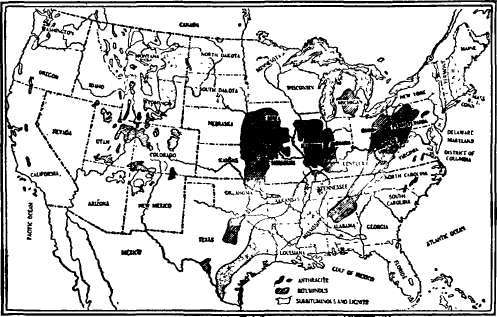
Fig. 2, Chapter 33.—Coal Fields of the U. S.
5 That is, "the amount which can be developed upon the basis of the flow age of the streams for a period of two weeks in which the flow as to equalize the flow, at least 100,000,000 horse-power, and possibly double that amount, could be developed. As it requires ten tons of coal to develop one horse-power a year in a steam-engine by present methods, there is here a potential substitute for coal equal to from two to four times our annual use of coal (above 600,000,000 tons).
But this does not mean that it would be economical, at present costs of mining coal and of building reservoirs, to make this substitution now. To determine when, how far, and by what methods to develop this water-power from lakes and rivers for the use of the people, and to make this substitution, is one of our great economic problems. The question is being daily decided, in numerous acts of legislation and administration, whether the water-power of the United States shall be more rapidly developed by becoming private property, or shall be developed more slowly as a part of the national domain.
§ 13. Economic basis of public ownership. The question as to the proper limits of public ownership is one most actively debated. The movement is progressing in accordance with the principle that public ownership is economically justified wherever it secures a product or service of widespread use that would otherwise be impossible, or insures the public a better quality or a lower price. The question of public ownership is not exclusively an economic question. There are incidental problems, such as its effects on enterprise and on political integrity, with which it is not possible here to deal. In the main, however, public ownership is simply a business policy which must be justified by its economic results. In the case of a general social benefit not to be secured without public ownership (as popular education or the cli matic effect of forests), the only question to answer is whether the utility is worth the cost. In the case of industries already in private hands, as waterworks, gas and electric lighting, there is needed, to make a wise decision possible, a knowledge of the effect a change to public ownership will have upon cost and service. If public officials can furnish some goods more cheaply than they are furnished by private enterprise, it is because of the wide margin of monopoly profit, not because there is any magic in public ownership. The same general items of cost must be met. The first cost of the plant and the annual interest payments are much the same. Experience shows that, because of political influence and of public opinion, wages are likely to be higher under public ownership, but salaries for management lower. Public collection of dues along with taxes is an advantage not enjoyed by private companies. Several public officials sometimes share the same office and thus reduce expenses. In small towns the public electric lighting and waterworks have been operated more economically under one roof. Some items of cost may be less under public management, but, on the whole, public industry probably has no advantage in these respects. Public industry does not have to meet the costs of lobbying and blackmail which are often forced upon private companies. But the greatest source of saving in public ownership is the value of monopoly privileges that, under private management, go into private pockets.
The temptation of political corruption may be more insistent when a large force of men is constantly employed, and when large supplies are constantly purchased, by public officials, but the temptation is not so strong or so centralized as it is in the granting of franchises to wealthy corporations. Public industry is weakened by the absence of certain motives to excellence that are present in private business. The income of public officials not being dependent on the economy of management, the spur and motives of competitive industry are lacking. No social discovery has made individual honesty and civic virtue useless to good government.
The decision in any specific case is one dependent on local conditions, and the exact limits of public ownership are not-fixed. Industry is changing so rapidly that new adjustments are made every year. The main outlines of public ownership, however, are now in large part determined. Some industries do well, others ill, under public management, and between these lie many debatable cases. Waterworks and probably electric lighting, because of the comparative simplicity of their operation, are more suitable for public ownership than are gas-works. No absolute line divides the one group from the other. But, whatever the changes, the fact cannot be ignored that the increase of public ownership is altering in manifold ways the organization of industry, and is reacting upon the production of wealth and the distribution of incomes.
References
Bemis, E. W., (Ed.), Municipal monopolies. N. Y. Crowell. 1890.
Brooks, R. C., Municipal Affairs, 5: 1-346. 1901. An exhaustive and well-arranged bibliography on all aspects of municipal problems.)
Fairlie, J. A., Recent extensions of municipal functions in the United States. A. A. A., 25: 299-310. 1905.
Guyot, Yves, Where and why public ownership has failed. Trans. 19: 61-73. 1902.
Lincoln, E. E., The results of municipal electric lighting in Massachusetts. Pp. 484. Boston. Houghton, Mifflin Co. 1918.
Maltbie, M. R., Municipal utilities. Princeton. University Press. 1917.
National Civic Federation, Report on municipal and private operation of public utilities. 1907. 3 vols. (A monumental study by an American delegation, which visited many cities of Europe and America; favorable, in the main, to extension of municipal ownership.)
Stephens J. L., A bibliography of municipal utility regulation and municipal ownership. Pp. 410. Cambridge. Harvard Univ. Press. 1918.
Todd, A. M., Municipal ownership, with a special survey of municipal gas plants in America and Europe. Public Ownership League of America. Chic. 1918.
Van Hise, C. R., Conservation of natural resources. N. Y. Mac-millan. 1910.
Continue to:


My Books

