


Common or Plumed Thistle

Description
This section of the book is from the "Wild Flowers Worth Knowing" book, by Neltje Blanchan. Also available from Amazon: Wild Flowers Worth Knowing
Common or Plumed Thistle
COMPOSITE FAMILY - Compositae: Common or Plumed Thistle
Cirsium

Is land fulfilling the primal curse because it brings forth thistles? So thinks the farmer, no doubt, but not the goldfinches which daintily feed among the fluffy seeds, nor the bees, nor the "painted lady," which may be seen in all parts of the world where thistles grow, hovering about the beautiful rose-purple flowers. In the prickly cradle of leaves, the caterpillar of this thistle butterfly weaves a web around its main food store.
When the Danes invaded Scotland, they stole a silent night march upon the Scottish camp by marching barefoot; but a Dane inadvertently stepped on a thistle, and his sudden, sharp cry, arousing the sleeping Scots, saved them and their country; hence the Scotch emblem.
From July to November blooms the Common, Burr, Spear, Plume, Bank,
Horse, Bull, Blue, Button, Bell, or Roadside Thistle (C.
lanceolatum or Carduus lanceolatus), a native of Europe and
Asia, now a most thoroughly naturalized American from Newfoundland to
Georgia, westward to Nebraska. Its violet flower-heads, about an inch
and a half across, and as high as wide, are mostly solitary at the
ends of formidable branches, up which few crawling creatures venture.
But in the deep tube of each floret there is nectar secreted for the
flying visitor who can properly transfer pollen from flower to flower.
Such a one suffers no inconvenience from the prickles, but, on the
contrary, finds a larger feast saved for him because of them. Dense,
matted, wool-like hairs, that cover the bristling stems of most
thistles, make climbing mighty unpleasant for ants, which ever delight
in pilfering sweets. Perhaps one has the temerity to start upward.
"Fain would I climb, yet fear I to fall,"
"If thy heart fail thee, climb not at all,"
might be the ant's passionate outburst to the thistle, and the
thistle's reply, instead of a Sir Walter and Queen Elizabeth couplet.
Long, lance-shaped, deeply cleft, sharply pointed, and prickly dark
green leaves make the ascent almost unendurable; nevertheless, the ant
bravely mounts to where the bristle-pointed, overlapping scales of the
deep green cup hold the luscious flowers. Now his feet becoming
entangled in the cottony fibres wound about the scaly armor, and a
bristling bodyguard thrusting spears at him in his struggles to
escape, death happily releases him. All this tragedy to insure the
thistle's cross-fertilized seed that, seated on the autumn winds,
shall be blown far and wide in quest of happy conditions for the
offspring!
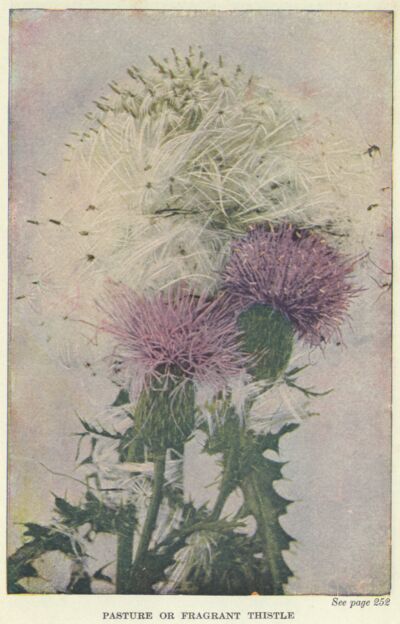
Sometimes the Pasture or Fragrant Thistle (C. pumilum or
Carduus odoratus) still further protects its beautiful, odorous
purple or whitish flower-head, that often measures three inches
across, with a formidable array of prickly small leaves just below it.
In case a would-be pilferer breaks through these lines, however, there
is a slight glutinous strip on the outside of the bracts that compose
the cup wherein the nectar-filled florets are packed; and here, in
sight of Mecca, he meets his death, just as a bird is caught on limed
twigs. The Pasture Thistle, whose range is only from Maine to
Delaware, blooms from July to September.
Continue to:
Books by Neltje Blanchan:



My Books

