


Tansy; Bitter-buttons

Description
This section of the book is from the "Wild Flowers Worth Knowing" book, by Neltje Blanchan. Also available from Amazon: Wild Flowers Worth Knowing
Tansy; Bitter-buttons
COMPOSITE FAMILY - Compositae: Tansy; Bitter-buttons
Tanacetum vulgare
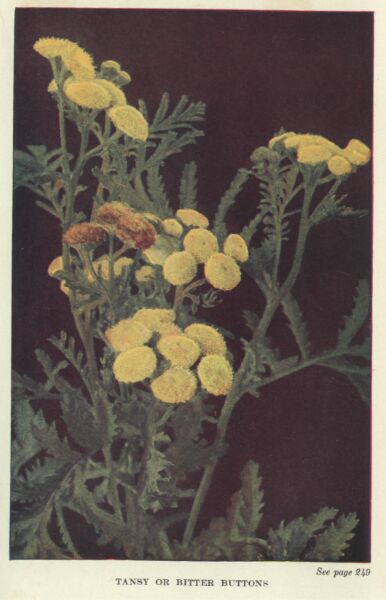
Flower-heads--Small, round, of tubular florets only, packed within a depressed involucre, and borne in flat-topped corymbs. Stem: 1-1/2 to 3 ft. tall, leafy. Leaves: Deeply and pinnately cleft into narrow, toothed divisions; strong scented.
Preferred Habitat--Roadsides; commonly escaped from gardens.
Flowering Season--July-September.
Distribution--Nova Scotia, westward to Minnesota, south to Missouri and North Carolina. Naturalized from Europe.
"In the spring time, are made with the leaves hereof newly sprung up,
and with eggs, cakes or Tansies which be pleasant in taste and goode
for the Stomache," wrote quaint old Gerarde. That these were popular
dainties in the seventeenth century we further know through Pepys who
made a "pretty dinner" for some guests, to wit: "A brace of stewed
carps, six roasted chickens, and a jowl of salmon, hot, for the first
course; a tansy, and two neat's tongues, and cheese, the second."
Cole's "Art of Simpling," published in 1656, assures maidens that
tansy leaves laid to soak in buttermilk for nine days "maketh the
complexion very fair." Tansy tea, in short, cured every ill that flesh
is heir to, according to the simple faith of medieval herbalists--a
faith surviving in some old women even to this day. The name is said
to be a corruption of athanasia, derived from two Greek words
meaning immortality. When some monks in reading Lucian came across the
passage where Jove, speaking of Ganymede to Mercury, says, "Take him
hence, and when he has tasted immortality let him return to us," their
literal minds inferred that this plant must have been what Ganymede
tasted, hence they named it athanasia! So great credence having been
given to its medicinal powers in Europe, it is not strange the
colonists felt they could not live in the New World without tansy.
Strong-scented pungent tufts topped with bright yellow
buttons--runaways from old gardens--are a conspicuous feature along
many a roadside leading to colonial homesteads.
Continue to:
Books by Neltje Blanchan:



My Books

