


![next page: 11. Myosotis [Dill.] L. Sp. Pl. 131. 1753](../../../images/nav/page_next.gif)
10. Asperugo [Tourn.] L. Sp. Pl 138. 1753
Description
This section is from the book "An Illustrated Flora Of The Northern United States, Canada And The British Possessions Vol3", by Nathaniel Lord Britton, Addison Brown. Also available from Amazon: An Illustrated Flora of the Northern United States, Canada and the British Possessions. 3 Volume Set..
10. Asperugo [Tourn.] L. Sp. Pl 138. 1753
An annual rough-hispid procumbent herb, with alternate entire leaves, or the uppermost sometimes opposite, and small blue or nearly white flowers, short-pedicelled and 1-3 together in the upper axils. Calyx campanulate, unequally 5-cleft, much enlarged and folded together in fruit, the lobes incised-dentate. Corolla tubular-campanulate, 5-lobed, the lobes imbricated. Stamens 5, included, inserted on the corolla-tube; filaments very short. Ovary 4-divided; style short; stigma capitate. Nutlets 4, ovoid, erect, granular-tuberculate, keeled, laterally attached above the middle to the elongated-conic receptacle. [Latin, rough, referring to the leaves.]
A monotypic genus of Europe and Asia.
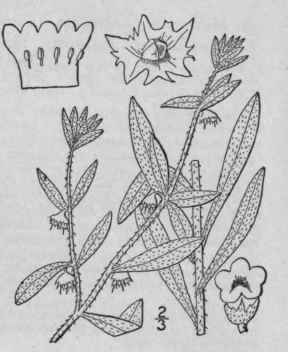
1. Asperugo Procumbens L. German Mad-Wort. Catchweed
Fig. 3528
Asperugo procumbens L. Sp. Pl. 138. 1753.
Stems slender, branched, diffusely procumbent, 6'-18' long, very rough with stiff bristly hairs. Leaves oblong, lanceolate, or the lower spatulate, obtuse or acutish at the apex, 1/2'-1 1/2' long, the lower narrowed into margined petioles; flowers very short-pedicelled, about 1" broad, blue, the pedicels recurved in fruit; fruiting calyx dry and membranous, strongly veined, 4"-6" broad; nutlets obliquely ovoid.
In waste places and ballast, Massachusetts to southern New York, New Jersey, District of Columbia and Minnesota. Adventive from Europe. Called also small wild bugloss and great goose-grass. May-Aug.
Continue to:


My Books

