
![previous page: 91. Chrysanthemum [Tourn.] L. Sp. Pl. 888. 1753. Continued](../../../images/nav/page_prev.gif)

![next page: 93. Tanacetum [Tourn.] L. Sp. Pl. 843. 1753](../../../images/nav/page_next.gif)
92. Matricaria L. Sp. Pl. 890. 1753
Description
This section is from the book "An Illustrated Flora Of The Northern United States, Canada And The British Possessions Vol3", by Nathaniel Lord Britton, Addison Brown. Also available from Amazon: An Illustrated Flora of the Northern United States, Canada and the British Possessions. 3 Volume Set..
92. Matricaria L. Sp. Pl. 890. 1753
Annual or perennial, mostly erect herbs, similar to some species of the preceding genus, with alternate leaves, dissected into filiform or narrowly linear segments and lobes, and peduncled heads of both tubular and radiate flowers, or rays wanting in some species. Involucre hemispheric, its bracts appressed, imbricated in few series, the outer shorter. Receptacle conic, elongated or hemispheric, naked. Rays, when present, white, pistillate and fertile. Disk-flowers yellow, perfect, fertile, their corollas 4-5-toothed. Anthers obtuse and entire at the base. Style-branches of the disk-flowers truncate, penicillate. Achenes 3-5-ribbed. Pappus none, or a coroniform border. [Latin, matrix, from its medicinal virtues.]
About 20 species, natives of the northern hemisphere and South Africa. The following are the only ones known to occur in North America. Type species: Matricaria inodora L.
Rays present, white.
Achenes obpyramidal, strongly 3-ribbed.
Plant tall, much branched: bracts of the involucre green.
1. M. inodora.
Plant low, nearly simple, arctic; bracts dark brown or black.
2. M. grandiflora.
Achenes nearly terete, oblong, faintly 3-"5-ribbed.
3. M. Chamomilla.
Rays none; achenes oblong, faintly nerved.
4. M. matricarioides.
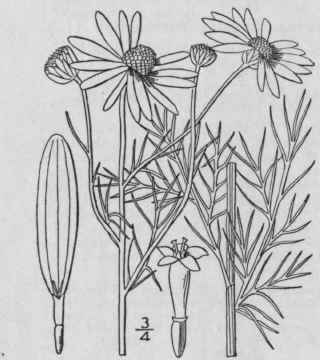
1. Matricaria Inodora L. Scentless Camomile. Corn Mayweed
Fig. 4565
Matricaria inodora L. Fl. Suec. Ed. 2, 297. 1755.
Chrysanthemum inodorum L. Sp. Pl. Ed. 2, 1253. 1763- Annual; stem usually much branched, glabrous, or very nearly so throughout, 1°-2° high. Leaves numerous, sessile, 2-3-pinnately dissected into filiform lobes, the rachis somewhat dilated at the base; heads several or numerous, terminating the branches, 1/2'-1 1/2' broad; bracts of the involucre lanceolate-oblong, obtuse, green with brown scarious margins; rays 20-30, white, spreading; receptacle hemispheric or ovoid; achenes obpyramidal with three prominent ribs; pappus a short entire or 4-toothed crown.
In fields and waste places, Newfoundland to New Jersey, Pennsylvania and Michigan. Naturalized or adventive from Europe. June-Sept.
2. Matricaria Grandiflora (Hook.) Britton. Arctic Camomile
Fig. 4566
Chrysanthemum grandiflorum Hook, in Parry's 2d Voy. 398. 1825.
Pyrethrum inodorum var. nanum Hook. Fl. Bor. Am. 1: 320. 1833.
M. grandiflora Britton, Mem. Torr. Club 5: 340. 1894.
Perennial; stem usually simple and monocephalous, glabrous, 4'-12' high. Leaves sessile, or the lowest short-petioled, 1-2-pinnately dissected, 1'-21/2' long; head not very long-peduncled, 1'-2' broad; bracts of the involucre ovate or ovate-oblong, obtuse, glabrous, brown or nearly black, or with broad, brown, scarious margins; rays 15-35, bright white, slightly 3-5-toothed at the summit; receptacle hemispheric when mature.
Coast of Hudson Bay to Alaska. Reported from Lake Huron, Summer.
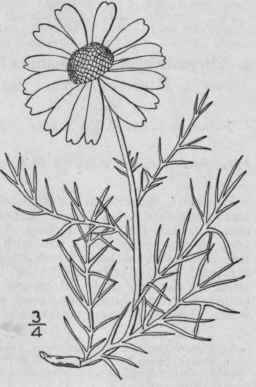
3. Matricaria Chamomilla L. Wild Or German Camomile
Fig. 4567
Matricaria Chamomilla L. Sp. Pl. 891. 1753- Annual, glabrous, much branched, 1°-2° high. Leaves aromatic, finely 2-3-pinnately dissected into numerous linear lobes; heads numerous, 8"-12" broad, slender-peduncled at the ends of the branches; bracts of the involucre oblong, obtuse, green, or with brownish margins; rays 10-20, white, spreading; receptacle ovoid, becoming conic and hollow; achenes nearly oblong, or somewhat obovoid, faintly 3-5-ribbed; pappus none.
In waste places and on ballast, southern New York to Pennsylvania. Adventive or fugitive from Europe. Horse-gowan. Summer.
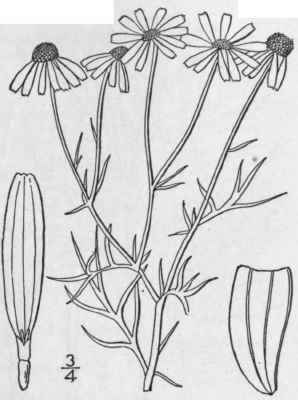

4. Matricaria matricarioides (Less.)
Porter. Rayless Camomile. Wild Marigold. 4568.
Santolina suaveolens Pursh, Fl. Am. Sept. 520.
1814. Not M. suaveolens L. 1755. Artemisia matricarioides Less. Linnaea 6: 210.
1831. Matricaria discoidea DC. Prodr. 6: 50. 1837. Matricaria matricarioides Porter, Mem. Torr.
Club 5: 341. 1894. M. suaveolens Buchenau, Fl. Nord. Tief. 496.
1894.
Annual, glabrous; stem very leafy, at length much branched, 6'-i8' high. Leaves 2-3-pinnately dissected into linear acute lobes; heads numerous, 3"-4" broad, peduncled; bracts of the involucre oval or oblong, green, with broad white scarious margins, much shorter than the ovoid yellow disk; rays none; receptacle conic; achenes oblong, slightly angular, faintly nerved; pappus an obscure crown, sometimes produced into 2 coriaceous oblique auricles.
In waste places, in ballast and along railroads, Missouri to Massachusetts and Maine. Adventive from the Pacific coast. Naturalized as a weed in northern Europe. May-Aug.
Continue to:


My Books

