


13. Conobea Aubl. Pl. Guian. 2: 639. Pl. 258. 1775
Description
This section is from the book "An Illustrated Flora Of The Northern United States, Canada And The British Possessions Vol3", by Nathaniel Lord Britton, Addison Brown. Also available from Amazon: An Illustrated Flora of the Northern United States, Canada and the British Possessions. 3 Volume Set..
13. Conobea Aubl. Pl. Guian. 2: 639. Pl. 258. 1775
Herbs, with opposite pinnately parted pinnatifid incised or serrate leaves, and small blue or white peduncled flowers, solitary or two together in the axils. Calyx 5-parted, the segments narrow, equal. Corolla irregular, the tube cylindric, the limb 2-lipped; upper lip emargi-nate or 2-lobed; lower lip 3-lobed. Stamens 4, didynamous, ascending, included; filaments filiform; anther-sacs parallel, not confluent. Style incurved at the summit; stigma 2-lamel-late. Capsule globose, oblong or linear, septicidally dehiscent, the valves entire or 2-cleft. Seeds numerous, oblong, striate. [Guiana name.]
About 8 species, natives of America. Besides the following, another occurs in the southwestern United States. Type species: Conobea aquatica Aubl.
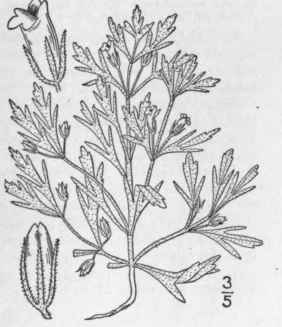
1. Conobea Multifida (Michx.) Benth. Conobea
Fig. 3780
Capraria multifida Michx. Fl. Bor. Am. 2: 22. pl. 35.
1803. Conobea multifida Benth. in DC. Prodr. 10: 391. 1846.
Annual, finely viscid-pubescent; stem at length diffusely branched, 4'-8' high, very leafy. Leaves petioled, 1/2'-1' long, pinnately parted into 3-7 linear or linear-oblong obtuse entire or incised segments; flowers greenish-white, 2"-2 1/2" long, mostly solitary in the opposite axils, about as long as their filiform peduncles; calyx-segments linear-subulate, slightly shorter than the corolla; capsule narrowly ovoid, glabrous, about equalling the calyx.
Along streams and rivers, Ontario to Ohio, Iowa, Kansas, Kentucky, Alabama and Texas. Introduced along the Delaware below Philadelphia. June-Sept.
Continue to:


My Books

