
![previous page: 12. Tragopogon [Tourn.] L. Sp. Pl. 789. 1753](../../../images/nav/page_prev.gif)

![next page: 14. Chondrilla [Tourn.] L. Sp. Pl. 796. 1753](../../../images/nav/page_next.gif)
13. Malacothrix Dc. Prodr. 7: 192. 1838
Description
This section is from the book "An Illustrated Flora Of The Northern United States, Canada And The British Possessions Vol3", by Nathaniel Lord Britton, Addison Brown. Also available from Amazon: An Illustrated Flora of the Northern United States, Canada and the British Possessions. 3 Volume Set..
13. Malacothrix Dc. Prodr. 7: 192. 1838
Annual or perennial, branching or scapose herbs, with alternate or basal, mostly pinnatifid leaves, and long-peduncled panicled or solitary heads of yellow or rarely white flowers. Involucre campanulate, its principal bracts in 1 or 2 series, equal or nearly so, with several series of shorter exterior ones. Receptacle flat, naked or bristly. Rays truncate and 5-toothed at the apex. Anthers sagittate at the base. Style-branches slender. Achenes oblong or linear, glabrous, 10-15-ribbed, 4 or 5 of the ribs usually more prominent than the others, truncate, or margined and 4-5-toothed at the summit. Pappus-bristles in 2 series, the inner naked or minutely serrulate, slender, coherent at the base and deciduous in a ring, the outer few (1-8), more persistent, or all deciduous in our species. [Greek, soft-hair, in allusion to the soft pappus.]
About 15 species, natives of the western and southwestern United States and lower California. Type species: Malacothrix calif ornica DC.
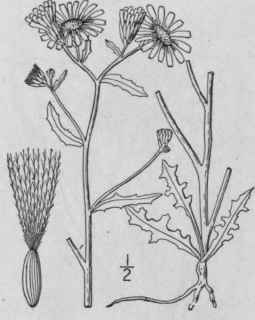
1. Malacothrix Sonchoides (Nutt.) T. & G. Malacothrix
Fig. 4060
Leptoseris sonchoides Nutt. Trans. Am. Phil. Soc. (II.) 7: 439. 1841.
Malacothrix sonchoides T. & G. Fl. N. A. 2: 486. 1843.
Annual, glabrous throughout, or slightly glandular; stem branched, 6'-12' high. Leaves somewhat fleshy, oblong or linear-oblong in outline, pinnatifid and the lobes dentate with mucronate-pointed teeth, the basal ones 1 1/2'-3' long, narrowed into short broad petioles, those of the stem smaller, sessile; heads several or numerous, 8"-13" broad; principal bracts of the involucre linear, acute, scarious-margined, the outer short, oblong, obtuse, or acutish; achenes linear-oblong, margined at the summit by a 15-denticulate white border; pappus-bristles all deciduous.
On dry plains, western Nebraska and Kansas to California and Arizona. May-Aug.
Continue to:


My Books

