


21. Isopappus T. & G. Fl. N. A. 2: 239. 1841
Description
This section is from the book "An Illustrated Flora Of The Northern United States, Canada And The British Possessions Vol3", by Nathaniel Lord Britton, Addison Brown. Also available from Amazon: An Illustrated Flora of the Northern United States, Canada and the British Possessions. 3 Volume Set..
21. Isopappus T. & G. Fl. N. A. 2: 239. 1841
Rough-hairy annual or biennial herbs, loosely paniculately branched, with alternate linear to lanceolate, 1-nerved, entire or somewhat toothed leaves, and small slender-peduncled heads of radiate and tubular yellow flowers. Involucre campanulate-cylindric, its appressed lanceolate or subulate bracts in 2 or 3 series. Receptacle alveolate. Ray-flowers 5-12, pistillate. Disk-flowers 10-20, perfect. Anthers not sagittate. Style-appendages narrow, hirsute. Achenes terete, narrowed below, silky-villous. Pappus a single series of rough capillary bristles, nearly equal in length. [Greek, equal-pappus.]
Two known species, natives of the southern United States, the following typical.
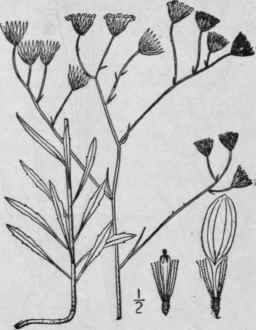
1 . Isopappus Divaricatus (Nutt.) T. & G. Isopappus
Fig. 4212
Inula divaricata Nutt. Gen. 2: 152. 1818.
Aplopappus divaricatus A. Gray, Syn. Fl. 1: Part 2, 130. 1884.
Isopappus divaricatus T. & G. Fl. N. A. 2: 239. 1841.
Annual or biennial, erect, paniculately much branched, slender, rough-pubescent or glandular, 1°-3° high. Leaves linear, linear-lanceolate, or the lowest linear-spatulate, acute or cuspidate, dentate with distant teeth, or somet'mes entire, 1' -3 ' long, 1"-3" wide, the uppermost much smaller, subulate or bract-like; heads numerous, 3"-5" broad; involucre campanulate, its bracts linear-lanceolate, subulate-tipped, pubescent, peduncles very slender, or filiform.
In dry soil, Kansas to Texas, east to Georgia and Florida. Aug.-Oct.
Continue to:


My Books

