


3. Serinia Raf. Fl. Ludov. 149. 1817
Description
This section is from the book "An Illustrated Flora Of The Northern United States, Canada And The British Possessions Vol3", by Nathaniel Lord Britton, Addison Brown. Also available from Amazon: An Illustrated Flora of the Northern United States, Canada and the British Possessions. 3 Volume Set..
3. Serinia Raf. Fl. Ludov. 149. 1817
[Apogon Ell. Bot. S. C. & Ga. 2: 267. 1824.]
Low glaucescent branching annual herbs, with alternate clasping entire or lobed leaves, or those of the stem sometimes appearing as if opposite, and few small long-peduncled heads of yellow flowers. Involucre broadly campanulate, its bracts about 8, equal, membranous, becoming concave after flowering. Receptacle flat, naked. Rays truncate and 5-toothed at the apex. Anthers sagittate at the base. Style-branches slender. Achenes obovoid, 8-10-ribbed, contracted at the base, rounded at the summit. Pappus none, or a mere vestige.
[Greek, small chicory.]
Three known species, natives of the southern United States, the following typical.
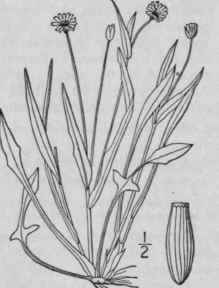
1. Serinia Oppositifolia (Raf.) Kuntze. Serinia
Fig. 4044
Krigia oppositifolia Raf. Fl. Ludov. 57. 1817. Apogon humilis Ell. Bot. S. C. & Ga. 2: 267. 1824. Serinia oppositifolia Kuntze, Rev. Gen. Pl. 364. 1891.
Glabrous throughout, or slightly glandular-pubescent along the ends of the peduncles, branched from the base, 4'-10' high. Basal and lower leaves petioled, oblong-lanceolate or spatulate in outline, acute or obtuse, entire, lobed or pinnatifid, 3'-5' long, 2"-6" wide; upper leaves mainly sessile, clasping, alternate, or appearing as if opposite, usually entire, smaller; peduncles very slender, sometimes 4' long; heads 1 1/2"-2" broad; bracts of the involucre acute or acuminate, about the length of the rays.
Kansas to Texas, east to North Carolina and Florida. Recorded from Missouri. March-May.
Continue to:


My Books

