


35. Erigeron L. Sp. Pl. 863. 1753. Part 6
Description
This section is from the book "An Illustrated Flora Of The Northern United States, Canada And The British Possessions Vol3", by Nathaniel Lord Britton, Addison Brown. Also available from Amazon: An Illustrated Flora of the Northern United States, Canada and the British Possessions. 3 Volume Set..
35. Erigeron L. Sp. Pl. 863. 1753. Part 6
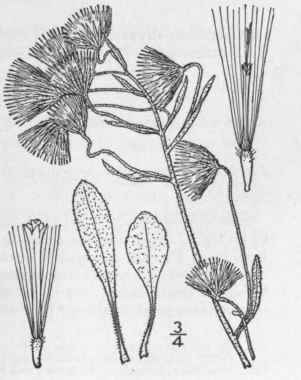
16. Erigeron Vermis (L.) T. & G. Early Fleabane
Fig. 4376
Aster vermis L. Sp. Pl. 876. 1753.
E. nudicaulis Michx. Fl. Bor. Am. 2: 124. 1803.
Erigeron vermis T. & G. Fl. N. A. 2: 176. 1841.
Perennial by stolons and offsets; stem slender, simple or branched above, glabrous, or the branches pubescent, 1°-2 1/2° high. Leaves mainly in a basal rosette, glabrous, obovate, oval or spatulate, obtuse, repand-denticulate or entire, 2'-4' long, narrowed into margined petioles; stem leaves mostly reduced to subulate-lanceolate scales, the lowest sometimes spatulate or oblong; heads not numerous, corymbose, peduncled, about 5" broad; involucre hemispheric, its bracts linear-subulate; rays 20-30, white or pink, 2"-3" long; pappus simple; achenes usually 4-nerved.
In marshes and moist soil, Virginia to Florida and Louisiana. April-May.
17. Erigeron Acris L. Blue Or Bitter Flea-Bane
Fig. 4377
Erigeron acris L. Sp. Pl. 863. 1753.
Erigeron Droebachianus O. F. Mueller, Fl. Dan. pl. 874.
1782. Erigeron acris Droebachianus Blytt, Norg. Fl. 1: 562.
1861. Erigeron acris debilis A. Gray, Syn. Fl. 1: Part 2, 220.
1884.
Biennial or perennial; stem hirsute-pubescent or glabrate, slender, simple, or branched above, 6'-2° high. Leaves pubescent or glabrous, entire, the basal and lower ones spatulate, mostly obtuse, 1'-3' long, petioled, those of the stem mostly oblong or oblanceolate, obtuse or acutish, sessile, shorter; heads several or numerous, racemose or paniculate, peduncled, 5"-6" broad; involucre hemispheric, its bracts linear, hirsute to glabrous; rays numerous, purple, equalling or slightly exceeding the brownish pappus; tubular pistillate flowers filiform, numerous; pappus simple or nearly so, copious.
Labrador to Alaska, Maine, Ontario, south in the Rocky Mountains to Colorado and Utah. Also in Europe and Asia. Races differ in size, pubescence and length of rays. July-Aug.
Continue to:


My Books

