


![next page: 4. Xanthium [Tourn.] L. Sp. Pl. 987. 1753. Continued](../../../images/nav/page_next.gif)
4. Xanthium [Tourn.] L. Sp. Pl. 987. 1753
Description
This section is from the book "An Illustrated Flora Of The Northern United States, Canada And The British Possessions Vol3", by Nathaniel Lord Britton, Addison Brown. Also available from Amazon: An Illustrated Flora of the Northern United States, Canada and the British Possessions. 3 Volume Set..
4. Xanthium [Tourn.] L. Sp. Pl. 987. 1753
Monoecious annual branching coarse rough or spiny herbs, with alternate lobed or dentate leaves, and rather small heads of greenish discoid flowers, the staminate ones capitate-clustered at the ends of the branches, the pistillate axillary. Staminate heads with a short involucre of 1 to 3 series of distinct bracts; receptacle cylindric, chaffy; corollas tubular, 5-toothed; anthers not coherent, mucronate at the apex; filaments monadelphous; style slender, undivided. Pistillate heads of an ovoid or oblong, closed involucre, covered with hooked spines, 1-2-beaked, 2-celled, each cavity containing one obovoid or oblong achene; corolla none; pappus none; style 2-cleft, its branches exserted. [Greek, yellow, from its yielding a yellow hair-dye.]
About 15 species, of wide geographic distribution. Type species: Xanthium strumarium L. Leaves lanceolate, acute at both ends; axils bearing 3-divided yellow spines.
1. X. spinosum.
Leaves orbicular or broadly ovate, cordate to truncate at base; no axillary spines. Bur, or its prickles, or both, more or less hispid-pubescent; beaks incurved. Body of the bur ovoid to oval, twice as long as thick or shorter. Bur 1' long or more, the prickles 4"-5" long.
2. X. speciosum.
Bur 10" long or less, the prickles 2"-3" long. Bur densely prickly, its pubescence brown.
3. X. echinatum.
Bur loosely prickly, its pubescence yellowish.
4. X. glanduliferum.
Body of the bur oblong, more than twice as long as thick. Prickles longer than the diameter of the body of the bur.
5. X. inflexum.
Prickles shorter than the diameter of the body of the bur. Bur narrowly oblong.
6. X. pennsylvanicum.
Bur broadly oblong.
7. X. commune.
Bur and its prickles glabrous, or merely puberulent; beaks nearly straight.
8. X. americanum.
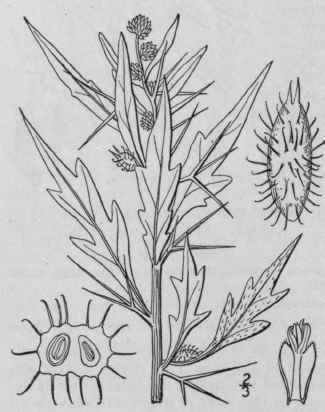
1. Xanthium Spindsum L. Spiny Or Thorny Clotbur, Clotweed Or Bur-Weed
Fig. 4132
Xanthium spinosum L. Sp. Pl. 987. 1753.
Stem pubescent or puberulent, much branched, ascending or erect, 1°-3° high. Leaves lanceolate or ovate-lanceolate, acute or acuminate, lobed, or the upper entire, narrowed at the base, short-petioled, white-canescent beneath and on the whitish veins of the upper surface, 2'-5' long; axils each with a short-stalked 3-pronged yellow spine nearly 1' long; ripe fertile involucre (bur) oblong-cylindric, 4"-6" long, about 2" in diameter, pubescent, armed with short subulate rather inconspicuous beaks, and numerous glabrous spines about 1" long.
In waste grounds, Maine to Ontario, Florida, Illinois, West Virginia, Missouri, Texas, New Mexico and California. Widely distributed as a weed in tropical America. Naturalized from Europe or Asia. Cocklebur. Dagger-cocklebur. Aug.-Nov.
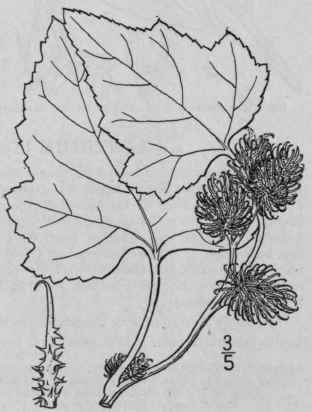
2. Xanthium Speciosum Kearney. Great Clotbur
Fig. 4133
Xanthium speciosum Kearney, Bull. Torr. Club 24: 574. 1897.
Very stout, 3°-4 1/2° high. Stem sharply angled above; lower petioles 4'-6' long; leaf-blades broadly triangular-ovate, the larger 6'-8' wide, 3-5-lobed, dentate, scabrous on both surfaces; burs commonly clustered, oblong to ovoid-oblong, 1' long or more, the stout beaks 5"-6" long, somewhat incurved, strongly hooked at the apex, equalling or a little longer than the dense subulate uncinate prickles, which are hispid to above the middle, and 4"-5" long.
Moist and waste grounds, North Dakota to Wisconsin, Tennessee, Montana, Nebraska and Texas, and locally in waste places eastward. Aug.-Sept.
Continue to:


My Books

