


69. Ximenesia Cav. Icones 2: 60. 1793
Description
This section is from the book "An Illustrated Flora Of The Northern United States, Canada And The British Possessions Vol3", by Nathaniel Lord Britton, Addison Brown. Also available from Amazon: An Illustrated Flora of the Northern United States, Canada and the British Possessions. 3 Volume Set..
69. Ximenesia Cav. Icones 2: 60. 1793
Pubescent caulescent herbs, with alternate or sometimes opposite, simple, toothed or somewhat laciniate leaves, and solitary or few, radiate, showy, peduncled heads. Involucre rather flat, of narrow spreading bracts. Receptacle convex, chaffy. Ray-flowers pistillate, fertile, numerous, the rays yellow. Disk-flowers numerous, perfect, fertile. Anthers somewhat sagittate at the base. Style-branches with slender pubescent appendages. Achenes flat, winged. Pappus of short and straight awns. [In honor of Joseph Ximenes, a Spanish apothecary and botanist.]
About 4 species, natives of America, the following typical.
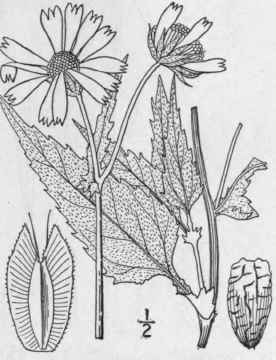
1. Ximenesia Encelioides Cav. Golden Crownbeard
Fig. 4491
Ximenesia encelioides Cav. Icon. 2: 60. pl. 178. 1793. Verbesina encelioides A. Gray, Syn. Fl. 1: Part 2, 288. 1884.
Annual; stem densely puberulent, much branched, 1°-2° high. Leaves deltoid-ovate or deltoid-lanceolate, thin, 2'-4' long, acuminate, acute or blunt at the apex, coarsely dentate, or even laciniate, green and minutely pubescent above, pale and densely canescent beneath, all alternate, or the lowest opposite, narrowed at the base into naked or wing-margined petioles, which are often provided with dilated appendages at the base; heads several or numerous, l'-2' broad; involucre hemispheric, about 1/2' high, its bracts lanceolate, canescent; rays 12-15, bright golden yellow, 3-toothed; achenes of the disk-like flowers obovate, winged, pubescent, their pappus of 2 subulate awns, those of the ray-flowers rugose, thickened, often wingless.
In moist soil, Kansas to Texas, Arizona and Mexico, and occasional in waste grounds farther east. Also in Florida and widely distributed in warm regions as a weed. Summer.
Continue to:


My Books

