


71. Bidens L. Sp. Pl. 831. 1753. Part 4
Description
This section is from the book "An Illustrated Flora Of The Northern United States, Canada And The British Possessions Vol3", by Nathaniel Lord Britton, Addison Brown. Also available from Amazon: An Illustrated Flora of the Northern United States, Canada and the British Possessions. 3 Volume Set..
71. Bidens L. Sp. Pl. 831. 1753. Part 4
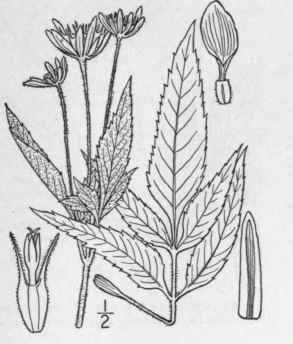
8. Bidens Vulgata Greene. Tall Beggar-Ticks
Fig. 4512
Bidens vulgata Greene, Pittonia 4: 72. 1899. B. frondosa puberula Wiegand, Bull. Torr. Club 26: 408. 1899.
Taller, sometimes 9° high, glabrous or nearly so, or crisp-pubescent above. Leaves pinnately 3-5-divided, the veins straight and prominent; heads larger, 7"-12" broad, stout-peduncled; outer invo-lucral bracts linear to linear-spatulate, ciliate, the inner mostly ovate or narrowly triangular, pubescent at apex; ray-flowers usually present, small, yellow; achenes very flat, 3"-41/2" long, 2"-2 1/2" wide, brown or greenish brown, the margins downwardly barbed above, upwardly hairy below; awns 2, half as long as the achene or more, downwardly barbed.
In moist soil, Quebec to British Columbia, New York, North Carolina, Missouri, Colorado and California. Aug.-Sept. Included in the preceding species in our first edition.
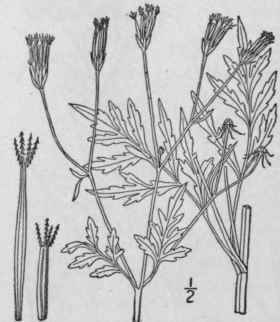
9. Bidens Bipinnata L. Spanish Needles. Cuckolds
Fig. 4513
Didens bipinnata L. Sp. Pl. 832. 1753.
Annual; stem quadrangular, erect, freely branched, rather slender, 1°-5° high. Leaves thin, acuminate, petioled, 1-3-pinnately dissected into ovate or oblong, toothed or lobed segments, the lower often 8' long; heads usually numerous, long-peduncled, 2"-4" broad; involucre narrow, its outer bracts linear, ascending, nearly as long as the broader erect inner ones; rays 3-4, yellow, short, sometimes none; achenes linear, 4-angled, slightly pubescent, narrowed upward into a beak, 5"-9' long, the outer ones commonly shorter and thicker than the inner; pappus of 2-4 (usually 4), downwardly barbed, slightly unequal, spreading awns, much shorter than the achene.
In various situations, often a weed in cultivated fields, Rhode Island to Florida, Ohio, Nebraska, Kansas and Arizona. Introduced as a weed into southern Europe and Asia. July-Oct.
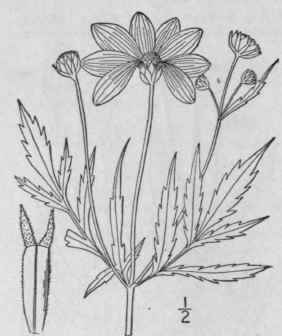
10. Bidens Coronata (L.) Fisch. Southern Tickseed-Sunflower
Fig. 4514
Coreopsis coronata L. Sp. Pl. Ed. 2, 1281. 1763.
Coreopsis aurea Ait. Hort. Kew. 3: 252. 1789.
Bidens coronata Fisch.; Steudel, Nom. Ed. 2, 202. 1840.
Annual, glabrous or nearly so throughout; stem branched, 1°-3° high. Lower leaves petioled, 3-5' long, 3-divided, the terminal segment lanceolate, acute or acuminate, serrate, much larger than the serrate or entire lateral ones; upper leaves much smaller, 3-parted, 3-lobed or undivided, sessile or short-petioled, entire or serrate; leaves rarely all undivided; heads numerous, slender-peduncled, 1'-2' broad; involucre hemispheric, its outer bracts linear-oblong, obtuse, equalling or slightly exceeding the broader inner ones; rays 6-10, obtuse; achenes broadly cuneate, slightly pubescent, 1"-2" long; pappus of 2 chaffy blunt divergent somewhat laciniate teeth, rarely with 2 shorter intermediate ones.
In wet places, Virginia to Florida and Alabama. July-Sept.

Continue to:


My Books

