
![previous page: 89. Achillea [Vaill.] L. Sp. Pl. 898. 1753. Part 2](../../../images/nav/page_prev.gif)

![next page: 91. Chrysanthemum [Tourn.] L. Sp. Pl. 888. 1753](../../../images/nav/page_next.gif)
89. Achillea [Vaill.] L. Sp. Pl. 898. 1753. Part 3
Description
This section is from the book "An Illustrated Flora Of The Northern United States, Canada And The British Possessions Vol3", by Nathaniel Lord Britton, Addison Brown. Also available from Amazon: An Illustrated Flora of the Northern United States, Canada and the British Possessions. 3 Volume Set..
89. Achillea [Vaill.] L. Sp. Pl. 898. 1753. Part 3
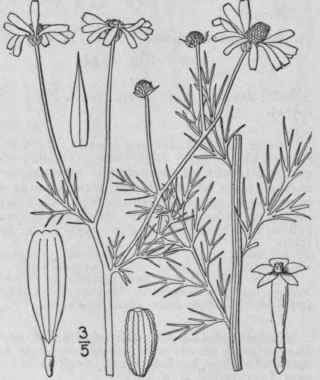
1. Anthemis Cotula L. Mayweed. Dog's Or Fetid Camomile. Dillweed
Fig. 4556
Anthemis Cotula L. Sp. Pl. 894. 1753.
Maruta Co ula DC. Prodr. 6: 13. 1837.
Annual, glabrous, or sometimes pubescent above, glandular and with a fetid odor and acrid taste, much branched, 1°-2° high. Leaves mostly sessile, 1'-2' long, finely 1-3-pinnately dissected into narrow, or almost filiform, acute lobes; heads commonly numerous, about 1' broad; bracts of the involucre oblong, obtuse or obtusish, usually somewhat tomentose; rays 10-18, white, at length reflexed, neutral, or rarely with abortive pistils, mostly 3-toothed; receptacle convex, becoming oblong, its chaff bristly, subtending the central flowers; achenes 10-ribbed, rugose or glandular-tuberculate; pappus none.
In fields, waste places and along roadsides, all over North America except the extreme north. Naturalized from Europe, and widely distributed as a weed in Asia, Africa and Australia. Other names are mather, dog- or hog's-fennel, dog-finkle, morgan. Dog-daisy. Pig-sty-daisy. Maise. Chig-ger-weed. Balders. June-Nov.
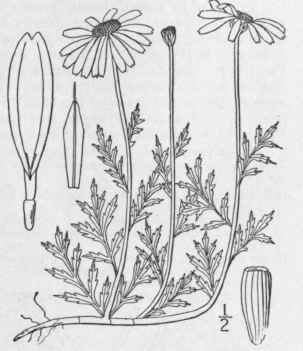
2. Anthemis Arvensis L. Corn Or Field Camomile
Fig. 4557
Anthemis arvensis L. Sp. Pl. 894. 1753.
Annual or sometimes biennial, not fetid; stem finely pubescent, usually much branched, about 1° high, the branches decumbent or ascending. Leaves sessile, 1'-3' long, 1-2-pinnately parted into linear or lanceolate acute lobes, less divided than those of the preceding species and with broader segments; heads commonly numerous, 1'-1 1/2' broad; bracts of the involucre oblong, obtuse, usually somewhat pubescent, with broad scarious margins; rays 10-18, white, pistillate, spreading, mostly 2-toothed; chaff of the obtuse receptacle lanceolate, acute or acuminate; achenes oblong, obtusely 4-angled; pappus a mere border.
In fields and waste places, Nova Scotia to Virginia, west to Michigan, Missouri, and on the Pacific coast. Naturalized from Europe. May-Aug.
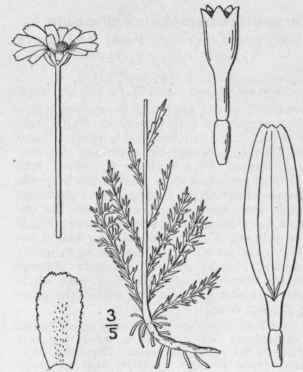
3. Anthemis Nobilis L. Garden, Scotch, White Or Low Camomile
Fig. 4558
Anthemis nobilis L. Sp. Pl. 894. 1753.
Perennial, pubescent, aromatic, much branched, 6'-18' high, the branches procumbent. Leaves numerous, 1'-2' long, finely and compactly dissected into nearly filiform lobes and segments; heads about 1' broad; bracts of the involucre obtuse, pubescent, their scarious margins broad; rays 12-18, white, spreading, pistillate, 2-3-toothed; chaff of the conic receptacle broad, membranous, obtuse; achenes oblong, obtusely 3-angled; pappus none.
Sparingly escaped from gardens, Rhode Island to Delaware, Michigan and Wyoming. Adventive from Europe. June-Aug.
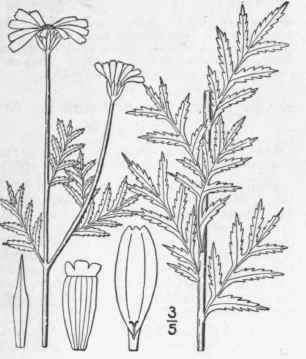
4. Anthemis Tinctoria L. Yellow Or Ox-Eye Camomile
Fig. 4559
Anthemis tinctoria L. Sp. Pl. 896. 1753.
Perennial, pubescent or tomentose; stem erect, branched, 1°-3° high, with nearly erect branches. Leaves sessile, 1'-3' long, pinnately divided, the oblong segments pinnatifid into narrow acute lobes; heads few or several, 1'-1 1/2' broad; bracts of the involucre oblong, obtuse, densely tomentose; rays 20-30, pistillate, usually 2-toothed, bright yellow or sometimes paler; chaff of the nearly hemispheric receptacle lanceolate, acuminate, rather rigid; achenes 4-angled, somewhat compressed; pappus a crown-like border.
In fields and waste places, New Brunswick to New Jersey, and locally escaped from gardens. Adventive from Europe. Native also of Asia. June-Sept.
Anthemis aurea (L.) DC, a species with small ray-less heads, was found many years ago near St. Louis, Missouri.
Continue to:


My Books

