
![previous page: 94. Artemisia [Tourn.] L. Sp. Pl. 845. 1753. Part 6](../../../images/nav/page_prev.gif)

![next page: 94. Artemisia [Tourn.] L. Sp. Pl. 845. 1753. Part 8](../../../images/nav/page_next.gif)
94. Artemisia [Tourn.] L. Sp. Pl. 845. 1753. Part 7
Description
This section is from the book "An Illustrated Flora Of The Northern United States, Canada And The British Possessions Vol3", by Nathaniel Lord Britton, Addison Brown. Also available from Amazon: An Illustrated Flora of the Northern United States, Canada and the British Possessions. 3 Volume Set..
94. Artemisia [Tourn.] L. Sp. Pl. 845. 1753. Part 7
18. Artemisia Ludoviciana Nutt. Dark-Leaved Mugwort
Fig. 4588
Artemisia ludoviciana Nutt. Gen. 2: 143. 1818.
Perennial, 2°-4° high; stem woolly, branched above. Leaves linear to obovate, 3' long or less, white-woolly beneath, at length dark green and glabrous, or very nearly so above, the base commonly narrowly cuneate, at least the lower ones pinnately lobed or toothed, their lobes lanceolate, acuminate; upper leaves often linear and entire; heads numerous, spicate-paniculate, 1"-1 1/2" broad; involucre oblong, tomentose; receptacle naked; central flowers fertile.
In dry soil, Missouri to Texas, Wyoming, Colorado and Arizona. Aug. - Nov.

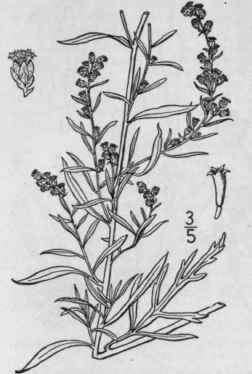
19. Artemisia Mexicana Willd. Mexican Mug-Wort
Fig. 4589
Artemisia mexicana Willd.; Spreng. Syst. 3: 490. 1826.
Perennial, less densely pubescent than A. ludoviciana, 2°-3 3/4° high, often branched; stem finely pubescent and ultimately often floccose. Leaves ovate or orbicular in outline on the lower part of the stem, 2-3 1/2' long, densely white-tomentulose beneath, green above, the lobes of the lower and the blades of the upper entire ones linear to narrowly linear or nearly so; heads small and numerous, usually inclined or nodding; involucre campanulate, loosely woolly, the pubescence sparse.
On prairies, hillsides and barrens, Missouri to Texas, Arkansas and Mexico. Sept.-Oct.
20. Artemisia Gnaphalodes Nutt. Prairie Or Western Sage. Cud-Weed Mugwort
Fig. 4590
Artemisia gnaphalodes Nutt. Gen. 2: 143. 1818. Artemisia ludoviciana var. gnaphalodes T. & G. Fl. N. A. 2: 420. 1843.
Perennial; stem white-tomentose, usually much branched, 1°-4° high. Leaves lanceolate or oblong, 1'-3 long, 2"-6" wide, entire, or the lower somewhat toothed, or rarely few-lobed, white-tomentose on both sides, acute or acuminate, sessile or the lower narrowed into short petioles; heads numerous, spicate-paniculate, about 1 1/2" broad; involucre oblong, tomentose; receptacle naked; central flowers fertile.
On prairies, plains, and dry banks, western Ontario and Illinois to Alberta, Missouri, Texas and Mexico. Locally established in waste grounds from New Hampshire to Delaware. Far western plants formerly referred to this species, which consists of many races, are, apparently, distinct.


21. Artemisia Bigelovii A. Gray. Bigelow's Sage-Bush
Fig. 4591
Artemisia Bigelovii A. Gray, Pac. R. R. Rep. 4: no. 1856.
Perennial, shrubby, silvery-canescent throughout, 8'-15' high, much branched, the branches erect. Leaves narrowly cuneate, or oblong, obtuse, truncate, or 3-5-toothed at the apex, 5"-9' long, about 1" wide; heads very numerous, about 1" broad, densely glom-erate-spicate in a narrow virgate panicle, 2-5-flow-ered, 1 or 2 of the marginal ones pistillate, the others perfect and fertile; involucre short-oblong, canescent or tomentose, its bracts obtuse; receptacle naked.
Kansas (according to Smyth); Colorado to Texas and Arizona. Aug.-Oct.
Continue to:


My Books

