


Sessile Bellwort. Wild Oats. Uvularia Sessifolia. Oakesia Sessifolia
Description
This section is from the book "Our Early Wild Flowers", by Harriet Louise Keeler. See also: Newcomb's Wildflower Guide.
Sessile Bellwort. Wild Oats. Uvularia Sessifolia. Oakesia Sessifolia
Oakesia, in honor of William Oakes, a New England botanist.
Perennial by rootstocks. Rich open woods and thickets. New Brunswick and Ontario to Minnesota and southward to Florida and Arkansas. Abundant in northern Ohio. May, June.
Rootstock
Slender, creeping.
Stem
Leafy, ten to twelve inches high, curving, angled, forking above the middle, bearing one or two almost terminal flowers.
Leaves
Alternate, lance-oblong, acute at each end, glaucous beneath, sessile or partly clasping, rough on the margin, parallel-veined, one or two below the fork.
Flowers
Pale yellow, lily-like, drooping, solitary on terminal peduncles, often hidden by the growth of the leaves, and often appearing opposite to the leaves by the growth of the branches; three-fourths to an inch long.
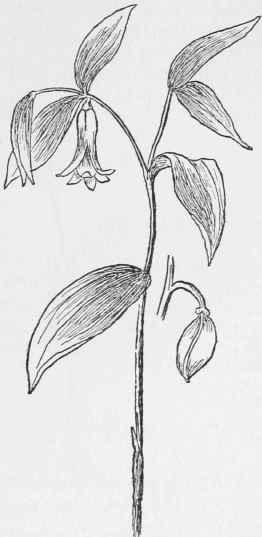
Sessile Bellwort. Uvularia sessifolia
Perianth
Sepals and petals indistinguishable, six in number, three-fourths to an inch long, gibbous without, with ridges within.
Stamens
Six, short, slightly adhering to the base of the perianth segments; anthers linear, opening laterally.
Pistil
One; ovary three-celled, three-angled; style three-cleft.
Fruit
Capsule, elliptical, pointed at each end, winged, opening rather late. Seeds globose.
Pollinated by flies and bees. Nectar-bearing.
"O the lights of earth and heaven Growing day by day; O the winds among the grasses, - Showers along the mountain passes; O the shy, straw-colored bell In the shadow of the dell; Heir to all the early freedom Of the May!"
- Dora R. Goodale.
A rather more common species than either of the Perfoliate Bellworts, flowering at the same time and having its stemless, pale-green, rough-edged, long-pointed, oval leaves set close upon the stalk and not pierced by it. This stalk rises about twelve inches and bears one or two leaves below the fork. The drooping flowers are three-fourths to an inch long, are cream-colored or greenish yellow, and followed by a shapely three-angled seed-pod somewhat resembling in shape a beechnut.
One or two flowers hang at first from the ends of the branches, but as the branches lengthen they later seem to be opposite the leaves. The leaves at the top of the stem look crowded and dishevelled, and the charm of the plant lies largely in its graceful curves.
Continue to:


My Books

