


Changing Character Of The Saratoga Waters
Description
This section is from the book "Beverages And Their Adulteration Origin, Composition, Manufacture, Natural, Artificial, Fermented, Distilled, Alkaloidal And Fruit Juices", by Harvey W. Wiley. Also available from Amazon: Beverages And Their Adulteration.
Changing Character Of The Saratoga Waters
One of the peculiar features revealed by the study of the Bureau of Chemistry is disclosed in the fact that as compared with the analyses of former years there has been a gradual diminution in the mineral content of the Saratoga waters. This is not surprising when the great drain to which the waters have been subjected is remembered. In earlier times when the springs were in a natural state the waters thereof received a maximum concentration by remaining as long as possible in contact with the soluble minerals from which their mineral content is derived. When the vogue of the waters was fully established and great drains were made upon their volume both at the spring and for shipping purposes, larger volumes of water in contact with the mineral substances for a shorter time were secured. As a result of this the maximum concentration could not be expected to take place. The vigor of the attack upon the water supply is well illustrated by a letter from the owner of the Arondack spring of Saratoga, which is as follows:
We have here wells varying in depth from 150 feet to 600 feet. In drilling the well the veins of water are liable to be struck at many intervals from 40 feet down to the bottom. The well is tubed, generally with a small iron pipe, down to a point that may be decided on as securing the best water. At the bottom of the pipe a seed bag is attached, which very quickly swells up and for a time, if properly adjusted, will shut out all the water above it, so that the yield is only of the water entering below the seed bag. Now in the course of time, which may be a few months and may be two years, the seed bag frequently shrinks or is eaten away a little, and this would allow a certain amount of the upper water to enter. It is also my experience that within about two years there will be at some point of the pipe perforations which again would allow water to enter.
Another point which we have noted is that many of the Saratoga springs are connected with each other. I do not know whether pumping is carried on at all by the mineral-water companies, but it is by all the gas companies here, involving a matter of about 50 wells. We have at our gas works two wells which are connected with a well of a competitor. When he pumps very hard or at all our water levels are more or less affected, as is also our yield of gas. He can pull our level down more than 20 feet. It seems to me that such a condition would, through hydrostatic pressure, affect the amount of water running into the well from the various veins.
By comparing the analytical results with those of earlier chemists Haywood found that the springs contain now only from one-half to one-fifth as much mineral matter as they did in 1871. Not only is the mineral content of the waters at the present time less than in former years, but the analyses show that this mineral content is continually varying, and especially it has been noticed that the rarer elements, such as the compounds of lithium and bromin, vary to a greater extent proportionately to their amount than the other mineral elements which are present.
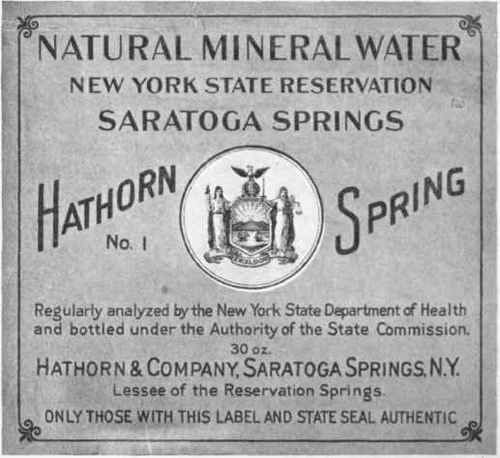
Fig. 6.
Continue to:


My Books

