


German Wines
Description
This section is from the book "Drinks Of The World", by James Mew. Also available from Amazon: Drinks of the world,.
German Wines
The Germans, says Cyrus Redding, like vain men of other nations, have wasted a good deal of idle conjecture on the antiquity of the culture of the vine in their country; and then, as though to show by example that this waste of idle conjecture is not confined to the Germans, Mr. Redding continues the investigation of this important matter himself. In the opinion of an experienced merchant these wines have a "distinct character and classification of their own." Their alcoholic strength is low, averaging about 18 per cent. To the north of Coblentz the wines are of little comparative value, though a Rhenish wine has been produced at Bodendorf, near Bonn. On the Rhine or its tributary rivers between Coblentz and Mayence, all the most celebrated wines of Germany are grown. The grapes preferred for general cultivation are the Riessling, a small, white, harsh species. The true Hochheimer, daily consumed in Germany, is grown to the eastward of Mentz, between there and Frankfort. The wines mellow best in large vessels, an experience which has produced the celebrated Heidelberg Tun, holding some six hundred hogsheads. The distinguishing characteristics of German wine have been said to be generosity, dryness, fine flavour, and endurance of age. The dyspeptic will learn with delight that the strong wines of the Rhine are extremely salutary, and contain less acid than any other. It is also averred that they are never saturated with brandy. Liebfrauenmilch 1 is grown at Worms. It is full bodied, as is that of Scharlachberg. Nierstein,1 Laubenheim, and Oppenheim are good wines, but Dei-desheimer is considered superior to them. Hock 2 is derived from Hochheim; but nearly every town on the banks of the Rhine gives its name to some lauded vintage. The flavour of Hock is supposed to be improved by thin green glasses. Perhaps, says the judicious Redding, this is mere fancy. The Palatinate wines are cheaper Hocks. Moselles have a more- delicate perfume. The whole eastern bank of the Rhine to Lorich, called the Rheingau, about fourteen miles in extent, has been famous for its wines for ages. Naturally, therefore, it was once the property of the Church. Here is Schloss- Johannisberger, once nearly destroyed by General Hoche, where a leading Rhine wine is made. Steinberger takes the next rank to Johannisberger. Grafenberg, also once ecclesiastical property, produces wine equal to Rudesheimer, which is a wine of the first Rhine growths. Marcobrunner, Roth, Konigsbach are excellent drinks. Bacharach has lost its former celebrity. The conclusion to which a celebrated connoisseur has arrived after an exhaustive examination of German wines is this: "On the whole, the wines of Bischeim, Asmannshauser, and Laubenheim are very pleasant wines; those of rather more strength are Marcobrunner, Rudesheimer and Niersteiner, while those of Johannisberg, Geissenheim, and Hochheim give the most perfect delicacy and aroma." The Germans themselves say Rhein-wein, fein-wein; Necker-wein, Lecker-wein; Franken-wein, tranken-wein; Mosel-wein, unnosel-wein.1
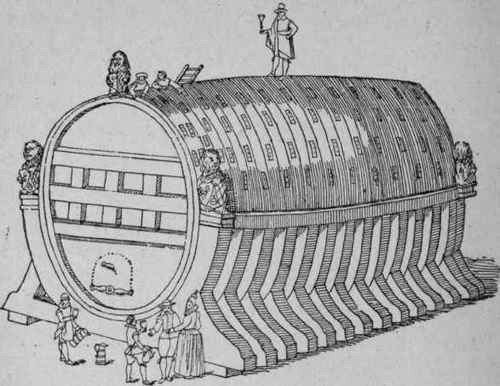
This illustration dates 1608 as "A Sciographie or Modell of that stupendous vessel which is at this day shewed in the Pallace of the Count Palatine of Rhene in the citie of Heidelberg." A model of this Tun was shown at the German Exhibition held in London, 1891. Its capacity was eclipsed by a famous tonneau, elaborately ornamented with allegorical figures, etc., which was shown in the French Exhibition of 1889. It would hold 200,000 bottles of Champagne, and came from Epernay. It had to be drawn by a large team, by road, and the French press was full of its imaginary adventures on its journey to Paris.
1 This wine is said to profit much by a quiescent state of the air afforded by the town wall.
1 A wine at Homburg, called Erlacher, at about one mark ft bottle, is, says Dr. Charnock, frequently superior to the ordinary Niersteiner.
2 "Hock," says one of those wine circulars, which weary alike the postman and the public, "is the English name for the noble vintages of the Rhine, which afford models of what wine ought to be. Their purity is attested by their durability. They are almost imperishable. They increase appetite, they exhilarate without producing languor, and they purify the blood. The Germans say good Hock keeps off the doctor. Southey says it deserves to be called the Liquor of Life. And so Pindar would have called it, if he had ever tasted it" Nothing surely can be added to this description of its virtues.
The red wines of the Rhine are considered inferior to the white. Red Asmannshauser is perhaps the best. Near Lintz Blischert is made. Konigsbach and Altenahr yield ordinary wines. The most celebrated of Moselle wines is the Brauneberger, of which the varieties are numerous. A variety called Gruenhauser was formerly styled the Nectar of the Moselle. The wines of Ahr, of which some are red, resemble Moselles, but will keep longer. Of the wines of the Neckar the most celebrated is Besig-heim. Baden, Wisbaden, Wangen, and Wurtzberg, all grow good wines. Of the last is Stein-wein, produced on a mountain so called, and named by the Hospital to which it belongs, Wine of the Holy Ghost. Leisten wines are grown on Mt. Saint Nicolas. Straw wines are made in Franconia. Calmus, a liqueur wine, like the sweet wines of Hungary, is made in the territory of Frankfurt. The best vineyards are those of Bischofs-heim. Wines of Saxony are of little worth. Meissen and Guben produce the best. Naumburg makes some small wines, like inferior Burgundy. The excellence of the Rhine wines has seldom perhaps been proved more clearly than by one who loved them well. Goethe, in his Aus einer Reise am Rhein, Main und Neckar, says: "Niemand schamt sich der Weinlust, sie ruhmen sich einigermaassen des Trinkens. Hubsche Frauen gestehen dass ihre Kinder mit der Mutterbrust zugleich Wein geniessen. Wir fragten ob denn wahr sey, dass es geistlichen Herren, ja Kurfursten gegluckt, acht Rheinische Maass das heisst sechzehn unserer Bou-teillen, in vierundzwanzig Stunden zu sich zunehmen ? Ein scheinbar ernsthafter Gast bemerkte, man durfe sich zu Beantwortung dieser Frage nur der Fasten-eeredigt ihres Weihbischofs erinnern, welcher, nachdem pr das schrecklicke Laster der Trunkenheit seiner G-meinde mit den starksten Farben dargestellt, also gesch-lossen habe - " But for those who understand not the German tongue we will give some of the sermon of this Church dignitary on the Rochusberg in English. "Those, my pious brethren, commit the greatest sin who misuse God's glorious gifts. But the misuse excludes not the use. Wine, it is written, rejoices man's heart. Therefore we are clearly intended to enjoy it. Now perhaps, beloved brethren, there is not one of you who cannot drink two measures of wine without feeling any ill effects therefrom; he, however, who with his third or fourth measure has so far forgotten him-self as to abuse, beat and kick his wife and children, and to treat his dearest friend as his worst enemy, let such an one discontinue to drink three or four measures, which thus render him unpleasing to God and despicable to man. But he who with the fourth measure, nay, with his fifth or his sixth, still maintains his sense in such a manner that he can behave properly to his fellow-christian, attend to his domestic duties, and obey his spiritual superiors as he ought, let him be thankful in modesty for the gift accorded to him. But let him not advance beyond the sixth measure, for here commonly is the term set to human power and endurance. Rare indeed is the occasion in which the benevolent God has lent a man such especial grace that he may drink eight measures - a grace which He has, however, accorded to me His servant. Let, therefore, every one take only his allotted measure und auf dass ein solches geschehe, alles Ubermaass dage-gen verbannt sey, handelt sammtlich nach der Vorschrift des heiligen Apostels welcher spricht; Prufet alles und das Beste behaltet !"
1 Thus unfortunately translated, Rhine wine is good, Neckar pleasant, Frankfort bad, Moselle innocent. But Moselle, we have been told, is very far from "innocent." Unnosel is without bouquet. Tran-ken means not bad but drinkable, and lecker is rather lickerish than good. A sample of the same carelessness occurs on the next page, where ein weinfask von anderhalb ahm ein pipe is intended to express ein Weinfass von anderthalb Ohm, eine Pipe. It is a pity that an excellent work, to which we, as many writers on wine have like ourselves been deeply indebted, should be marred by these irregularities.
Continue to:


My Books

